
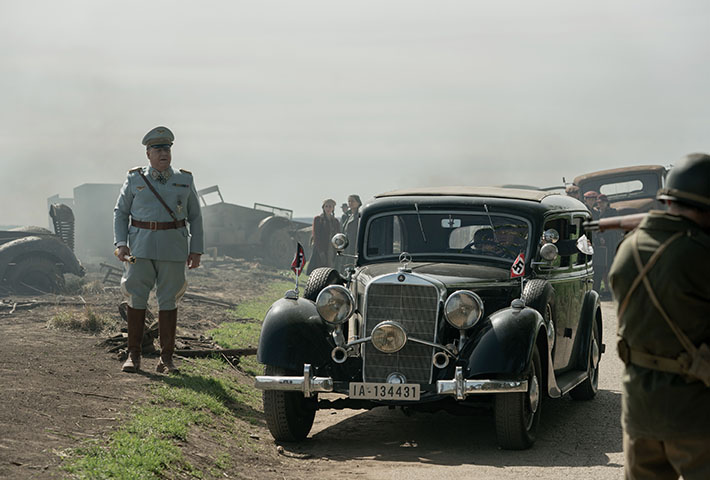
Nuremberg (Vanderbilt, 2025)
Nuremberg is a sprawling mess of a movie, one that I admittedly appreciated all the more for its messiness. Topics like the Final Solution don’t lend themselves to commercial slickness, so when commercial movies leverage moral seriousness from their topics, they better have some substance to go with their good intentions.
True, much of the substance here comes from the actors elevating writing that is a bit too on-the-nose and a bit too prone to Oscar-bait speeches, but elevate it they do.
First in line for praise is Rami Malek. He plays Douglas Kelly, a psychiatrist charged with interviewing the Nazis awaiting trial at Nuremberg, including Hermann Göring (Russell Crowe) in order to assist prosecutors. The script can’t decide (until deep in the movie’s two-and-a-half hour run time) whether Kelly is infatuated with Göring himself or with the opportunity to become famous for writing the book on him. Malek goes for the sort of both/and performance that too often causes films to crumble by implying too many contradictory things. But his performance ends up serving a film that revels in its contradictions trying to resolve them. What is the difference between the Nazis (and their supporters) and humans from other civilizations, a colleague asks Kelly. “Nothing,” he responds. The answer is perhaps a bit too pat in the way it invites application to current political moments and regimes, but for once such attempts to say that World War History mirrors our age does not feel anachronistic since Nuremberg posits that the prosecutors of the Nazis were already deconstructing their own arguments.
It helps Malek that he has Russell Crowe to work with. As the film insists several times that Göring is a narcissist, a number of less confident actors would probably lean into the flamboyance of the part. Crowe invests his monster with human intelligence but avoids making him into a criminal mastermind. This allows Kelly to occasionally feel sorry for him, such as when the Allies use his wife and daughter as leverage, without asking him to ever seriously contemplate succumbing to those feelings.
Michael Shannon and John Slattery are both charged with some important expository speeches that would be far more grating were they performed by less experienced actors. They don’t fight those speeches, understanding they are more for the modern audience than the historical one, but their delivery is understated enough to not come across as patronizing in the moment. Shannon, especially has to embody contradictions, since the “why” questions posed to Justice Jackson need to be asked but have no pat answers.
Leo Woodall has the most theatrical of the award-bait speeches too, standing in for the victims. He plays a Jew of German descent who has to articulate the point of view of the helpless victims, give a human face to the abstract stakes, and somehow help all the gentiles to quash their own misgivings and uncertainties without himself giving in to rage. If he did not absolutely nail his scene, the film would crumble too near the finish line to recover. Fortunately, he is fully believable, and like everyone else understands that material this melodramatic needs a strain of restraint in the delivery to keep from becoming bombastic.
The film’s final act is admittedly the weakest, with too many attempts to interject dramatic uncertainty in what we know — and the characters probably knew — was a foregone conclusion. Nuremberg tries way too hard to replicate the prosecution/witness dynamic of A Few Good Men. In that, it fails. Even if it had succeeded, Göring’s testimony comes too near the archival footage of the Concentration Camps entered as evidence. Once those images have been seared into our consciousness, there really is very little need to catch their perpetrators in a lie about them. There is a persistent claim — did they have January 2021 in mind — that no matter how much evidence is presented against a narcissist or criminal, he or they will always find ways to claim that it is all one big lie constructed by enemies. But if no amount of evidence can make a narcissist or his followers feel guilty, will his confession on the record make any difference?
Even after the trial, the film struggles to know how and when to bring the curtain down. Kelly’s fate is hardly a surprise to those who are historically informed or have been paying close attention during the movie, but how the film wants you to feel about it is not clear, which is a big miss at a crucial moment. The ending doesn’t negate the good that preceded it, but a slightly more polished and tighter script could have landed the film in Best Picture discussions. This one is good, not great. I recommend it for the acting master classes on display, but Judgment at Nuremberg remains a superior treatment of the subject and its deeper, more important themes.

