
One Big Happy Family (Sohn, 2025)
Comedy about specific ethnic or religious groups can be one of the hardest genre subsets to evaluate because the line between Horatian self-deprecation and Juvenalian contempt can move–or appear to–depending on whether the satire is coming from an insider or an outsider. This is particularly hard for me to navigate as a Christian viewer looking at Jewish comedy, since cringe-inducing moments can feel like calls for pity (how sad you had to endure/put up with that) or confessions of self-loathing (so, you’re saying, you hate your culture…yeah, I can see why). This challenge is not limited to Jewish films. Satires of Christians play different for me depending on the perceived agenda of its creators. In principle, those from within a group are best equipped to critique it, mock it, or both. But the lines between critiquing, mocking, and being mildly chagrined by one’s family and friends are then and messy.
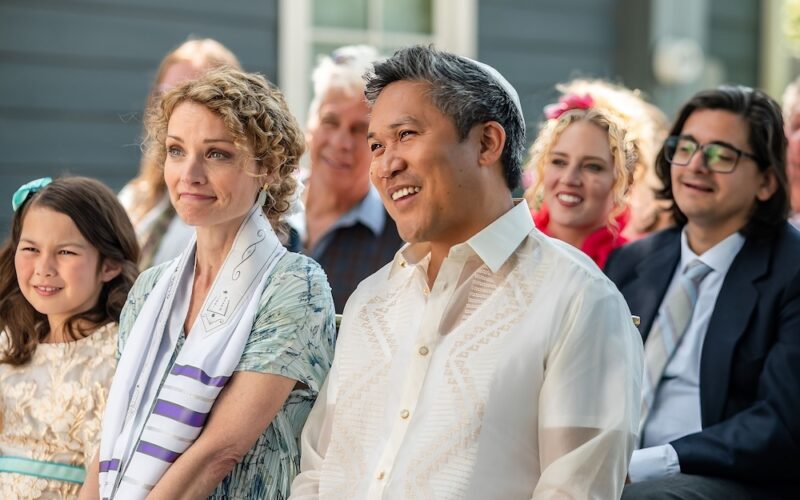
Take for example the opening bat mitzvah scene of One Big Happy Family, a flashback where a grown woman remembers the speech her mother gave at her ceremony that first embarrasses her with an extended description of menstruation and then horrifies us (but not her?) by confessing that her mother, as was customary, slapped her the first time she bled. The tone here signals that the hoped-for response is bemusement at a public embarrassment. We are, I presume, supposed to feel bad for Rachel (played by writer Lisa Brenner) that she had to muddle through the awkward-for-all teen years with an especially tactless mother. But by the end of the film, the title, the dedication to actress Linda Lavin (who plays Rachel’s mom), and Rachel’s daughter’s bat mitzvah all signal that One Big Happy Family is intended as a celebration of a quirky yet loving family that Rachel must and should learn to cherish, warts and all.
That’s not a bad message, and I don’t think it would give me pause if the connections between self-acceptance and family acceptance were a bit more artfully integrated. That connection is mostly limited to Rachel’s despondency at a DNA test (what did she think was going to happen?) that complicates her relationship with her feelings for her dead father. This climaxes in one of those classic identity-crisis speeches about not knowing who one is because of some new revelation about one’s biology. This speech–and Rachel’s crisis–never quite lands because the film feels a little too afraid to let Rachel be angry or to show anyone being unlikable. The discovery about the details of her conception are presented as like-in-kind to her mother’s embarrassing personality–something that happens to Rachel for which we should empathize with her but something which she, and the film, ultimately claims is no big deal, especially in light of all the positive aspects of her family and culture. One Big Happy Family appears to want to have it both ways, presenting Rachel’s Jewish culture as something that is so embarrassing it messes her up but also something that she celebrates and we should too.
That tension is not helped by the fact that the script offers more cringe moments than laughs. When Rachel and her mom question a doctor about his Jewish identity, we get tired stereotypes about names. Doctor: “Can you get any more Jewish than Feinstein?” Grandmother: “Goldenberg.” Doctor nods in agreement.
The one moment that the film surprised me was actually a throwaway. Although it is hardly germane to the plot, Rachel is an actress, and she goes to an audition where she gets a note to deliver a line about feeling “the light of Christ” inside her with more enthusiasm. Given that writer Lisa Brenner’s first listed movie credit on IMDB is Mel Gibson’s The Patriot, it feels like this scene snuck in from a different movie, one that explores what it is like to be Jewish not just among well-meaning but exasperating family members but among those outside the faith, or of different faiths, whose understanding and appreciation of Judaism is forged not by personal relationships but cultural stereotypes. I hope Brenner writes that movie someday, because I would genuinely like to see it.

