



The Christmas Dream (Spurrier and Spurrier, 2025)

It is a central tenet of my approach to film criticism that my central task is not to say whether or not I liked a film but to describe it in such a way that a reader can make an informed judgment about whether or not he or she wants to watch it. For the most part that approach has served me well, but every now and then a film like The Christmas Dream lands in my inbox and it is so peculiar that I have a difficult time even speculating who it is for or for whom it might land.
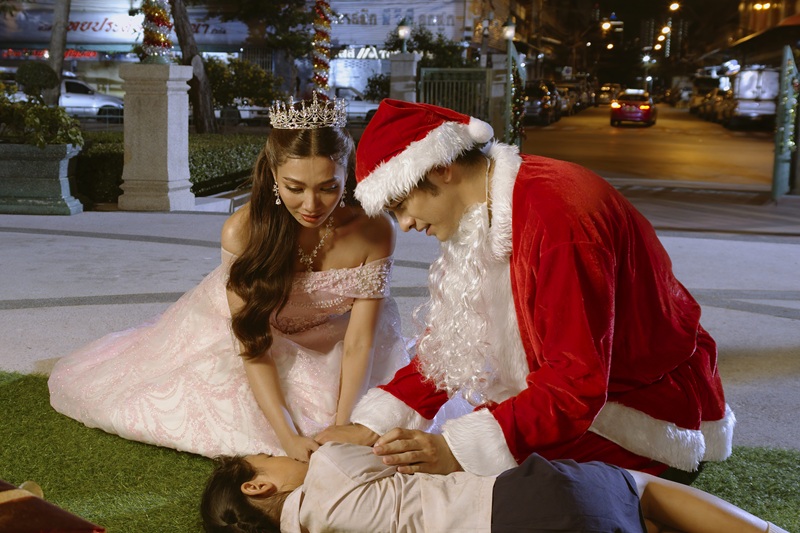
Touted by its publicity as Thailand’s first musical in fifty years, it was released on the festival circuit under the title Dream!. Perhaps encouraged by recognition from the New York Long Island Film Festival and the Rhode Island International Film Festival, the makers have retitled it to include the word “Christmas” in the title despite the fact that the story takes place in a country that does not celebrate that holiday and where only about 1% of the population is Christian. The film does begin with a beleaguered girl singing about believing in Santa Claus, and it ends with her in Bangkok beneath a giant Christmas tree wishing for a holiday miracle.
Overall, however, The Christmas Dream is more influenced by American popular culture than by its holidays or religion. It plays a bit like a cross between pre-spectacle Broadway musicals like Annie and the made for TV movies you might have grown up on watching The Wonderful World of Disney.
The camera work and performers are up to the task, but the songs themselves are mostly forgettable. As is sometimes complained about in traditional musicals, the songs don’t so much advance the story as bring it to a halt. This style is not a major issue in theatrical musicals where such pauses allow the integration of dancing and spectacle, but The Christmas Dream leans heavily on ballads with a lot of exposition — the kind where characters stand in profile and sing to the camera or wander aimlessly across the stage or set in the manner of Dorothy Gale singing “Over the Rainbow” in the Wizard of Oz. The lyrics are very generic and do little to distinguish or develop the characters beyond archetypes: “Dreams come to me at nighttime / And disappear at dawn” sings our heroine.” Later we are told, “I believe there is magic in the world / I believe that miracles can happen.”
To be fair, there are plenty of American movies that use Christmas as a safe context for talking about faith and belief without seriously engaging what the holiday is about — Miracle on 34th Street is the obvious example. In this thematic area and really throughout, the cultural fusion manifests as an awkward mash up rather than an interesting intersection. I tally slightly longer on the skittish relationship to the religious meaning of the holidays only because the American group I think most likely to give a chance to such a movie — conservative Christians who mostly eschew R-rated fare and are always on the look out for something devoid of sex, profanity, or violence — would most likely feel as though they got the bait and switch.
To the extent my personal response is relevant, I was restless watching it. I have seen enough Bollywood films to understand that in some parts of the world the audience wants its money’s worth. (Yes, I know, Thailand is not India, just making a point that expectations around length are conditioned by the way theaters and television have developed in our culture as opposed to being aesthetically driven.) Given how disjointed the story is, I might have been carried along by the music if the film was closer to ninety minutes or longer but broken up into episodes for a streaming service. As given, each of its two hours and twenty minutes is felt and the songs started blending into one another.
Harvey Fierstein famously opined in The Celluloid Closet that if films made for a particular audience provided entertainment or meaning to anyone else that was well and good — it just shouldn’t distract from the primary motivation for making those movies in the first place. The real value of The Christmas Dream may be that it allows Thai viewers, especially kids, to see stories about themselves rather than having to project themselves always and ever into American movies. Whether American kids will want to project themselves into The Christmas Dream or lose themselves in its narrative is a question about which I am highly skeptical.
Author


You may also like...



Learn more about our sponsors:
