
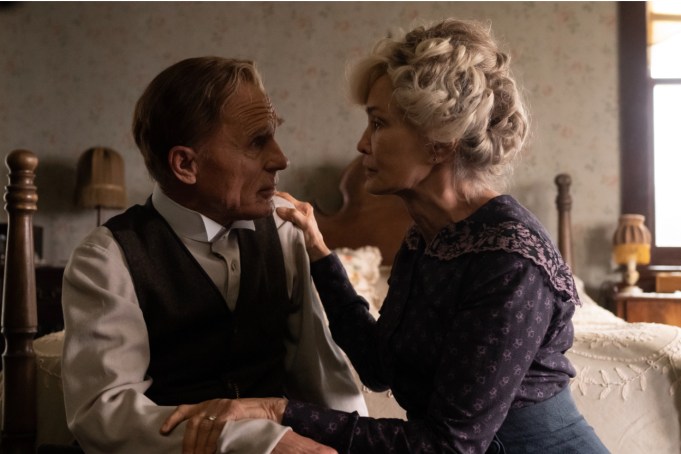
Long Day’s Journey Into Night (Kent, 2025)
If the Virginia Film Festival is an accurate bellweather, this awards season is likely to feature a lot of contendors celebrating actors and about the craft of acting. I Play Rocky is the commercial crowd pleaser. Elsinore is the arthouse Oscar bait, and Long Day’s Journey into Night is the revival of an American classic featuring a dream team cast. Regional film festivals frequently give awards or showcases to talent as a means of attracting guests who might otherwise skep the smaller venues in their promotional tours. Jessica Lange was at Charlottesville to promote the film, and although I did not see her Q&A, I was able to get a peek at the latest adaptation of Eugene O’Neill’s bitter melodrama.
My response was roughly the inverse of my response to Elsinore. While I expected to love that one and ended up unimpressed, I anticipated an ambivalent response to Long Day’s Journey only to find myself giving it grudging respect. And, to be frank, a lot of that response was a result of Lange’s performance as Mary Tyrone, the opium addicted matriarch whose illness is a foundational element but not the sole cause of the family’s dysfunction.
My historical response to O’Neill’s work has always been one of antipathy. American chamber plays have, I think, featured families and lovers so caustic, so bitter, so broken, and so ugly, that I have a hard time appreciating the craftsmanship the playwrights demonstrate to craft such characters or that actors demonstrate to bring them to life. It probably didn’t help that my late Gen-X birth meant that I never had the Katharine Hepburn fixation required to love Sidney Lumet’s film adaptation. An eighties television movie was, admittedly, more of a Jack Lemmon showcase, putting the play’s focus on James Tyrone. That part is played here by Ed Harris, who is always solid, and whose caustic voice captures the man’s perpetual frustration without becoming one-note.
The essence of what makes Lange’s turn as Mary the best I have seen is that the character has to be far enough along in her descent into madness that the finale is credible, but not yet entirely gone. If Mary is mad throughout, if there are no flashes of understanding, no glimmers of memory, than the the finale just becomes one more dose of what the entire play has spoonfed the audience rather than the step that is bitterest because it is last on a long journey.
Lange is a bit of an outlier as an actress in that her two Oscars, one for Best Actress and one for Best Supporting Actress, were for roles in a largely uncelebrated movie (Blue Sky) and a comedy (Tootsie). Just as sports leagues can fall into the rut of giving the MVP award to the best player on the best team, the Academy and critics’ guilds frequently nominate the leads in the best pictures. While there is most certainly a correlation between the quality of the performances and the quality of the films, there are more great actors (in my opinion) than there are great roles. Sometimes the role is so good, it hardly matters who does it so long as she is adequate. Sometimes, a talented thespian can elevate otherwise mediocre material. But every now and then — and Long Day’s Journey Into Night might well be one of those times — complex and difficult material requires a special performance to make it land spectacularly.
There are pop songs so catchy, they are pleasant to listen to even in karaoke bars. But there is also music so challenging, difficult, and beautiful that one wants to hear it played well or not at all. I thought that I didn’t like Eugene O’Neill’s play. Turned out, I had just never seen Jessica Lange perform it.

