
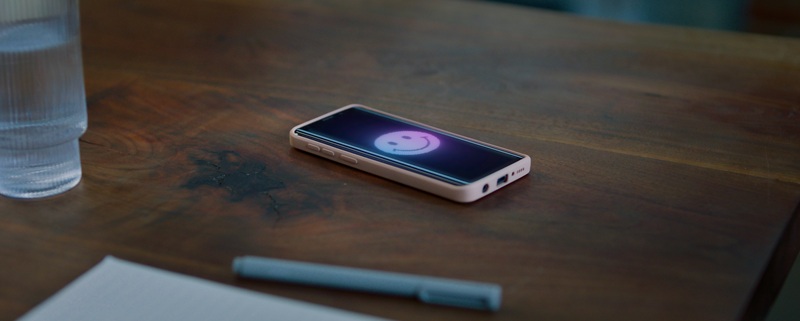
Good Vibes Only (D’Ambrosio, 2026)
AI is hardly the only technological development one could say this about, but I sometimes wonder if all the worry that goes into its possible negative effects at some indeterminate point in the future might distract us from focusing on the real, specific, negative effects it is having right now.
According to a March 2026 article in Science, “sycophantic AI” can descrease “prosocial intentions” and increase a user’s dependence on the techonlogy for emotional affirmation. Broadly speaking, “sycophantic” behavior, whether in humans or chatbots, is described as the tendency to flatter, agree, and avoid conflict. The reasoning behind making AI sycophantic is that people are alleged to use the techonology more if it makes them feel good — and who doesn’t like being agreed with?
One problem with sycophantic behavior, as Sarah D’Ambrosio’s short film Good Vibes Only so aptly illustrates, is that it is inherently in danger of becoming a feedback loop. The more a certain behavior promotes a given response, the more likely that response will prompt more of the behavior. What can seem a welcome contrast to regular or healthy human interactions — which are often laced with conflict, disagreement, or challenges — quickly becomes a caricature of itself when it becomes the new norm. Salt is a great seasoning for one’s diet; it is a terrible staple. So too cheerfulness in the face of problems. When it is authentic, it can be a powerful sign of emotional health. When it is forced, coerced, or expected, it can seem monstrously false.
Good Vibes Only is a dystopian comedic short, postulating a world where AI companions are ubiquitous, intrusive, and relentlessly positive. But when a young woman experiences a painful relational break up, she senses intuitively that saying “peace, peace” when there is no “peace” is hardly the best way to process, integrate, and heal from trauma.
That observation is a good one, so take this as a positive review of the short. In the spirit of not being too sycophantic, though, I guess I can add that I am not sure the short offers much beyond its manifest message. Like much of the best comedy or dystopian ficiton, the film is exaggerated enough to escape realism while remaining plausible enough to be entirely credible. The fantasy’s proximity to reality does run the risk of eliciting a muffled rather than sharp response. It almost feels as though the film wants credit for being more insightful or prophetic than I think it is.
There is a famous scene in Lawrence of Arabia where Lawrence confesses to “enjoying” the killing of a prisoner too much, a response that scared him precisely because he saw how easy it would be to become accustomed to the pleasure and forget about the less powerful but nevertheless real, conflicting emotions. That’s more or less the reason why I have never had and probably never will have a chatbot companion. Not because I worry that I won’t like it, but because I worry that I will like it enough to overcome my reservations until it is too late. Good Vibes Only, then, is, in a very real sense, preaching to the choir. If you haven’t thought much about mental health and the role that grit, relience, or strength play alongside of comfort, the short might land a little harder. But I think most of us have thought of these things. This means, ironically, that the film works best on a sycophantic level, agreeing with those of us who are worried about the deleterious effects of AI and perhaps flattering us a little that our fears and concerns are more unique and penetrating than they actually are.

