
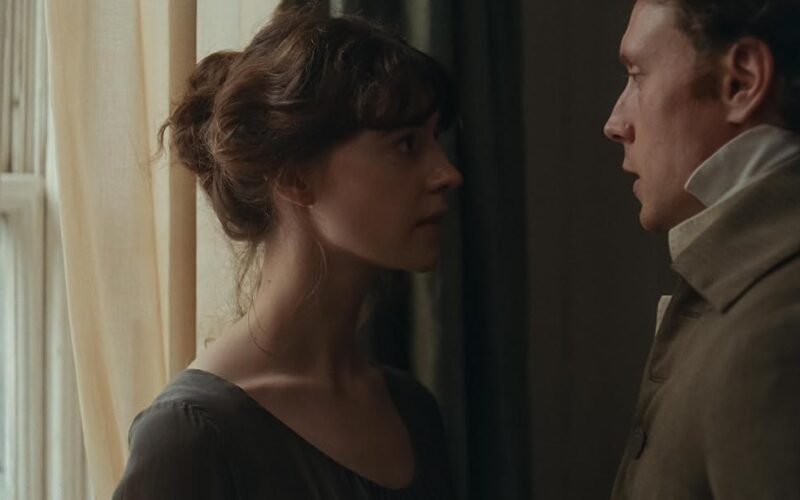
Sense and Sensibility (Oakley, 2026)
Sense and Sensibility is listed at IMDB as director Georgia Oakley’s first theatrical feature-length film. (She has some previous credits for shorts and teleivision work). It is also listed as screenplay writer Diana Reid’s first feature credit.
On the one hand, it feels unfair to evaluate their work in comparison to others who have attempted to adapt Jane Austen’s novels into theatrical or television movies. Joe Wright won two BAFTA awards. Emma Thompson earned an Oscar for her screenplay of the same material. Ang Lee won two Oscars for directing, even though he didn’t get nominated for his Austen adaptation. To adapt an Austen novel is to invite comparison to some of the greatest directors and writers of all time, one of them being Austen herself. She was nineteen when she wrote her first novel, and while it admittedly lacks some of the depth and nuance of her her subsequent works it is rightly hailed as a masterpiece.
Oakley’s and Reid’s take on the material is never unwatchable, but it also never rises to equal those works to which it invites comparison. Lee’s and Thompson’s Sense and Sensibility, while not without faults (Thompson and Winslet, for all their talents, do not make credible teenagers), has a fuller and deeper understanding of its characters. Joe Wright’s Pride & Prejudice, whether its influence here be deliberate or unconscious, had a visual richness and attention to detail that this film can imitate but not fully replicate.
It is not a bad film by any metric, but if I had to list my favorite and most recommended Austen adaptations, I am not sure this one is cracking the top ten. Some of the reasons for that lie at Austen’s door. Thompson honed and focused her screenplay to make Elinor the center of the story. The novel, whose very title suggests it is offered as a contrast between the two sisters, is as much about the worldviews of the siblings as it is about their romances. I would also not be the first person to point out that as a romance, Sense and Sensibility offers a number of thematic and structural difficulties. The love interests are not present for much of the movie, with the themes advanced by the way the sisters resopnd to their prospective suitors’ respective absences more than their personalities and actions.
The idealized conceptions of love and coutrship are somewhat adolescent in the case of both sisters, not just in the case of the sixteen year-old who must express everything she feels. Elinor (Daisy Edgar-Jones) is fairly static, remaining a paragon of steadfast virtue in her willingness to accept not only the inevitability of Edward’s secret engagement but the virtue of his honoring it. Roger Ebert once famously opined that the central structural problem of most romances was not how to bring the lovers together at the end of the movie but how to keep them apart until the end of the movie. Part of what makes Sense and Sensibility a candidate for Austen’s weakest novel is that the way she keeps Elinor and Edward apart is largely through an external and rather conventional plot device. He has a commitment that predates his knowing her. Compare that to the reasons that keep the potential partners apart in Pride and Prejudice, Persuasion, or Emma, and it is easier to see the difference between internal and external impediments. Austen at her best writes novels with fully realized characters. In Sense and Sensbility, she is still working out the mechanices of the marriage plot.
It bears repeating, though, that saying a work of art or literature is not as good as some of the all-time greats, is not the same thing as saying it is without merit. Reid’s sreenplay and Oakley’s direction does make the Dashwood sisters younger (if not quite young enough), and this matters particularly in the telling of Marianne’s story. Herbert Nordrum thrives despite being given the nearly impossible task of trying to make audience’s forget about Alan Rickman’s turn as Col. Brandon, and I would pay to watch Caitríona Balfe read the phone book.
If I had to pick one moment that illustrates this version’s limitations, it would be a small aside when Edward visits the cottage and Elinor wrongly assumes he (and not his brother) has married her rival. “I will remain mistress of myself” she says to buck up her courage. It is a classic example of telling rather than showing, all the more disappointing because even those who haven’t read the novel mutliple times must surely know by this point what the character is likely feeling without having it repeated and underlined one more time. The great novelists frontload so much of their character development so that the action can flow freely at climactic moments. Sense and Sensibility has a climax so perfectly set up that almost all other faults could be forgiven if an adaptation nails this particular scene. Unfortunately, at the climactic moment we get neither imitaiton nor sufficient innovation.
All of which is to say, I found the execution competent but the design puzzling. What was the fresh insight, new idea, different focus that justified making a new film from material that already has successful adaptations? It was a Jane Austen movie for a Marvel age, one that assumes that what viewers most want is that which they have already seen, slight tweaks on the familar, the comfortable, and the previously beloved. You can make a commercially safe project that way, one that enough people will watch out of a sense of hope or dutry or expectation, but I honestly have a tough time understanding why anyone, having seen this film once, would choose to rewatch it rather than revisiting the Ang Lee film or simply rereading the novel.
For more discussion, see my podcast with Prisca Bird:

