
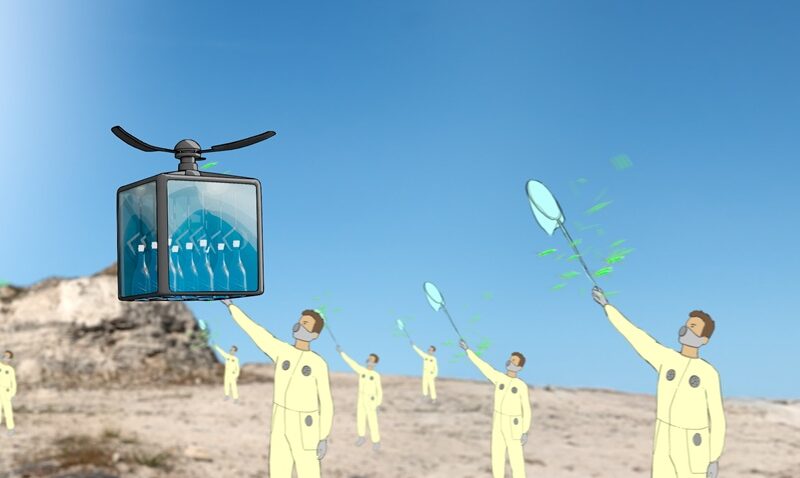
Iridescence (Lhoste, 2025)
Iridescence is a four minute, animated music video with no dialogue or musical lyrics. A drop of water is encased in a bottle and delivered by drone to a group of weathy partiers.
The film is fabulous. It is creative, easy to understand, accessible to most different cultures, and, since it is a music video, not dependent on captions or language translation. By their very nature, though, shorts are difficult to review. Plot summary? One can dispense with that in one sentence. At the same time, shorts often come with better production notes that answer many, if not all, of the interpretive questions. The director’s statement and the film’s press kit underline the film’s themes ways that are clearer and more definitive than any review could.
In his statement, Lhoste shares some of his creative influences (Jodorowsky’s unrealized Dune film), his intentions (to draw attention to water scarcity as an imminent human rights crisis), and his methods. He is generous in his explanations of animation techniques, describing which scenes required live shots to act as models for rendering (the dance), which were made in 3D (the drone shots), and how he aimed for a 2D “aesthetic” to have the form reinforce the environmental theme. You don’t have to know any of this to appreciate the film as a social or political statement, but knowing it does, perhaps, confirm the impression that the artists are putting time, thought, and effort into making something artistically excellent rather than just something politically correct.
My favorite moment in the film is when a figure on the ground throws a bar (or a stick?) at the drone, knocking one of the bottles out of it. Our knee-jerk response is to see the gesture as destructive. Water is precious in the dystopian desert landscape. But the film’s adoption of the drone’s perspective also renders the figure insignificant, a part of the hostile landscape to be passed over. It’s worth pointing out, too, that the rich figures at the end are similarly non-descript. Iridsescence arrives as a moment in which arguments over AI and data centers are trending. Both are, in a way, versions of the same argument — one that questions the assumption that wealth will remain a protection against scarcity. It cannot be if wealth comes at the escalating cost of more and more finite resources creating nothing new and simply focusing on the draconian distribution of remaining resources rather than their renewal or preservation.
A scene where the drone becomes submerged in the ocean did not quite work as well for me as it seemed to conflate a totally different but equally serious concern: that of pollution and mechanical waste. Perhaps that might have been left for a sequel. I think the short would have worked just as well without it.
Then again, there are a lot of nice touches in nearly every piece of the film. As the drone moves through an interior luxury resort (or home) we see an increased use of cacti as decorative plants, an admission that even those shielded from the effects of drought are forced to make some concessions to reality. As the drone passes over a full swimming pool surrounded by empty chairs, it is hard not to feel something akin to what one feels looking at a ghost town from a century ago or from pictures of Chernobyl and its surrounding areas. The absence of humans to enjoy it makes even luxury sad. The same scene has a lifesize sculpture with no arms and no head. Even the idealized human form is not whole. Part of the success of Iridescence is not just in its ability to make the scarred desert look bleak but in how it makes the scenes of opulence look bland and sterile.
It is wishful thinking, I guess, that a Jeff Bezos or Mark Zuckerberg might ever see such a film and just meditate on the consequences of their decisions. Something like a drone that seemed so unimaginably futuristic just ten or twenty years ago has now become a symbol of despair as we beomce increasingly aware how much it costs us to fill the world with such gadgets and how few lives of the world’s occupants are made better by them. The word “iridesence” is used to describe the phenomenon when an object appears to change color as one’s angle or perspective shifts. Knowing the definition makes the title the most optimistic part of the film. It implies that by looking as such things as drones or bottled water from a different angle, we may find that our perspective about them changes as well.
The film is available to watch at:

