
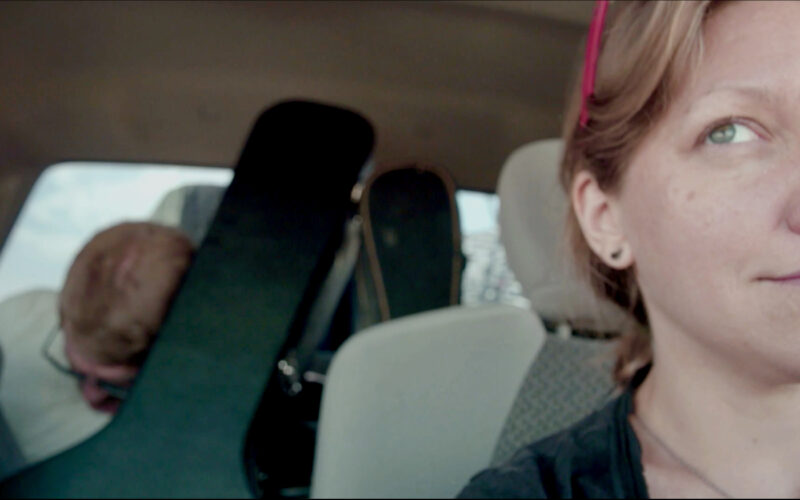
Flood (Scoggin, 2025)
There are, I think, two very different documentaries vying to be born in the chaos that is Katy Scoggin’s Flood. The one is a dispassionate look at young earth creationism, Campus Crusade for Christ, and the aging of a generation of Christians trying to reconcile their beliefs with the contempt with which every one else looks at them. The other is about how much Katy Socggin seems to despise her father.
I wanted to write the word “hate” there, but that’s such an ugly word, such a destructive word, such a triggering word, that it would, most likely, participate in the kind of culture war discourse that Flood and PBS would most likely claim they are trying to rise above but (by laying the blame for it entirely on one side) also appear to depend on. Not that “despise” is much better. I considered not even writing this review at all because some part of me knows that when the artist’s personal life becomes the subject matter of her art, criticism of the art and the person are so hopelessly intertwined that any criticism sounds like, may actually be, taking sides.
A couple of disclaimers may thus be necessary, even though I am pretty pessimisstic about any of them being believed. The first is that nothing I say in this review is meant as an indictment of Scoggin’s self-professed atheism. The second is that I don’t mean for this reviw to be a criticism of her as a person. I have read or seen plenty of great narratives (some autobiographical, some fictional) about adult children and the complicated relationship with the parent or parents for whom the artist blames some, most, or all of his or her trauma. Alison Bechdel’s Fun Home is a painful but fitfully funny masterpiece. Alice Sebold’s anger at her mother, so sharp in Lucky gets toned down a little in The Lovely Bones but is still so strong that it threatened (at least for me) to overwhelm some of the deeper, more beautiful parts of her narrative. I once was threatened with terminiation from a Bible College for teaching Saul Bellow’s “Something to Remember Me By,” a story about the suffocating legacy a relgious father imposed on his son and that son’s complicated matrix of anger and self-loathing at the lengths he will go to be free of it. My point being, it isn’t that the content of Flood is out of bounds that keeps it from being great. From my seat in the rafters, pointing out how the woman in the arena striving valiantly could have done better, Flood ultimately falters due to a lack of artistic control, not artistic intent.
In Running from Crazy, one of my ten or twenty favorite films of all time, Barbara Kopple and her subject, Mariel Hemingway, discuss candidly that their portrait can only work to the extent that Hemingway is able to be completely honest — about herself and not just about the people, events, and circumstances that have traumatized her. The film works so brilliantly and engenders such empathy in part because Kopple is a step removed from the traumas and can frame them artistically but mostly because Hemingway herself has aged and matured to the point where she is able to speak with equal measures of candid frankness and measured grace, both for herself and others.
I am categorically not claiming that Scoggin lacks any of those qualities. To do so would be both arrogant and condescending. But I do think the parts of herself that she chooses to share with us through the film are so bleakly devoid of empathy for her antagonist (her father) that they make it hard to see the film as anything other than a bid for sympathy — look what I had to put up with my whole life and how it messed me up! When she asks an advisor how to handle approaching her father, a man rightfully suspicious of an alienated, hostile daughter who now wants to reconnect just so that she can make a film about how awful he made her life, the advisor suggests she tell her father that she loves him. Her response to that recommendation suggests to me just how much of Scoggin’s trauma is unresolved, which again, is not meant as a personal slight. I’m just saying that critiquing someone’s art therapy is a differnt thing than critiquing her art.
None of this, of course, is meant to imply that religious parents can’t and don’t ever mess up their kids. One thing that is absolutely indisputable from the film we are given is that Scoggin’s trauma is real. I spent enough of my young life around groups like Campus Crusade that I can well imagine what it might have been like growing up in the homes of my friends who were more invested in that brand of evangeliclism than I was. We used to have a joke in my own college faith group that the way you could tell someone was from Campus Crusade is that he (or she, but almost always he) would wait until someone in a conversation used the word “the” and then interrupted to interject, “Speaking of ‘the’ have you heard of ‘the’ four spiritual laws…?” I read Josh McDowell’s amateur apologetics, and I remain convinced to this day that it was (and still is) valuable for asking Christians to think critically about whatever they were told regardless of the sources. And that lesson has served me well even if four decades later some people use the same scripts to question vaccinations or climate science. Campus Crusade and that generation of Christians is not, in my opinion, entirely responsible for the “do your own research” self-hypnosis crowd who cannot and will not make a distinction between parroting a talking point and critiquing a research study. A better film, perhaps the film I wanted, might have explored how the one makes or made a certain generation of Christians more suscepitble to the other, but I think that would have entailed talking to a lot of other Christians besides her dad. It also would have entailed listening to them (or him), something she makes clear she had little capacity to to after decades of being preached at and lectured to. Again, no shade on her for that choice, but then why make the film if you have no interest in your subject’s point-of-view and lack the emotional and psychological energy to bracket your own personal responses to it long enough to say something meaningful about it?

