
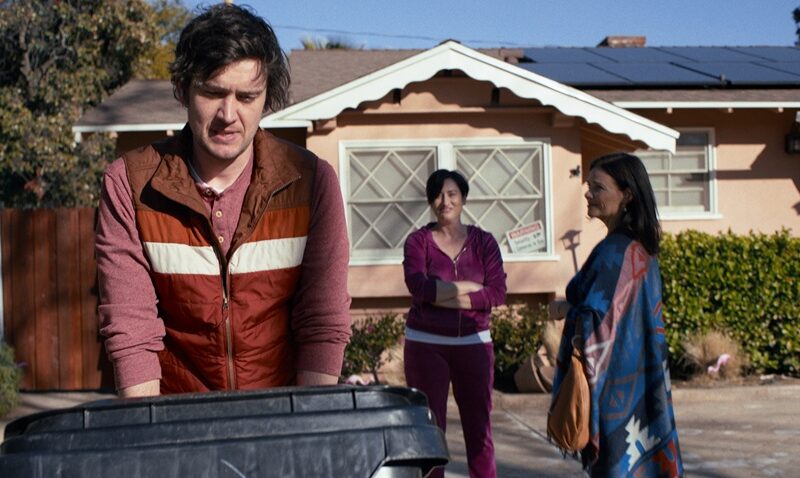
I Hate Myself and Want to Die (Davis, 2024)
Trigger Warning: This review contains potential plot spoilers for the film reviewed as well as for Rosetta and It’s a Wonderful Life. It also contains discussion of suicide. Assistance is available through suicide and crisis hotline at 988.
The first fifteen minutes of J. Davis’s I Hate Myself and Want to Die is so good that it is hard to blame the rest of the movie for never quite reaching the heights that the introduction does.
The opening is — and this is a key point — disarmingly funny. It is reminiscent of the car scene in Pulp Fiction or the crucifixion scenes in Life of Brian. I know I should not laugh, but…I…just…can’t…help…myself. Jacob (Mike Castle) runs tubing from his car’s exhaust, sends a good-bye e-mail to his best friend, calls up the most meaningful (numbing?) song on his phone and waits to slide into oblivion.
I will refrain from summarizing what happens next both because a major part of the pleasure in watching the film is to see if Davis can write his way out of a corner (he does) and because, as Eddie Murphy warns in his concert video, bad retellings tend to ruin other people’s jokes. Suffice it to say, Jacob’s intention is at least momentarily thwarted. Then he has to do one last thing before he can kill himself, and that one thing turns into two, and two turns into what my wife likes to call a “sequential vortex.” Very few peope that I know have ever tried to commit suicide, but almost all of us have known the frustration of trying to stay on task only to have the most organized plans blown up by random details and relentless distractions. It is, I think, precisely in this intersection of the exceptional and the banal that I Hate Myself lands hardest by allowing you to empathize with Jacob.
Davis insists in the press notes that Jacob does in fact hate himself and want to die, claiming the film is about the people around Jacob who don’t want him to die and how, when we are depressed, we are not the best judges of our own worth. That message is less precisely conveyed than I would like, and the ambiguity of the film’s intention makes the middle parts of the film problematic. There is, as there should be, some thematic tension in the middle of the film as it is unclear whether Jacob remains committed to his plan (to kill himself) and is just awaiting an opportunity or whether any of the events through which he ostensibly learns his worth are landing in the moment. Because of that, the end, while not unexpected, did not feel fully satisfying for me.
Given Davis’ thematic description, the most obvious point of comparison here is It’s a Wonderful Life. There are some important and impactful differences between them, despite thematic similarities. Because Capra’s film is structured in flashbacks, it can (and does) go on longer, making it easier for the audience to entertain an argument that Jimmy Stewart’s life is meaningful. By showing the character the potential results of his suicide, that film makes it easier for him to repudiate it. He was depressed, but he was wrong to despair. (Side note: Is there any Biblical significance to Davis’s protagonist being named Jacob, the man who literally and sympolically wrestled with God?) I Hate My Life asks its middle section to convince, in the span of an hour, both Jacob and the audience that his life is worth living. That task turns out to be a super hard needle to thread, because Davis doesn’t quite trust the audience to appreciate a gradual awakening without the drama of a last second change of heart. So Jacob has to both remain committed to his suicidal objective but also plausibly be changing enough that we are willing to accept a happy ending at face value.
Spekaing of Davis’s self-interpretation, I find it ironic that the film’s best scene, for me, is when the mother of a teen girl who has snuck into Jacob’s car berates the (seemingly suicidal) character for his lapses in judgment, implying, at times outright stating, that he is a loser with little or nothing to live for. Unlike Capra’s film, the turning point here is not someone trying to convince him of his worth but someone agreeing with his feelings of worthlessness. It is only when criticized by another that Jacob not only sees his value, but fights for it. His protestations are feeble, but he does stand up for himself as best he can. He knows his intentions were right and that Hayley (Ali Gallo) could have gotten into much more trouble if she had randomly stumbled into someone else’s car. There are all sorts of sublte distinctions in play here — between being depressed and being depressive, between being weary and being weak, between feeling worthless and being worthless, between hating your life and hating yourself. Jacob’s epiphany is yet to come, but I think this scene is the film’s true climax.
Despite the obvious Capra comparison, the film I think should be better paired with I Hate My Life and Want to Die is the Dardennes’ Rosetta. That film also has an interrupted suicide attempt, but at a climactic moment. Within the context of the Dardennes’ world view we are invited to at least entertain the possiblity that the interruption is providential. Of course, by placing it at the end of the film, the Dardennes leave some difficult questions unresolved: What comes next? Is saving an act of mercy if one cannot address the reasons a person wants to die in the first place? If a single, seemingly random event or encounter is enough to change a protagonist’s mind, was their despair insurmountable or only temporary? The answers to these questions, in turn, impact how we as readers might feel about suicide in general or assisted suicide in particular and what we understand the film to be saying about that choice. The Dardennes have spent a quarter of a century and ten films wrestling with the question of “what comes next,” so I am not knocking Davis for not being able to resolve some of those tough questions in the central section of a single film.
I hope it is clear, however, that I am praising the film by implication rather than critiquing it. I don’t think it’s inability to get from its sublime opening to its ending downgrades it so much as keeps it from reaching the more elevated levels of some of the films to which I am comparing it. One could always argue — and I have — that if an artist is going to tackle certain subjects such as racism, depression, sexual violence, etc.) he or she should expect to be held to a higher standard. Suicide is one such topic where it may not be enough for some viewers that a film be okay or even good. Compared to the vast majority of comedies, I Hate My Life and Want to Die is funnier, more daring, and more insightful. Do I wish that the screenplay had been confident enough in my ability to see what was happening at the heart of the movie without it being underlined by a second suicide attempt? Absolutely. And I will argue that the coda would have been more beautiful and meaningful and plausible if Jacob had come to the realization without that second attempt. But, as one of my critic friends is fond of telling me when I make such obseverations, one can only critique the film we are given not the one we wish we had seen.

