
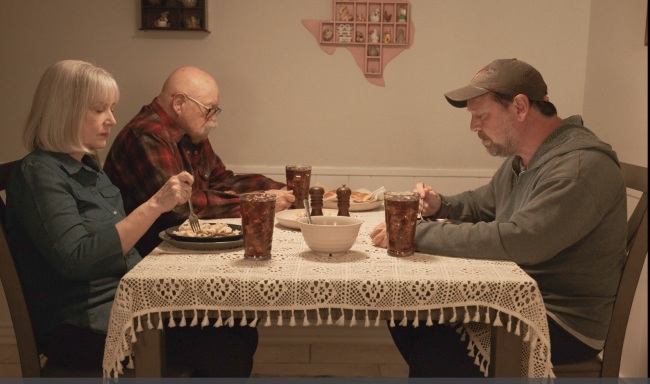
Worst Enemy (Machate and Masterson, 2026)
The first thing that I noticed about Worst Enemy, a twenty-three minute short co-written and co-directed by Kevin Machate (who also stars), is that it has a very polished final cut. The direction, acting, editing, and sound are all commensurate with what one is used to from a commercial feature-film. Since shorts are often used as a proof-of-concept for artists not yet able to generate the investment funding for a feature, they can often look a little cheap. I have learned, over the years, to look past some of technical limitations created by micro-budgets and try to see the potential on display. Here, what was on display was not potential talent but actualized talent. As the short’s IMDB page notes, the cast and crew of Worst Enemy have thirty-four Emmy nominations between them. This short isn’t Exhibit A of some film student’s demo reel; it is very much the work of experienced professionals who know what they are doing.
The story is fairly simple, as it must be in a short. Shane (Machate) is a veteran who, in the opening scene, receives a diagnosis of severe depression and Boderline Personality Disorder. The initial scene with his doctor (played by co-director Masterson), sets the tone for a disturbing and painful contrast between well-meaning and sincere allies, including a famous cousin, Ashley (Beth Shea), who he obsessively calls on the phone for reassurance and human connection. We hear a dozen calls go to voice mail, yet the one actual conversation shows Ashley to be genuinely supportive.
The opening consult hints that there are other traumas besides military service that have fed and formed Shane’s mental health struggles. As is not uncommon for victims of childhood abuse or neglect and certainly not uncommon for those with military experience, Shane reflexively dismisses his own suffering. “I’ve been dealing with this for so long, I’m sure I’ll be fine.” Shane also clings to the narrative that the only form of child abuse that matters is “getting beat up every day” and so resists the clinical label. The film is smart here in that it resists the temptation to give a more dramatic visual representation of the childhood abuse via flashback. By having the doctor characterize the abuse as extreme but the victim retain a more stoic affect when talking about it, the film goes beyond simply documenting something that creates sympathy. It advances the thematic idea that levels of distress can be high even when the person experiencing them remains functional.
This theme requires Machate to pull back enough as an actor to allow the scenes in isolation to genuinely contrast with the scenes where he is trying, albeit falteringly, to maintain a facade of normalcy. The centerpiece scene is a dinner with his father (Barry Corbin) who directs a vitriolic stream of toxic-masculinity criticisms towards his son. “You don’t look disabled to me,” his father scoffs, and twists the knife with a reminder that “I was in Vietnam.” Shane walks out on the dinner with his parents just as he walks out on the meeting with his doctor. His patience extends only so far, and he doesn’t have any way other than his phone calls with Ashley and a lot of Miller Lite to release his stress.
The short includes a subplot about a job-offer that Shane receieves to teach English as a local college. It is rescinded for a reason that did not strike me as invalid but which underlines some of the practical difficulties of trying to pull oneself out of the hole of depression. In fact, if I have one concern about the short it is that the severity of Shane’s mental health challenges makes the plot and tone fairly static. In a twenty-three minute short, that stuckness is bearable, but I wonder if in a longer feature it would become tedious for an audience with less saintly patience than Shane’s celebrity cousin.
I was also confused about Shane’s diagonosis. I am not a mental health professional, but I have researched and read about Borderline Personality Disorder (BPD) quite a bit. I did not see too many of the behaviors I associate with BPD, though I will concede that this disorder is much more frequently diagnosed in women, who may manifest differently, than in men.
There was a part of me, if I am honest, that found it easier to appreciate the film as an educational video or public-service documentary than a dramatic film. As well done as the film is, I wasn’t sure what the take away was beyond that depression sucks, and we should all try to be sensitive to the possibility that those around us are silently suffering. That is a message I absolutely endorse, but the uncomfortable reality is that dramas that center around dyanmic, changing, characters usually land harder than those about characters who are “stuck.” I suppose a longer version of this narrative might work as Oscar-bait material if it were framed as an Oscar showcase, but the nature of the material makes me skeptical that giving himself a juicy role was the reason Machate wrote it.
That said, not every twenty-three minute short has to be a stepping-stone to something else. If nothing, else, this short is exactly the sort of little gem that suggests to me that if the cast and crew can elevate the short-form narrative, they could interject some of that same polish if given charge of a serial project (television) or a screenplay with a more narrative complexity.

