
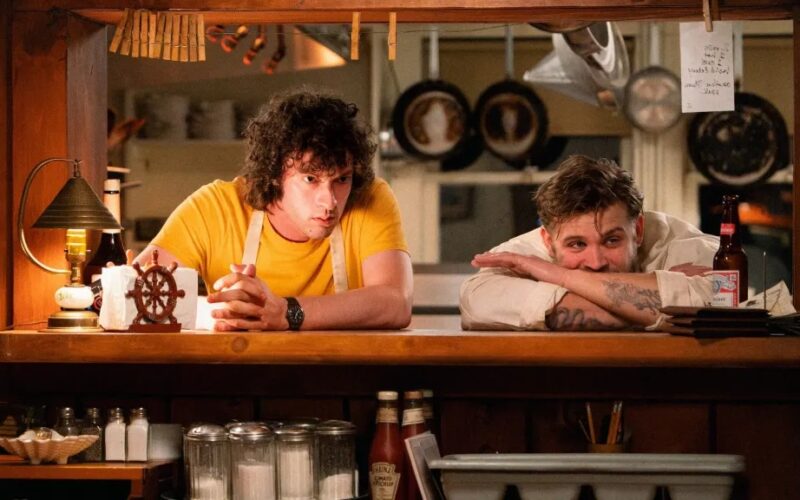
Tony (Johnson, 2026)
I admired Tony the movie even if I found it very difficult to root for Tony the human being. This film is an origin story, so it both helps your understanding and hinders your pleasure if you know anything about what is yet to come. (Everything in his life after the transformative Summer that leads him to apply for culinary school is rendered in a footnote.) What I can tell you about Tony in the movie, is that his adult, retrospective self, describes himself as a “spoiled, miserable, narcissistic, self-destructive and thoughtless young lout.”
There have been, no doubt, many young louts who grew eventually into good men, and everyone loves a redemption arc. The problem here is that the transformation is only hinted at, not documented. Tony lies to his family, lies to his teachers, lies to the girls he wants to sleep with, lies to the man who gives him a job, and lies to his co-workers. He takes cocaine, steals a car to go joy riding, cusses up a storm, and when he forces the restaurant he is working at to close by cuasing a fire, resolves to steal money from the man whose business he destroyed.
That Tony is sympathetic at all is a testmaent to Dominic Sessa’s acting, Matt Johnson’s direction, and a script (credited to multiple contributors) that is always tight but never rushed. To be honest, I liked the story the better for its refusal to underline pivotal moments or invest them with the clarity of hindsight. In the film’s best scene, Tony confesses to Nancy, the young woman he is pursuing (Emilia Jones), that he finds the habit of using big words annoying in others, especially his mother. The pause between when she asks, “Then why do you do it?” and he answers, “I don’t know” is the most notable of the many silences in which the movie invites you to think about what you are seeing rather than merely telling you what to feel about it.
Were Tony a fictional character, the story of this one chapter in his life might be satisfying. Given that most watching the film will be at least marginally aware of the chef’s death by suicide in 2018, the film as is has an air of gloom hanging over it that the hopeful ending can’t make much of a dent in. I don’t know that one needs to believe in an afterlife to fend off fears of life’s meaninglessness, but given how desperately the young man depicted in the film longs for significance, it is hard to fend off a reading that culinary school was not the first step of a life of meaning but just the next failed attempt to keep despair at bay. Johnson loves to let his camera linger on artifacts, especially those through which characters measure the passage of time. (They are counting out their lives not in coffee spoons but in broken dishes, in stuffed tip jars, in wooden chips denoting sexual conquests.) Perhaps the most significant of these artifacts is a book that Chef (Antonio Banderas) gifts Tony, one with his own notes. Like the book Bourdain would eventually write, it is not a recipe for success so much as a biography of his own failure to make his life understandable and meaningful to those looking on from the outside.
Banderas’s character is the hero of the movie, and the actor gives a restrained performance, making Chef more of a Mr. Miyagi type mentor than a saint or tough-love savior. There is a scene where Chef makes the Atheist Tony go to church, and it is the sort of visible display of Christianity that often plays like catnip for Christian film critics. But I thought a lot more about his rules against using the lord’s name in vain that is applied to everyone but only ever really explained to Tony. If invoking the name of God is a knee-jerk response to a great (or terrible) life experience, why not thank the giver of life for whatever exceptional experience one is aware of that is prompting the exclamation?
Tony’s best quality is that he sees. It is ironic, of course, that this is also his great weakness. He tells Nancy that he wants her to take his picture because he likes the way he feels when she looks at him. The he helps start the fire because he can’t take his eyes off of her, desperate to see her return his gaze after her meal has been delivered. There is a lot happening in that scene, but from my perspective it is the best illustration of how even service — making others happy by delivering good food — can become a trap for those who are (or become) addicted to bringing pleasure to others since they can only feel it vicariously. For all the love and admiration I felt being directed at Bourdain from the audience (I saw a preview screening with a lot of food industry personnel invited as special guests), I could not quite shake my own reading that his life was a tragedy to be mourned rather than a triump to be celebrated.

