
Black Men in Uniform: The Untold Story (La-Paz, 2025)
Black Men in Uniform is one of those rare films that I am so reluctant to criticize that I wish I had not watched it. I trust that the intentions of all involved were good, but what made it to the screen is a scattershot montage of unrelated Black history topics desperately in need of some sort of focus. The title suggests the narrator will get to thematic focus eventually, but an emphasis on military history (or anything else) never actually materializes.
Perhaps ten percent of the film, maybe less, is about Black men in uniform. I actually stopped the film three separate times to verify that I was watching the correct title. Other topics covered include the sexual subjugation of male slaves, the use of slave labor to build the White House, Harriet Tubman, Jack Johnson’s boxing career, the Loving v. Virginia court case, Black women in World War II, the meaning of “I can’t breathe” as a slogan, Langston Hughes, Jackie Robinson, Billie Holliday, Hattie MacDaniel, whitewashing at the movies, Elizabeth Taylor, Halle Berry, Little Black Sambo Books, and Malcolm X…
It is as if Billy Joel wrote a Black history sequel to “We Didn’t Start the Fire” and a grade-school instructor forced students to look up Wikipedia entries on each of the lyrics. Just as the title misleads by suggesting there will be a focus on Black men in the military, the subtitle misleads by suggesting the film will offer new information about its topics. But there have been full movies or books chronicling nearly every surface that is scratched in this montage. A quarter to a third of the film consists of outtakes from one those films — The Jackie Robinson Story.
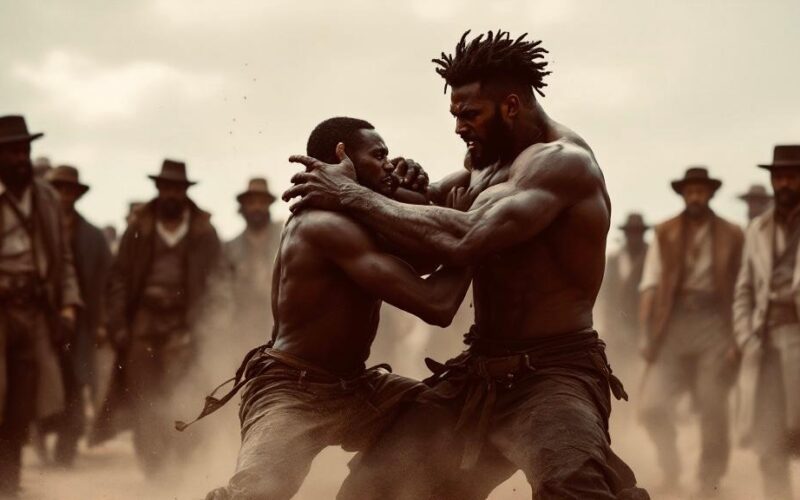
On a formal level, the film also presents challenges to the sympathetic critic looking for something constructive to fold into the criticism. By far the aspect of the film that was most engaging was the archival footage of Jack Johnson and photography that appears to date back to the antebellum period. But the liberal inclusion of what appears to be AI generated images (see stock illustration above provided in the film’s press kit) raised questions about the authenticity of the rest. Having the audience wonder if what it is looking at is authentic or reconstructed is not a good outcome in any documentary, but it is especially unfortunate when presenting on polarizing subjects. It doesn’t help on this score that if one visits the film’s production company (LittleAntProductions.com), one finds La-Paz’s two films, Black Men in Uniform and Born Sexy Yesterday listed alongside Barbie, The Little Mermaid, Into the Spider-verse, and Dune on a page labelled “Our Movies.”
Emunah La-Paz (aka Vicki L. Hubbard in her Filmfrenzy bio) is credited as cinematographer, editor, and narrator while Daniel Hubbard has producer credits, so I have no argument with anyone who wants to cut the film (or its makers) some slack for it being an indie in every sense of the word. But no serious indie filmmaker that I have met or interviewed wants to be graded on a curve. And the reported budget (again at FilmFrenzy) of $560,000, while a fraction of that of a Hollywood blockuster, is on the high end for commercial documentaries. I get that making movies is expensive, but I have seen better editing on some YouTube channels. I can see where the film pinched pennies, but in what area(s) was the big budget spent?
Still, none of those formal aspects would matter if the film delivered on its promise to tell me something I didn’t already know. In one of the film’s many brief waves at historical context, we are told that the Trump administration required exhibits about the Tuskegee Airmen to be scrubbed from some historical sites or venues until the public objected. The fact that there was an outcry suggests to me that the public knows a little about Black men in uniform and that the percentage of that same public who would like to know more is not insignificant. To the extent that it is increasingly difficult to find reliable historical documentation about Black men in uniform, it is all the more frustrating when one anticipates an educational film experience and gets the bait and switch treatment.

