
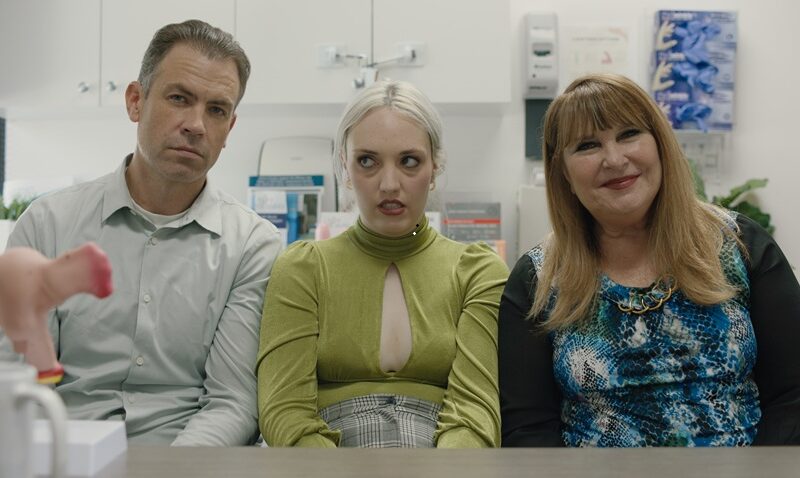
Lady Parts (Boyd, 2024)
What feels like the most important thing to say about Lady Parts is that it isn’t funny. Not even a little bit.
That is not a criticism. The film is the better for playing the material relatively straight. But attempts to fit it into a traditional genre category undercut what is good about it. Its press materials label the film as a “dramedy,” while IMDB labels it simply as comedy. The assumption, apparently, is that we are only able to talk about female health if we laugh about how uncomfortable those words make us. Whether that assumption is true or not, marketing it as a comedy seems to me like a lose-lose proposition. Those who might appreciate the film for its nuanced approach to the subject matter may well pass, assuming it is no different than standard commercial fare that would capitalize on the awkwardness many still feel when discussing female bodies rather than interrogating that awkwardness. Those who do want a lighter, comedic tale are likely, if fooled by the advertising, to be disappointed.
If it matters, I am in the former camp. I almost passed on the film based on a misreading of its intentions from the trailer. I am glad I didn’t.
Based/inspired by a true story, Lady Parts, follows Paige (Valentina Tammaro), a writer on the verge of her first big professional break who has to choose between professional advancement and taking time off to have a vulvar vestibulectomy to address and correct a lifetime of pain. In one of the film’s best scenes, Paige struggles to explain to her parents (and herself) why this choice is even a debate. Her parents — her mom especially — rather than being caricatures who are too embarassed to say the word “vagina,” take it as a matter of course that their daughter deserves a life free of pain and that no amount of money can compensate for being unable to use and enjoy parts of her body.
The reluctance that Paige has to be open about her surgery, much less to letting her parents help her financially and act as caretakers, appears to stem from something much deeper and more complex than mere embarassment, although the latter is a small part of it. In an exchange that should land hard for anyone, male or female, who has experienced long periods of dependence on caregivers, a post-operation Paige laments, “I really don’t want to complain any more.”
We see from the opening scene how social taboos surrounding frank discussions of female biology lead to Paige habitually suffering in silence. When Paige, presumably having her first period is being instructed on how to insert a tampon, her mother mistkes the dauther’s claims of physical pain with shame or embarassment, insisting that “it shouldn’t hurt at all.” While that statement is techincally true, the girl does not have the experience or composure to double down, downgrading her report to “it doesn’t feel right” instead of “it hurts.” In another subversive scene, the film stays in the examining room for an actual vaginal examination. In a context in which Paige is finally allowed, even encouraged, to express pain, a setting that is so often played for the easy laughter caused by mild embarassment becomes surprisingly poignant as we watch Paige try to balance the conflicting emotions of chronic pain with hope that someone may finally believe her.
Another way in which the film itself is better than its promotional materials will indicate is in its depiction of men. The trailer suggests a fairly narrow representation of prospective sexual partners who lack the patience or empathy to deal with someone who can neither have pain-free sex nor speak openly about how her phsyiology is influencing her behavior. While there are one or two jerks, neither of which are major character, the three most prominent male characters (her father, her doctor, and her eventual love interest, Cody) are portrayed as decent, understanding, and patient. One could even argue that Cody treats Paige better than she treats him, since, as he points out, she ghosts him rather than trying to explain why she suddently panicked at the prospect of a relationship that was getting more serious.
Lady Parts is good, but not as good as it might have been. There are two weakness that kept it from landing as hard as it might have. The first, already hinted at, is that it spends more of its time and energy on the phsyical aspects of surgery and recovery than on the psychological or emotional impact of Paige’s conditions. She has to sleep on Pee Pads, needs help going to the bathroom, and has to treat constipation as a potential emergency that could rip her stitches. While the medical details of her post-surgery recovery are embarassing, they are not all that much different from any surgical recovery and the emphasis on them pushes a film that is at its best when it is more specifically about Paige’s particular condition in a more generic direction.
The other weakness, for me the biggest one, is that Lady Parts never finds a narrative hook to give the story focus. It works very well as a documentary, but since the condition is the antagonist, it has a hard time resolving things once surgery is over. There is a relational drama that feels tacked on, and Paige’s return to work comes across as an end rather than a destination. There is some embarassment over a blog post that goes public and the revelation that speaking openly about her “parts” encourages other women to do the same. There is a scene where we see Paige’s mom arguing with an insurance company over whether the surgery is “cosmetic” and a few others where the issue of costs invites arguments about health care financing that film can’t quite pull the trigger on pursuing. In a very interesting late scene, we see Paige’s last interaction with her doctor, and while we are half expecting a generic, “I could never thank you enough” exchange, she instead pointedly asks him for the last time if he still doesn’t accept insurance.
The film is good enough that it is worth watching, which means it is good enough to wish it were better. Earlier this year, I Swear showed that it was possible to make a satisfying narrative out of a likable protagonist suffering with a little-understood medical condition. Maybe we needed to spend a little more time with Paige, get a broader understanding of the breadth and length of her struggle in order for the end to be more satisfying. There is a throwaway scene late in the film where Paige is listening to music, using a vaginal dilator , and, the film implies, perhaps feeling sexual pleasure for one of the first times in her life. In the best version of this film, such a climactic moment (pun intended) would carry a lot more emotional weight. We should, I would think, feel so happy for her that after over a decade of suffering and a painful surgery, she is experiencing a foretaste of what she worked so hard to have. Instead, there is a knock on the door as her dad invites her to watch a penguin video. She covers her face with a pillow. It is a sweet moment, but a film this emotinally heavy could use at least one moment of genuine joy.

