
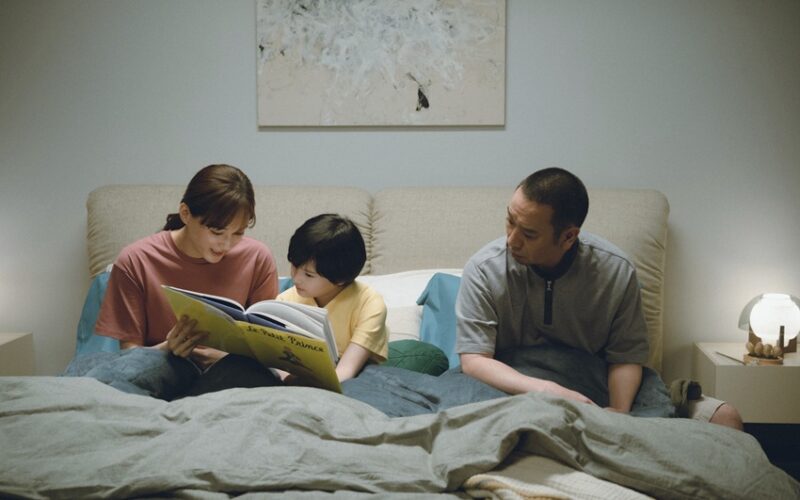
Sheep in the Box (Koreeda, 2026)
Based on reviews coming out of the festival circuit, Sheep in the Box is for hardcore Koreeda fans only. I guess I qualify, since I both appreciated and enjoyed the master’s new effort.
I concede that the film does have the misfortune of landing in the United States in the midst of a general cultural malaise about all things AI. When I understood the plot — Otone and Kensuke acquire a lifelike robot to replace their dead son — I wondered if it would simply be a rehash of Spielberg’s A.I. Artificial Intelligence or Alex Garland’s Ex Machina. But while these films all deal with machines emulating humans, their thematic concerns are different.
The most obvious difference is that Garland’s film and Spielberg’s film are a bit more interested in trying to explore or define the definition of humanity. What makes us humah? Whether it be through the famous Turing test — can another human distinguish the difference between man and machine — or some broader descriptive criteria such as the possession of imagination, selfishness, or free will, the borders between man and machine are forever being mapped, challenged, and mapped again. The theme isn’t even unique to the AI age; it’s the same thematic question that lies at the heart of Frankenstein.
What I liked about Koreeda’s treatment is that it never really got caught up in asking those same questions once again. Otone and Kensuke know Kakeru is not their son. In one particularly effective scene early, Kakeru asks Kensuke why he cannot call him “papa.” The man replies: “I’m not your papa. So don’t call me that.”
That scene is indicative of what I think Koreeda is interested in examining. How the artificial boy affects the parents’ grieving even though they know he is not really their deceased son. The center from where they get the robot claims in a promotional video that a loved one can be “reborn” and stay at your side. These are euphemisms, of course, and everyone knows them to be such. But much like propaganda, euphemisms have a way of altering our thinking. We think that acknowledging that something isn’t real will insulate us from the emotional consequences of treating it as such. It is somewhat ambiguous what the purpose of the AI units is from the makers’ perspectives. In one aside, the couple say they were chosen and not charged for taking possesion of the unit.
Ostensibly then, the puprose of the AI units is supposed to be therapeutic. Not suprisingly, though, the reappearance of a Kakeru who has the same appearance and knowledge of the human who died doesn’t so much alleviate grief as change the nature of it. Stephanie Sarazin, in her book, Soul Broken, describe “ambiguous grief” as “the feeling experienced from the loss of a loved one who is still living, accompanied by a change in or death of the relationship.” Kakeru is not still living, and the attempts to pretend he is accentuate rather than alleviate the grief over the death of the relationship since the couple, indvidually and corporately, are constantly confronted with reminders that even though the son they have know looks and acts like Kakeru, the relationship they have with him is quite different. By not acknowleding the loss openly, the couple hinders the natural expression of their grief, which, it turns out, is an important part of their healing.
What I apparently found more intresting here than did many other reviewers is the way Sheep in the Box avoids simple dichotomies. In the current anti-AI social environment, I expected the film to lean into the psychologically destructive nature of the project itself as a cautionary tale or a wholehearted rejection of the technology. Maybe it is that, but I think a closer look at the back half of the film can support a reading that Kakeru helps the couple process their grief rather than simply avoid it. Such a reading admittedly opens the door to a numbre of other psychological problems since it is impossible to avoid new emotinoal attachments that come with their own griefs. The recognition that we can form emotional attachments to things as well as people is hardly profound. (In the recesses of my mind I hear Ferris Bueller’s friend, Camerson, screaming at his absent father, “Who do you love? Who do you love? You love a CAR!”).
The film recognizes that ownership in modern society does not come with an expiration date, so often our responsibility for things outlives our attachment to them. But how do we dispose of things, other than by throwing them away? The more that things look human, the more our relationship to them becomes akin to humans, and the more likely we are to start blurring the lines, already tenuous, between what we find acceptable treatment of people and what we find acceptable treatment of things. So, yes, add Toy Story to the list of films interested in similar themes. The difference is, Toy Story, like A.I. Artificial Intelligence, talks about the violence of breaking that conneciton from the point of view of the object. The relationship here stays pretty firmly on the humans, and I do find the ways they treat their robot interesting. Not because they have been fooled into thinking it is real, but because the memories and emotions it has helped them process very much are.

