
Hadestown: The Musical
The American professional basketball player Brian Scalabrine once made headlines by claiming to non-professionals on social media that he was “closer to Lebron [James]” in talent and athleticism than any non-professional basketball entusiasts were to him. He backed it up that claim in a public exhibition in which he defeated a handful of challengers by an aggregate score of 44-6.
Scalibrine’s exhibition, although it was about sports, illustrated for me in a way that was easy to comperhend and explain to non-theater people why Broadway theater can be so exhilirating. The chorus member with the smallest part is usually better than the star of your local amateur production. Like nearly anyone else, I am happy to go to a Broadway production and marvel at the delivery of a star belting out a showstopper. But I also often find myself watching the margins, looking for a single performer who is metaphorically taking a play off or is a quarter-second behind everyone else in a complex routine. I am continually amazed at the consistent attention to even the smallest detail.
One might think that doing the same numbers eight shows a week would make the performances stale, but instead the level of repetition can and often does create an opportunity to polish to perfection. In a film, the director might have twenty or thirty takes to choose from. On stage, the first take in front of a live audience is the one you are going with, even if there are hours of rehearsal and experimentation that precede it. Consequently, there is an excitement around live theater. Anything can happen. It is electric to watch talented people at the peak of their craft doing difficult things and making them look easy.
Hadestown is, of course, not just any musical. It won eight Tony Awards in 2019 and a Grammy for Best Musical Theater Album. With all due respect to Hamilton, Hadestown is the preeminent Broadway show of the twenty-first century. Then again, anyone who has seen theatrical versions of Evita, Les Miserables, or Wicked know that stage doesn’t always translate to screen.
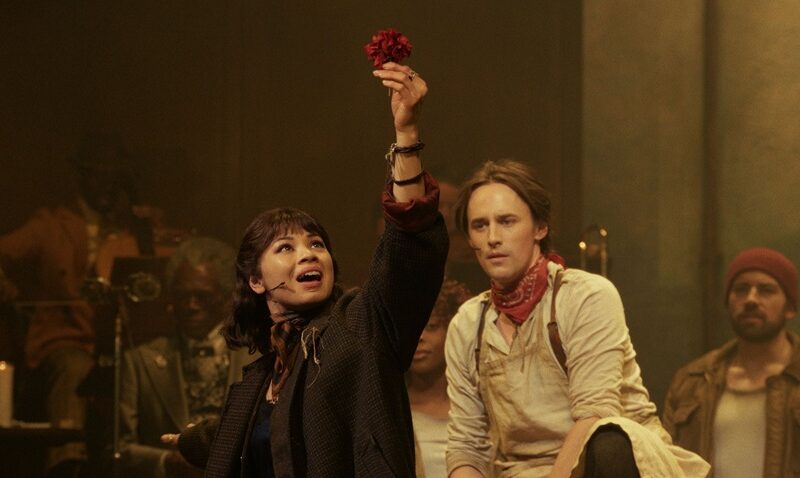
The show itself being wonderful, I remained concerned going into Hadestown: The Musical that performance captures and concert videos lacked the energy of live events. There is something about physical presence that heightens the experience, but plenty of televion shows are filmed in front of a live audience. Watching a show live is just not the same as watching a show that someone else is watching live. The opening and editing create the illusion that we are watching a single performance from beginning to end, but the press notes are coy as to whether this is the case. In the worst examples of this genre, two or three cameras from various audience vantage points might record a performance. Here, we get enough close-ups, reverse shots (of the audience) and point of view shots (including one looking up from a hole in the stage) that I had to wonder if we were getting a composite of multiple performances edited to look like one. No shade if they did. The variety of angles kept the production visually interesting, even if they did force our attention onto parts of a larger tableau.
The strength of Hadestown is in the songs and the staging. And while the latter lose just a bit of impact outside the immersive qualities of the theater — remember the first time you expeirenced the swinging lights of “Wait for Me”? — the emotional impact of the songs hits just as hard. The sound mixing is fantastic, with the lyrics being clearer than they are in the cast album in places. The entire cast is exceptional, and Hadestown is a generously written show, giving show-stopping moments that allow all five of the leads to be the center of attention at key moments. André De Shields (as Hermes) and Amber Gray (as Persephone) give precise, detailed, exquisite renditions of characters that could become cartoonish in the hands of less accomplished actors. Watching Gray, specifically, as part of the chorus in “Why We Build the Wall” is amazing. Few actors have the range or confidence in live theater to allow their facial expressions to work in counterpoint to their vocals. Patrick Page has to make you have sympathy for the devil, and he does.
It is undeniable that at least part of the power of Hadestown is that it works particularly well as an allegory for the present political moment and as a commentary about how the conflicts between the powerful and the powerless are timelss. “When the Chips are Down,” “Why We Build the Wall,” and “Chant” all have pretty specific contemporary targets, at least in my opinion. And yet the show is strangely optimistic in the ways that it reminds us that oppression, whether we experience it or witness it, is hardly a unique feature of the present political climate. That may be why one of my favorite moments in the show is when the Fates give a musical defense of Eurydice:
“Go ahead and lay the blame
Talk of virtue
Talk of sin
Wouldn’t you have done the same?
In her shoes
In her skin?
You can have your principles
When you’ve got a bellyful
But hunger has a way with you
There’s no telling what you’re gonna do
When the chips are down
Now that the chips are down
What you gonna do when the chips are down?”
Anyone who has spent significant time in and around Christian churches has probably heard Eve scapegoated and blamed for causing Adam’s downfall. Hadestown asks the viewer not just to be sorry for the oppressed for what they endure but for all the ways the world tells them and us that their suffering is their own fault and not the product of a system impossible to navigate or overcome.
And yet for all that it is not a nihilistic show. The first time I saw it, I wondered half way through how it could end true to the source material without morphing into a joyless screed about the pointlessness of life. It captures so much of the disappointment of missing or losing the joys of life without falling into the trap of insisting those joys are not, were not, or could never be, real. Hadestown is a balm to a hurting age, and if the film version allows more people to experience it, the greater reach more than justifies the only slightly blunted impact of wrenching it out of its theatrical setting.

