
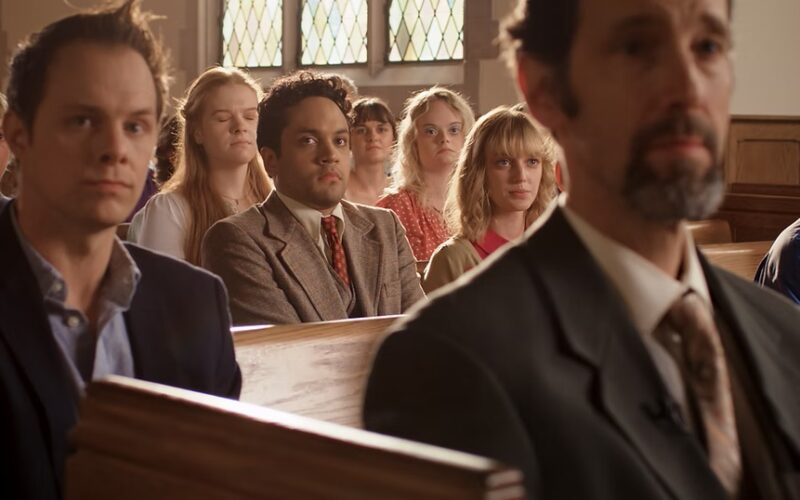
Holy Irresistible (Corkey, 2026)
In the first chapter of Inconspicuously Christian Film Criticism I suggest that for a film to fit comfortably in the genre of “Christian Fiction” it needs to be answer at least two of the following three questions affirmatively:
- Is it about Christians?
- Is it made by Christians?
- Is it made for Christians?
While these questions are broad enough and ambiguous enough to allow argument about particular titles, they are meant, at least when I use them, to be descriptive rather than pejorative. To say that Holy Irresistible is not a Christian film is to say nothing, at first, about its quality. It is worth saying, though, to help illustrate why it shares some of the problems that plague that genre even as it avoids most of that genre’s worst artistic offenses.
The loose plot premise — Ivy (Ian Gregg) is attracted to a Christian girl, Sadie (Leah Merritt) and so tries to pass as Christian to get close to her — is really just a variation on the standard romantic comedy trope of a relationship built on a big lie. One of the ways that this film pushes past the clichés of that romcom trope is by having both Sadie and her pastor father immediately see through Ivy’s imitation of surface-level Christian mannerisms and lingo. While the eschewal of the most common romcom variation of the so-called “idiot plot” is welcome and nudges the film toward moral seriousness, it also foregrounds a bigger problem that plagues most comedies for or about Christians: it’s not that funny.
I have mentioned elsewhere when discussing the intersection of Christianity and comedy that it is particularly challenging to write comedic treatments of religion not only because Christians are reluctant to laugh at themselves but also because they refuse to countenance others laughing at them. In literary historical terms, satire generally falls into one of two categories. The first, Horatian satire, is typically directed toward an audience of those who are also the subject of satire. It is meant to induce laughter through familiarity and reform through mild embarassment. The ideal response is something like “it’s true, we are like that and now that I see my/our behavior through another’s eyes I admit that it can be silly sometimes.” The second category, Juvenalian satire, is more caustic. The target is a group separate from the audience, and it is meant to induce scorn or ridicule. The desired response is something closer to “aren’t those people ridiculous — join me in laughing at them.”
Returning to my opening paragraph’s classifications, it is important to note that neither Ivy, the character, nor Pamela Corkey (the director), identify as Christian. Corkey describes herself (in the press notes) as a lifelong “devout atheist” who became aware through suffering of the “sacred in everything” and who identifies with her main character’s anger toward the “universe.” Since the film is not made by Christians exclusively nor about Christians exclusively, it isn’t really possible for it to be Horatian. If anything, the Horatian satire is directed towards Ivy’s atheist friend who is more militantly anti-Christian and who Ivy confronts when he perceives the friend is unable to distinguish between those who hurt him and those he is trying to punish for that hurt.
But neither does the film appear to have much interest in being Juvenalian. It feels like there is a fear of offending here, which is toxic to comedy. On either side of the tribal divide, sources of conflict are safely exemplified and carried out by surrogates rather than the main characters. Sadie and her dad both stand up to homophobic bigotry, (rightly) confronting hateful protesters with the gulf between their actions and the Bible’s teaching. Ivy stands up for Sadie and her dad to his friend, meaning neither of the main characters has to grow, examine themselves, or wrestle with tough questions about their own conduct. Holy Irresistible bends over backwards making sure that neither the main Christians nor the main atheist are hypocrites, and in doing so pushes any real-life disagreements or grievances to the periphery. It’s a “can’t we all get along?” treatment of religious tribal wars. There is, of course, a guest Pastor who is more virulently homophobic — hmmm, I wonder if he is a closeted, self-hating homosexual himself?
I am Christian, so I am perhaps not the best audience to critique the film’s treatment of atheists or skeptics. (Aside, I don’t capitalize “atheist” here because Corkey does not do so in her director’s statement.) The screenplay leans very hard into the psychoanaltyic explanation for atheism, claiming that the atheist is more often than not one who is angry with God rather than one who sincerely disbelieves in His existence. That the film relies on this characterization so much made me wonder if screenplay might have been written from a Christian’s perspective. (The early references to Dostoevsky also fueled that interpretation as I know more Christians who see The Brothers Karamazov as illustrative of their doubts than atheists who see in it an explanation for their belief system.) With a screenplay that appears to have a Christian perspective on atheism and direction that admittedly has an atheistic/skeptical perspective on Christianity, the film ends up lacking a consistent point of view that would serve it’s non-comedic themes or allow it to move from superficial comedy to something more dramatically and thematically meaningful.
It’s not that the militant atheist who is fueled by his own anger at God (or “nature” or “the universe”) doesn’t exist. I once met a very vocal professed atheist who admitted to me in a quiet moment that he was really just pissed at Christians because the mom of a girl he liked would not give her permission to date him. But, especially in Christian movies, it’s such an overused, tired, stereotype that I would be hard pressed to blame any atheist for gritting his teeth at it wherever it pops up. That problem is compounded here because Ivy’s rejection of God never registers as much heat as its root cause might allow. I want to be clear and honest here. The opening two minutes are pretty strong precisely because they are dark. A Christian driver singing a praise song is intercut with a child obliviously riding a toy bicycle in the street. The editing here conveys standard foreshadowing, and the horrific nature of the potential consequences gives the scene very real tension. (Alfred Hitchcock once opined that more terror was conveyed by knowing what you think it going to happen than by being surprised.) Was the film really going to go there?
It seemed daring to offer up a Christian who would not just be the target of an atheist’s misplaced, prejudiced, anger, but actually at fault for a very real injury or death, even if the that outcome was not intended. Were the scene to play out the way the editing suggested it would, one could easily understand why grieving parents would harbor rage not just at God but at Christians who claim to represent Him yet also claim to be oblivious to the ways their actions hurt others. As bad as the outcome that we get in the movie is — the boy on the bike ends up witnessing his parent’s death rather than being hit himself — the film still softens it by not showing us the key moment that understandably traumatized him in his young life. More importantly, having Ivy displace his anger from the driver to God feels too abstract to be credible, elides years of Ivy’s suffering from the consequences (we are mostly told the impact it had on him rather than shown it), and lets the driver off the hook. “Acts of God” is a euphemism for activities (such as accidents) which we think are random or for which we cannot reasonably lay blame on any indvidual. Ivy blaming God would make more sense if the opening wreck were truly an unavoidable accident caused by mechanical failure, happenstance, weather, or whatever. The film seems a bit too timid here. Perhaps it is afraid of letting us see too much of the actual pain caused by the Christian characters lest we share any of the atheist’s resentment toward the God who allegedly favors them.
As an aside, I would say I see the same problem in the treatment of Ivy’s gay friend. We are told — and can easily believe — how much he has been hurt by Christian homophobia, but Christian anti-gay bias gets abstracted to namelesss crowds of shouting bigots with hostile signs or the straw man caricature of Pastor Haggass. The film rarely invites us to empathize with those who suffer (be they Christian or atheist) by calling on us to witness their suffering. That’s even true of Ivy’s “terminally ill” aunt, Rad (Lea DeLaria) whose suffering is implied through props (artificial oxygen, wigs or bandanas connoting the loss of hair) but never really shown to us. One could argue, I guess, that she is putting on a brave face for those she loves or that she doesn’t want to be pitied as a victim (who the hell does?), but even in scenes where she is alone, I never sense any real pain behind the bravura.
None of these observations are meant to convey that Holy Irresistible is awful. I mostly think its reach exceeds its grasp, which is, in its own way, admirable. The actors all do the most with what they are given. I thought Merritt stood out in particular, making Sadie something more or other than the stereotypical pastor’s daughter. She is neither the repressed rebellious teen acting out against her restrictive environment (Footloose) nor the pure emblem of virtue that has no real inner life of her own (Cruel Intentions, Valmont, etc.). Sadie was actually a much more interesting character than Ivy, and her character’s treatment made me wonder if Holy Irresistible might work as a double feature with Laurel Parmet’s The Starling Girl. Both films are directed by females who profess to bring an outsider’s eye to films about Christian communities. Perhaps because The Starling Girl has a female protagonist it does a better job at showing the trauma characters experience at the hands of Christians being fueled by systemic issues (most notably patriarchy) that pervade their subculture rather than always and only being the product of a few bad apples or over-the-top hypocrites.
Ultimately, though, while it was easy enough to find elements to praise here and there, I have to admit that film seemed to care so much about not demonizing any of its subjects that it ended up playing it too safe. The biggest descriptor in the press release that I take issue with is “edgy.” To me, that adjective describes films like Monty Python’s The Life of Brian or South Park: Bigger, Longer and Uncut, works that straddled the line between offensive and hilarious, only managing to get away with the most scandalous parts because they were so damn funny. At its best, Holy Irresistible‘s depiction of Christians attempts to channel early seasons of The Simpsons, but it’s closer to the show’s representation of Reverend Lovejoy than its depiction of Ned Flanders. It elicited a few weak smiles, particularly when Ivy receives a cheat sheet of Christian catch phrases and what they meant, but no real laughs. As social satire, its arrows were too scattershot to land much, and when they did, their tips too blunted to ever sting.

