
The Invite (Wilde, 2026)
As presented, The Invite is fitfully funny, occasionally caustic, and consistently engaging. I enjoyed it, but I am not sure I ever believed it.
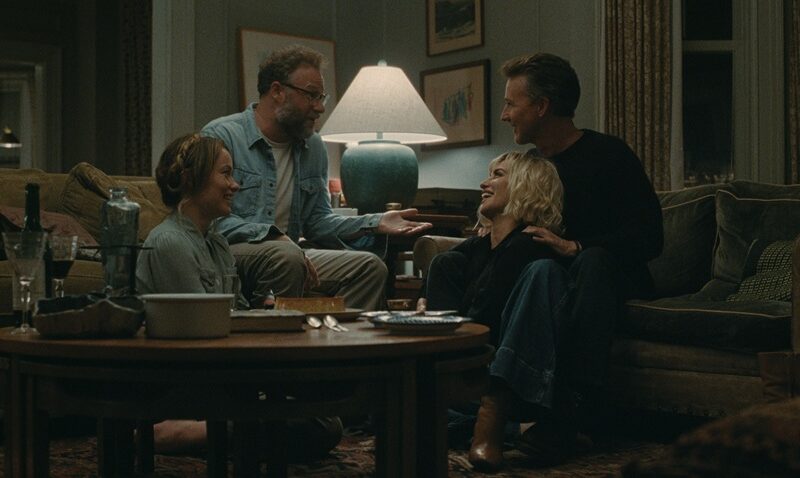
I spent most of my post-screening contemplation trying to decide if that lack of belief stemmed from writing issues or acting issues. Edward Norton and Penélope Cruz — in what I thought were more difficult roles — struck me as playing actual characters. They did not always say what I expected, but the actors found a way to deliver the lines that made me accept that a character might say what they were saying. Seth Rogen, on the other hand, felt to me like an actor I was familiar with delivering lines. Olivia Wilde was more convincing in spots than Rogen, particularly once the other couple arrived, but her character still occasionally said and did things because the plot needed her to say and do them and not because I think someone like that character would act that way.
Then again, I have never been in the situation these characters were in — that of being invited to participate in group sex. If I were in such a situation, my responses would be predicated on different backgrounds, values, and experiences than those of these characters. So I am not entirely sure where the assumptions about believability come from. The Invite is a comedy-drama hybrid, and some comedy is built on exaggeration, even farce. As a result, I am not even sure if I am supposed to find all of their responses believable.
The above probably would have been less of an issue if The Invite picked one lane (sex comedy or marital relationship drama) and stayed with it. But that blending of genres is what makes the film interesting. If all one wants to see is the final stages of an embittered marriage, one can watch Who’s Afraid of Virginia Woolf? or a Marriage Story. If one wants to see an unhappy person deal with the awkwardness of sexual attraction or availability one can rent just about any Woody Allen flick.
All that makes it sound as though I was down on the film, but I really wasn’t. I laughed fairly consistently at the middle part (the increasingly flustered responses of the protagonists as they are confronted with something outside their comfort zone), and I felt some emotion at the last act (the same couple being forced to interrogate what has led them to the point that they want the non-monogamous sexual experience). It all works…sort of. But neither the humor nor the pathos lands with the emotional impact that they would if these characters were even just a little more nuanced. Stripped of the comedy elements, the film is about as deep as an Esther Perel TED talk. Taboo subjects are broached, and there is some leaning into the awkwardness prompted by taboos, but the taboos themselves are never really explored beyond the preliminary (and obvious) admissions that is difficult to enjoy sex if you don’t like your partner and aren’t enjoying your life.
Also on the positive side, I noted a lot of small touches that one sees from confident directors, writers, or performers. I sensed that there was something going on with Wilde’s mise-en-scène, making The Invite one of those films that I honestly wished I could watch again more carefully before having to file a review. The use of editing and camera proxemics struck me as purposeful,particularly in conveying Angela’s (Wilde’s character) emotional isolation. I liked the way in which rote interactions revealed small things about characters without them always having to be verbalized. For example, even though Hawk (Norton) and Piña (Cruz) are visitors, Hawk ignores Joe’s prohibition against playing a certain record, making Joe actively rather than only just verbally, stop him. That character trait is repeated when Angela says the bedroom is not part of an apartment tour and Hawk walks right in anyway. Are these tests to see if denials of consent are rhetorical habits or sincere laying out of boundaries? Is Hawk pushing boundaries deliberately to test their limits or is he correctly intepreting half-hearted protestations as formulaic?
Other small details, though, seemed pointed enough to imply they were meaningful without really providing enough clues as to why they might be so. Why do we get one (and only one) scene outside the apartment? Is this meant to singnal that Joe is the proagonist? To give us external verification of some aspect of his personality? Is it important that Angela and Joe have a daughter even though she is never seen and rarely mentioned except to explain why she is not home?
The end of The Invite is painful with glimmers of hope, which is probably the most honest and believable part of it. It is tempting to say that the evening brought the marital issues to a head, but really it just forced them to address things that were already at a head but that Joe and Angela had been simply choosing to live with rather than to name bluntly. Or…rather…there are moments early in the film where some of the relational dynamics are addressed bluntly, but they are done so in the form of accusations and barbs that are never replied to. Their relationship is like a tennis match of all serves and no volleys. Is it credible to think that one speech from a relative stranger would be enough to get them both to say aloud what are the plain implications of their conduct? Is it plausible or possible that these characters could and would take such a painful infleciton point as the first step in a hard journey of rediscovery? Like so many of the questions The Invite made me ask, I am not sure how to answer. There is a lot of talent on display here, but its in service of a screenplay that thinks it is edgier than I thought it was and one that is ultimately less profound than some of the best episodes of In Treatment.

