
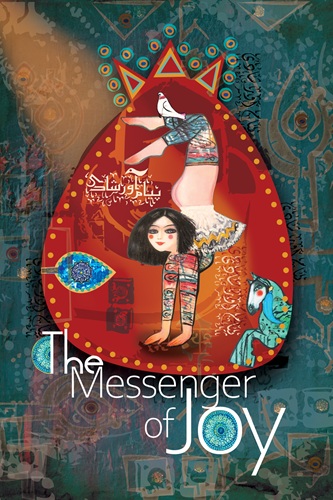
The Messenger of Joy (Kwanje, 2026)
“Hello, I’m Nasser Ovissi, and this film is about my life…”
The Messenger of Joy opts for a simple, direct introduction that is befitting its overall presentation. It succeeds at the most basic level, providing those unfamiliar with the artist’s work with a foundation from which to understand and appreciate it.
Director Alexander Kwanje and writer Mohammad Saeidian make some smart structural choices in their presentation. The first section broadly describes Persian art in order to situate Ovissi’s work in it .Subsequent sections will allow talking heads to describe later influences and developments — one calls him “the Iranian Matisse.” These discussions which can sound abstract and static on the page are overlayed with generous and apt pictures of the work itself, allowing the viewer to see the connections that the art critics are describing.
As with most films from or about Iran directed to an American audience, The Messenger of Joy has to thread a narrow needle, addressing the socio-political history that informs current Iranian culture without appearing to engage in political propaganda or commentary. Potential critiques of post-revolutionary governance in Iran are necessarily indirect, but they are present for those with ears to hear. Ossivi himself says he only studied political law in hopes that a civil service job would allow him to travel and see more art. A seminal moment of discovery comes from the father of a British friend who gifts him colored pencils. He states that encouragement of children is an attitude learned from “foreigners.” Ovissi’s Wikipedia page states that he moved to the United States after the Iranian revolution and currently lives in Virginia, but the film doesn’t emphasize that fact, presenting him more as a modern Persian than an expatriate.
It would be wrong, though, to classify the film’s (or Ovissi’s) attitude as anti-Islamic. In a key segment from the back half of the film, Ovissi’s daughter emphasizes her father’s belief that we are “all” influenced by something–our history, our surroundings, other artists. Choosing to foreground and celebrate those elements of our influence that are positive does not imply a sycophantic posture towards ones culture. Given the current state of American politics, Ovissi’s ability to project love of country and culture distinct from love of a particular administrative body is worth contemplating deeply.
The latter parts of the film also push back on criticisms that Ovissi’s work is “decorative.” It is hard to gauge whether this is meant as a legitimate criticism of an artistic style or is political dog-whistle language from parties who might reflexively reject any attempt to interject modern, Western ideas (even artistic ones) into traditional representations from older cultures. Art evolves to reflect the world around it, but the traditinoalist mindset in some religious, political, or cultural traditions would seemingly prefer that modern artists reject all change and innovation. This tension between tradition and evolution is one that faces most artists from most time periods, but an argument can be made that artists from more exacting, demanding cultures could very well feel it more keenly.
If there was a part of the film that did not quite work for me, it was the interjection of brief animated segements, sometimes inspired by the artwork. It is hard to not instinctively think of Persepolis (or even Sita Sings the Blues) here, but there is a fundamental difference beween illustrations that are inherently narrative (or part of a narrative) and illustrations turned into something else. Persepolis was a multi-media project to begin with, with movement often implied through the paneling of the graphic novel. Here the addition of movement to animated renderings feels superflous, a technique used to keep the viewer visually engaged rather than to enhance the artwork itself.
As of this writing, The Messenger of Joy does not have any release information. The film’s official homepage, under the banner of AK Films, offers links to Netflix, IMDB, and Wikipedia. Is a streaming deal in the works? For now, the film appears to be on the festival circuit, having shown in Montreal in 2025 and Toronto (TINFF not TIFF) in 2026. While waiting for distribution news, North Carolina residents can see some of Ovissi’s work at the North Carolina Museum of Art.

