
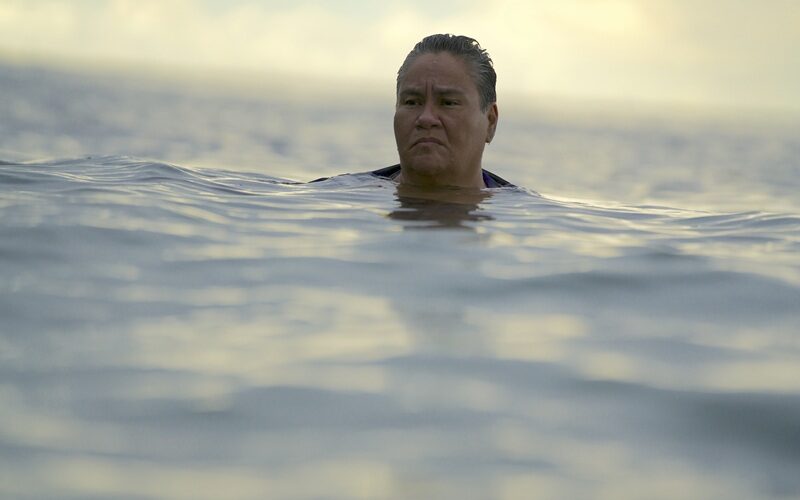
Before the Moon Falls (Bassford, 2025)
Reviewer’s note: This review contains what might be considered a plot spoiler. While I typically attempt to avoid spoilers, I was not able to meaningfully review this film without disclosing a key plot point that the film does not reveal until fairly late in its run time. I usually recommend readers see a film before reading a review or try to avoid the spoiler until a film has had ample time to find its audience. In this case, the spoiler materially alters my recommendation about the film, which is why I include it.
Before the Moon Falls begins as a starightforward profile of Samoan poet and novelist Sia Figiel. It morphs into a chronicle of mental illness after Figiel is diagonosed with bipolar disorder. Then, at the eleventh hour it abruptly becomes something entirely different: a piece of self-reflection from director Kimberlee Bassford about how Figiel’s incarceration (and eventual conviciton for murder) changes, if at all, her attitude towards the author’s work and her own portrait of that author.
It would be crass — and not entirely true — to say that this tragic turn saves the movie. It did, however, if I am honest, shift it from one that I found rote but respectable into one that I kept thinking about after the credits rolled. Rightly or wrongly, I did not have the same connection to Figiel and her work that Bassford did. (She mentions in the press notes that she fell in love with Figiel’s work during a Pacific Island Study Abroad semester.) I could (and did) respect the work on a professional level, and I agree with the tone of this first act that representation is important in the arts. But even as the gradual reveal that Figiel is biploar invites us to wrestle with the age-old question of whether the trauma the births great art justifies itself by the art’s creation, the film still cleaves to more comfortable cultural metanarratives about abuse and mental illness.
Truth is, we as a culture are far more comfortable looking at and talking about those with mental illness (and those struggling with sexual abuse trauma) as fighters or battlers whose stories are inspiring because of how they respond to the disease or trauma. Our preferred narrative is, of course, the victim who overcomes adverstity, who metaphorically “wins” the battle with disease, depression, or inner demons. I say “metaphorically” because those who literally win are few and far between, especially if we insist on framing “winning” as the total eradication of disease or the distress that results from the intial trauma. If winning is analogous to being cured (defeating a disease or disorder) what does that mean for the vast majority who manage their disatress and are able to lead functional, even thriving, lives while never being entirely free of the pain caused or intensified by their disorder?
For me, Before the Moon Falls doesn’t hit its stride until the end, when Figiel is arrested for the murder of a colleague. Bassford wisely includes two different recording of Figiel attempting to explain what happened — of being triggered by an idle remark about diabetes that made her feel as though her colleague never actually listened to her. The senselessness of this explanation almost demands it be given at first hand so that we empathize with the director’s (and friend’s) confusion. Because this portion of the film grapples with the moral implicaitons of filming rather than intervening, the points of comparison that occurred to me were Free Solo and Nyad. While there are similarities — protagonists dealing with trauma and/or mental illness; onlookers being forced to endure the often queasy thin space between inspiration and self-destuciton — a key difference is that in those films the potential for dangerous, even fatal outcomes is foregrounded. It is the source of the tension throughout, and hence the complicity of the filmmaker (or the viewer) is always present. Here Bassford purports to being blindsided by the outcome. How many viewers, if they are honest, will claim to be as well?
I am not claiming that any amoutn of proximity to a person suffering from bipolar disorder should enable a layperson to predict violence. I am saying that Bassford’s situation at the end of the film comes with its own pathos. The story of the friend or colleague or acquaintance trying to live with and understand the person scarred by trauma or suffering from a mental disorder is more relataable to me than the story of the film’s subject. Bassford is not, I think, asking anyone to feel sorry for her– and neither am I. Having one’s passion project get derailed by another’s mental disorder is not in the same ballpark as being the actual victim of that person’s violence. But…Bassford invested nine years of her life in that project, and anyone who has expended significant time, energy, or money on a relationship, be it with a friend, family member, spouse, or colleague, only to watch that relationship die as the result of actions from the other party can be excused for feeling something akin to mourning.
I belabor this point in case Bassford comes into criticism for being opportunistic or is somehow accused of exploiting Figiel’s tragedy. Yes, the film needed an ending, and the cynical might pearl-clutch at the reporter calling the prison to get one last quote from her subject before the waves of life separate them completely. But there was, I thought, something brave or at least something important in the director’s final words — an attempt to reach Fiegel not just with an assurance of her own love but also with a message of mourning. Figiel’s victim did not deserve to die. In those scenes, Before the Moon Falls elicits memories of similar exchanges between Sister Helen Prejean and the man (or men, in the book) she spiritually counseled in Dead Man Walking. If we absolve the perpetrators of violence without remembering (and requiring them to face) the suffering they caused as well as the suffering they endured, we rob them of their agency and their humanity.
A century from now, it seems possible that if Figiel is remembered at all it will be for the good she did, for giving voice to people who didn’t have one. For creating art that inspired and encouraged those who read it. I am okay with that, I think. But I am not sure. How does one measure…can one measure…the value of thousands being strengthened, inspired, and enlightened against the life of even a single innocent victim? Figiel would not have been the person she was, would not have developed the powerful voice she had, apart from her experience of sexual abuse. But that does not mean the abuse was good or should even be tolerated. Bassford’s work would not be as complex or rich as it is if it did not recognize the agonizing contradiciton that Dr. Caroline Sinavaiana-Gabbard, Figiel’s victim, is not merely a footnote in the novelist’s biography, but may actually be a living embodiment of a truth that lies at the heart of it.

