
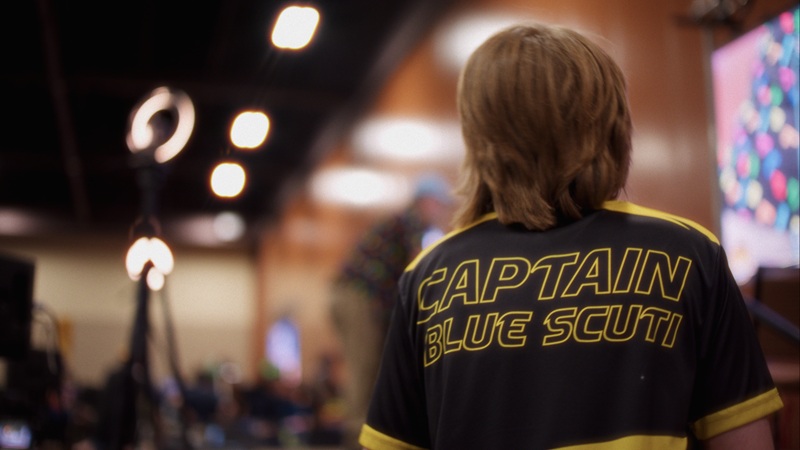
Blue Scuti: Tetris Crasher (Moukarbel, 2025)
There are two very different movies, each with potential, that could be formed around this footage and subject matter. The one that I was more interested in and that the film’s trailer and title seemed to promise, is a serious philosophical examination about fate, determinism, and human interaction with machines as the non-living embodiments of unchangeable fact. The other is a routine “who will win?” sports chronicle of the Tetris World Champtionship.
That Blue Scuti: Tetris Crasher begins as the former and morphs into the latter is not in itself disqualifying. Some of my favorite documentaries of all time (Shut Up and Sing!; The Queen of Versailles) make mid-movie pivots when life itself disrupts the anticipated script that made the documentarian show up in the first place. And it is not as though tournament highlights is a format devoid of entertainment value. Even non-sports films such as Boys State or Cookie Queens use the structural anchor of some sort of competition to track multiple participants and create an artificial but real sense of drama around the revelation of the eventual winners.
But here the problem is not just that the film isn’t sure which genre lane it wants to drive in, it is also that it fails to execute either plan particularly well. The subtitle suggests that defeating (or “crashing”) Tetris is the more significant achievement, but the lead up to that happening is brief and the reflections on its significance are severely limited. The crash itself is at around the fortieth minute, and any tension about it is bizarrely undercut by a series of player vignettes that inform you who was the second or fourth player to crash Tetris before we see the first. It doesn’t help either half that the most thoughtful and camera-ready player is not Blue Scuti (a Stillwater teen named Willis Gibson) but one of his competitors, Fractal. As the film slowly marches towards the World Championship we get smatterings of interviews with the other players, but nothing like the full backstory we get for Scuit.
That backstory is dramatic, after a fashion. Warm-up tournaments are played against the backdrop of a father’s illness, which makes it easy enough to root for the protagonist. The thing about sports, though, is that you can’t script tomorrow’s game. So when the World Championship does not go according to plan the crashing achievement is a distant memory and the film doesn’t have any place to pivot to for climactic tension or narrative meaning. This is particularly at issue here because there is no dramatic tension in the games themselves. I have seen YouTube channels devoted to Tetris that have been more informative and clearer about how the “rolling” technique developed and were able to parse out the exposition so that the dramatic moments in a game — as it approached a kill level — could be understood even if one didn’t play the game. Here we get crowd shots of parents cheering and an announcer telling rather than showing that someone is behind. Most sports don’t work on radio precisely because it takes a very skilled announcer to describe what is happening in real time.
Ultimately, Blue Scuti: Tetris Crasher is pleasnt to watch as the players are all either young enough or on well-behaved enough to make you not care who wins. These players invest insane amounts of time and energy at repetitive tasks waiting in order to make incremental improvements. One might even argue that since there is an element of randomness in how the shapes of the pieces are given to the players, once a certain threshold of speed is reached those incremental improvements are determined as much by luck (or brute force time spent) than honed skill. The crazy thing is that in competition they are all so close to optimal that a title — the best — that might more accurately be decided over a larger sample size is determined over a best of five match. A knock-out tournament bracket adds additional levels of randomness since even if the better player has an off-round, there is no guarantee that he will do so against a competitor close enough in skill and technique to take advantage of it. In such an environment — where luck is not determinative but has a more noticeable impact than in some other competitions — it is interesting who the teens are able to retain a degree of sportsmanship and good will even in the face of an environment that is cruelly indifferent to merit, effort, or desire. There are lessons to be learned from the players and a viewer would have to be fairly jaded to get none of them. But the film leaves a lot of meat on the bone.

