
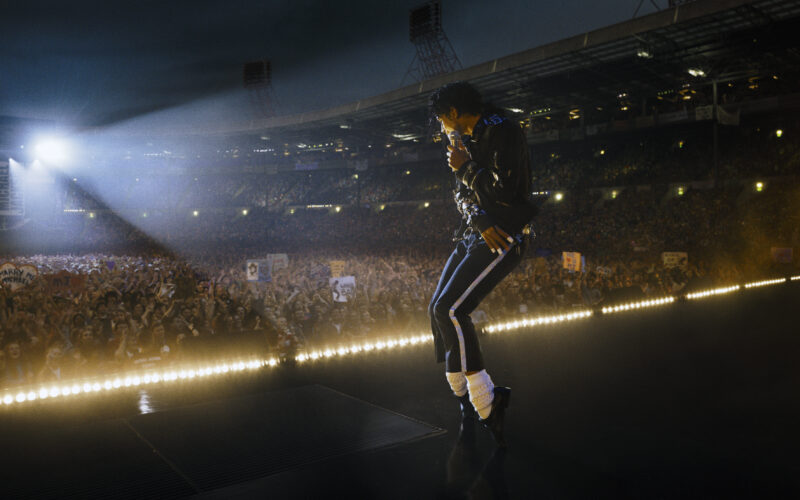
Michael (Fuqua, 2026)
Every story of Michael Jackson’s life does not need to begin and end with the reported fact that he agreed to a $23 million settlement to someone who accused him of child sexual abuse. But any story of his life that elides that chapter altogether comes across to me as lacking moral seriousness or integrity.
Whether that lack of seriousness will hurt the movie with its target audience remains to be seen. The preview audience I saw the film with sang along with the concert footage, cheered at the tortured fanfic moments, jeered at Colman Domingo’s cartoonishly evil (yet paradoxically impotent) portrayal of Joe Jackson, and stayed in the their seats, clapping, through most of the credits. It’s hard for me to believe that none of them knew any of the details about Jackson’s life that the film refuses to address; it’s much easier to assume they didn’t care. And that made sitting through MIchael about as much fun as sitting in the back row of a Trump rally when he goes on one of his anti-press screeds.
It has been widely reported that some version of the screenplay and perhaps even some scenes shot but left on the cutting-room floor did address these accusations, unsurprisingly accepting Jackson’s own denials and channeling the family’s/estate’s interpretation that his accuser(s) expolited naive peculiarities for money. I leave it to readers as yet uninformed about those allegations to track down Leaving Neverland on their own.
Again, my point is not to replay the arguments for and against Jackson’s guilt, but to make a narrower claim that the radioactivity of the charges pulsates through every second of the movie even if it ends abruptly prior to the events leading to those charges. Had the film included those charges to attempt to refute them, I might not have agreed with the stance, but I would have respected it more. For over 2,000 years drama has sought to deliver what Aristotle described as unity of character — the credible portrayal of a character whose actions are, if not rigidly consistent, at least contextually plausible. For this reason, the skittishness about the abuse allegations is just the biggest example of a larger skittishness about saying anything definitive regarding its subject. One might even argue that the film is aware of its own inability to portray a coherent characterization, giving Jackson a line about wanting to be “mysterious” at a key moment.
The word “mystery” is not a writer’s get-out-of-jail-free card, though, and there is a difference between a character whose motivations are not clear to you and one whose actions and assertions are in tension with one another. Michael is on the one hand, a scared, abused child himself, cowering in the bathroom after being whipped with a belt by his bitterly angry father. Yet the film also insists that he is a forceful, determined, and resilient entrepeneur who stands up for himself…except when he doesn’t. The film shows the cause of Jackson’s severe scalp burn but declines to include his later, public admission that he was addicted to painkillers. In the film, Michael says he does not want painkillers only to have his doctor insist. That scene becomes an epitome for the movie’s overall approach to its subject…let’s explain why its not really his fault while assiduously not mentioning what we are saying is not his fault less the knowledge of what’s been omitted detracts from the audience’s ability to accept and enjoy the story as given. MIchael shouldn’t be blamed for selling his music to Pepsi, since that was his father’s influence, but he should get credit for getting Black artist’s on MTV.
I will concede that the film pops with energy in its concert footage, but even here I wonder who it is for. I will watch Jackson’s iconic Motown special performance on YouTube every now and then, and my jaw still drops at the moonwalk even if I know it is coming. Because the quality of Jackson as a performer is the one thing nobody disputes, the film’s best part may be the “making of” vignette as he walks various dancers through the making of the “Beat It” video. But even here, Michael didn’t increase my esteem for or enjoyment of that classic music video so much as make me anxcious for the biopic to be over so that I could go home and consume the real thing.
P.S. The line “it doesn’t matter whose wrong or right, just beat it” sure lands differently than it did forty years ago.


I think you’re overlooking a pretty important reality here: anything related to those allegations is tied up in serious legal constraints, especially when it comes to a film backed by the estate. It’s not simply a creative choice of “let’s ignore it,” it’s about what can and cannot be portrayed without opening the door to legal consequences. As a serious film critic, that’s something you should at least acknowledge before framing it as a lack of “moral integrity.”
Also, a good film doesn’t need to lean on controversy or sensationalism to have value. Michael, starring Jaafar Jackson, chooses to focus on the artistry, legacy, and personal journey of Michael Jackson—which is a completely valid creative direction, especially for a biopic centered on his music and cultural impact.
You’re essentially criticizing the film for not being the version you personally wanted, rather than evaluating what it actually set out to do. Not every portrayal has to relitigate decades-old accusations to be considered “serious.” And honestly, reducing the entire value of the film to what it omits says more about your expectations than the film itself.
At some point it starts to feel less like critique and more like you came in determined not to like it.