
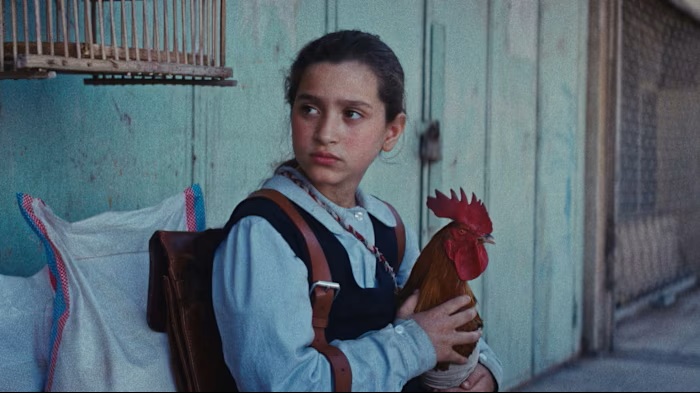
The President’s Cake (Hadi, 2025)
For the first thirty minutes or so, The President’s Cake sets up its premise — that an Iraqi girl must overcome poverty and food shortages fueled by economic sanctions against her country to bake a cake in honor of Saddam Hussein’s birthday — with a polished, almost commercial efficiency.
That very efficiency may undercut some of it’s power, since it doesn’t feel like a first feature. And, to be honest, it feels vaguely familiar at times . . .like an Iraqi cross between Where is The Friend’s House, Germany Year Zero, and Osama, with a touch of The Hunger Games thrown in.
But at that half-hour mark, the film took what was for me an unexpected turn and became about something more than navigating poverty or surviving harsh conditions. Or rather, it remained about those themes but broadened its scope beyond the focused incident of the cake to make it clear that this was simply one local manifestation of a deeper, pervasive problem that touched nearly everyone alive and trying to remain so in such a harsh environment.
The film is elevated by one of those absolutely remarkable child performances that the medium seems to provide with more frequency than one would think possible. Baneen Ahmad Nayyef plays Lamia, the girl who is selected by lottery to provide the titular cake for her class despite the fact that food is rationed so severely that that the cost of any one of the cake’s ingredients would bankrupt most families. Lamia goes to school with an apple, a special windfall of the day that she forgets to eat before school and is promptly confiscated by an adult soldier.
The terrorizing and indoctrinating of the children is appropriately dismaying and heartbreaking, especially since Lamia has not yet lost all of her innocence or all of her fight. I have seen some reviews that knock the film for this — and, indeed if the she remained static throughout the film, I might have objected to that most Romantic of all tropes–that a child’s moral innocence insulates her (or him) from suffering. But as the film progresses, we see that although harsh conditions can be pervasive, they don’t always land evenly on everyone within harsh environments.
I don’t want to give away too much of the plot that unfolds after Lamia and her Bibi go to Baghdad, ostensibly to sell family heirlooms in exchange for the ingredients to make the cake. How Hadi as a writer opens up the narrative is one of the things I appreciated about his approach, and the film is the better for the script’s patience in revealing the adults to the children — and to us.
The work The President’s Cake most reminded me of was, oddly enough, Barbara Ehrenreich’s Nickel and Dimed, not because Lamia was undercover but because we, as observers are, and because Ehrenreich stated the reason she went undercover is to test the lazy assumption that there is a secret survival talent of the poor that is magically and mysteriously unlocked by necessity. Necessity is the mother of invention, but that does not mean that invention can and always will be able to solve whatever problem is before it. It does mean that humans will press forward, will try, no matter how impossible the task. Sometimes, as in The Martian, reducing the impossible to a series of small problems can lead us out of the labyrinth of hopelessness. Sometimes, as in The Pursuit of Happyness, we are told that being stretched beyond our capacity in the short term can buy us enough forward progress the we are able to win long-term gains as a result of temporary sacrifices.
But let’s be real. Too long a sacrifice makes a stone of the heart. Sometimes the universe, our leaders, and even those who genuinely love us, are forced to be indifferent to our suffering and force us to be indifferent to that of others. The very things that keep The President’s Cake from being a weay slog good for little more than increasing first world guilt — it’s light touch and endearsing heroine — might make it seem fake to the most cynical viewers.
Ultimately, I appreciated the film for not oversentimentalizing some of the most difficult decisions people in such circumstances face.

