
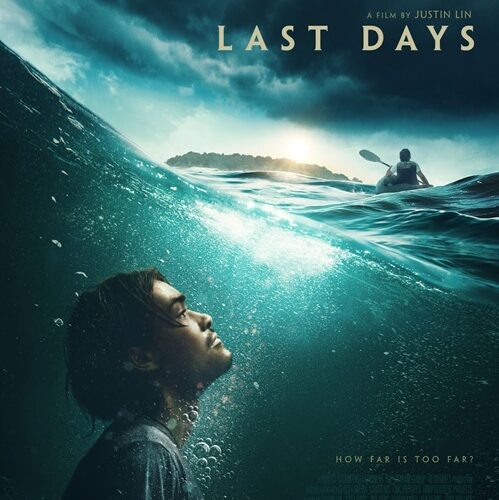
Last Days (Lin, 2025)
I was mostly ambivalent about The Mission, the 2023 documentary chronicling the attempts of John Chau to evangelize the occupants of North Sentinel Island despite access to the island being forbidden. I thought that instead of telling John Chau’s story, it used that story as a case study to debate the ethics and propriety of mission work in general.
Justin Lin’s film surprised me by having more scope and, despite it being a narrative, more balance. There are characters within the film who are critical of John personally and the subculture that helped create him and egged him on in his desire to climb the “Mount Everest” of mission work. His father and an Indian police woman are two characters in the film that voice that point of view. But their perspective is balanced by the script’s portrait of John and an award-worthy performance of him by Sky Yang.
John here comes off less as a zealot and more as a seeker. Like some spiritual cousin of Chris McCandless from Into the Wild, he longs for authenticity while being surrounded at every turn by people more ready to tell him how to live his life than to practice what they preach. An assembly full of students at Oral Roberts light candles to symbolize their commitment to missions, and John berates himself for not being willing to let his mouth write checks his soul might not be able to cash. A flirtatious missionary pilot practically challenges his manhood by dividing the missionary world into tedious representatives of corporate agencies who hand out water bottles and those willing to do…more. (Guess which kind she bats her doe eyes at.)
One of the film’s best achievements is the way it presents those escalating calls to do more, give more, risk more, not as seductions but as empty promises. The film absolutely nails what it is like to be a Christian of a certain age, weaned on and taking to heart instructions about how God rewards and responds to our devotion, and assuming that our failure to feel His blessing or presence must indicate some deficiency in our effort or understanding. That achievement is all the more impressive given that director Justin Lin (see interview) does not consider himself religious. But maybe that slight distance is what allows Lin and screenwriter Ben Ripley to have compassion for John. I find it fascinating that Lin said in an interview that when he heard about Chau’s story for the first time his immediate reaction was to judge and dismiss him. After reading Alex Perry’s The Last Day’s of John Allen Chau, Lin began to become more interested in seeing and telling Last Days as a portrait of John, a complex and conflicted human being, rather than as a referendum on the ethics or sensibility of his last and most controversial life choices.
It is also to the film’s credit that it acknowledges those most critical of Chau are not entirely without their own struggles to speak, act, and love authentically. An Indian police “sub-inspector” claims to be outraged on behalf of the North Sentinelese who, she self-righteously declares, just want the freedom to be who they are. Yet her hatred of Chau and the religion he represents may have more to do with religious intolerance she has experienced from others and is making John a scapegoat for. John’s own father, played brilliantly by Ken Leung, blames religious extremists for poisoning John’s mind, while insisting that he (and John’s mother) have “always” supported John. Most of the first act centers around John trying to tell his father, without much success, that he does not wish to attend Medical School. Dad is not a bad man. He is portrayed as a loving father who is gutted by his son’s fate, and I am not trying to say otherwise. But in a film about how difficult it is to live up to what we say we believe, nobody is immune from shading their personal truth a little in one direction or another to help them ease the pain.
The film’s final third is both the most interesting and the most painful because it takes place after an initial, failed encounter with the North Sentinelese. Will John go back? Most people who see the movie will already know how it ends, but the reasons why John makes the choices he does here hint that another ending might have been possible. Great movies are usually about more than one thing, and great tragedies are usually caused by more than one choice. Those most prone to condemn or ridicule John, I think, seem to want to believe he is driven exclusively by a desire for glory. A fellow missionary tells him early in the movie, “I see you…you want to be that hero.” And there are unquestionably elements of that motivation presented in the film. But…the last act appears to show John motivated by something even deeper, a desire, a need, to have his actions makes sense, to fit into a plan, ordained by God, that is discernible to humans.
For how can someone be what he claims to long to be — obedient to God — if God’s commands are not comprehensible, decipherable, and clear? For a painful minute we see the possibility of Isaac’s hand being stayed at the last moment, of one’s obedience being enough to appease God, of Him being so pleased by the willingness to sacrifice that He relents in demanding it. But such a narrative would would still only make sense to John (in the movie) if it led to his true path, his true purpose. He couldn’t be wrong about God wanting him to go to North Sentinel, but maybe, just maybe, could he have jumped to the wrong conclusion about why God wanted him to do so and what God was hoping to accomplish? The psychological term for what I am convinced the film is trying to depict in its last act is called “sublimation” — substituting a more accessible goal or desire for a more dangerous or taboo one. John flirts with the idea that evangelism is the highest calling but that his purpose might be to evangelize someone (or someones) other than the North Sentinelese. The problem is that the person he attempts to redirect his evangelical zeal toward is no more receptive to it than are the North Sentinelese.
If that sounds like I am blaming the person who rejected John for sealing his fate, I am absolutely not. The scene is crucial, thematically, because it accomplishes something The Mission never does — it makes the question of evangelism a personal rather than anthropological one. To see one’s only purpose as evangelism, as noble as one might think that makes one, is to treat others, individually or corporately, as means rather than ends, as metrics through which God measures your love for Him and expresses His love to you. Never as autonomous beings in their own right. In the film’s opening scene, John tells the faceless, unidentifiable North Sentinelese on the beach, “I love you.” Throughout the film there are characters who challenge that assertion on a broad, anthropological and social level. How can love result in such devastating social upheaval? When has missionary work prompted by “love” improved the standard of living for those who received it? These arguments are partially defanged by their abstract nature and because they, right or wrong, presume to speak for the North Sentinelese. The characters who voice them are often doing the very thing they accuse John of, which is assuming they know what is best for others. The retort to “I love them” that finally lands hardest is “You don’t even know them!” Is it possible to love that which you don’t know? Perhaps, but I am skeptical. To the extent that love, true love (whatever that means) involves honoring another’s autonomy, wishes, and choices for themselves, probably not.
Am I convinced or confirmed in my judgments about John Chau? Far from it. For me, the excellence of the film is not that it presented a convincing argument or made a bullet-and-arrow-proof case for or against mission work. It was that by refusing to make judgments of its own, it invited me to look more honestly and openly, challenge some of my own assumptions, and, most of all, have empathy and compassion for those who think and act differently from how I suspect I would in the same situation.
Bonus Content — Check out Ken’s interview with Justin Lin by clicking below:

