
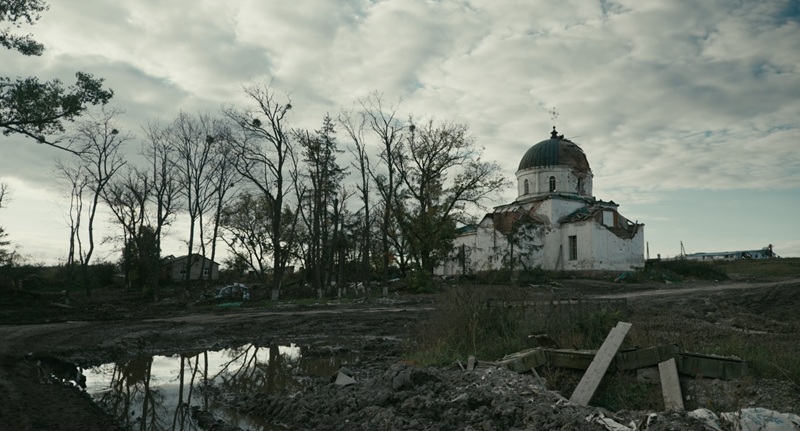
Divia (Hreshko, 2025)
It is hard for me to evaluate Divia, since the element I value most in films, narrative, is at best implied and at worst totally absent.
The film’s notes describe it as a “meditative, sound-driven journey.” I tend to think of film as a visual medium, so I interpret “sound-driven” as a euphemism for “without dialogue.” Being without a voice-over is not an inherently bad feature of a meditative film, but it was hard for me to shake the impression that here “sound-driven” was a tacit admission that the images themselves were insufficient to communicate meaning.
The journey is through Ukraine, and it consists of images of that landscape “before, during, and beyond” that country’s invasion. On a very basic level, one can see and affirm the film’s thesis — that war is bad for the environment. The juxtaposition of wildlife, vegetation, and human activity with dead carcasses and abandoned instruments of warfare is hard to misread. But such a point is made in the first ten to fifteen minutes, and the film stretches out over seventy-nine.
The problem with the length and format is not merely that it makes it harder for the viewer to remain engaged (although it does) but also that it ultimately muddies even that basic message. On the one hand, director Dmyto Hreshko says in his Director’s Statement that he is “documenting the Russian military’s eco-crimes.” At the same time, the film’s press materials state that the film illustrates “renewal” and “regeneration.” The director claims that neglecting “environmental concerns” (which he says might not be a primary focus of Ukrainians amidst “pressing issues”) could pose a greater threat to Ukrainian lives than “anticipated.” It is difficult to see the images and emphasis on environmental resilience and renewal as not being in tension with the more alarmist messaging accompanying the film.
Hreshko also states that the title “Divia” serves as a “symbol of the ancient Slavic goddess of nature and all living things.” I could not find any references online to a Slavic goddess named Divia, though there is one called “Devana” mentioned on Wikipedia, so it is unclear whether the film’s title is meant to be directly symbolic or merely associative.
In an interview with Filmmaker Magazine, Hreshko says the the origin of the film came from noticing “littered garbage” on the outskirts of Kiev, and how this was just one example of the “impact of humans on Ukraine’s environment.” He concedes, however, that “It would be strange to make a film about Ukrainians harming nature during wartime.” The evolution of the project from a general one about humans impacting the landscape to a more specific one about “the Russian military’s eco-crimes” does raise some questions about whether Divia represents the vision of the filmmaker or the interests of its financiers. As a part of a larger meditation on different ways humans impact their surroundings, the footage might have been more effective. Though Jennifer Baichwal’s Manufactured Landscapes has already treated that general theme brilliantly, there was/is probably room to explore the Russian invasion of Ukraine as a part of that larger theme. But as an extended meditation on a more focused subject, the film fails to move the viewer beyond the broad claim, which most probably already assented to, that war is bad, not just for the people living on earth, but for the earth itself.

