
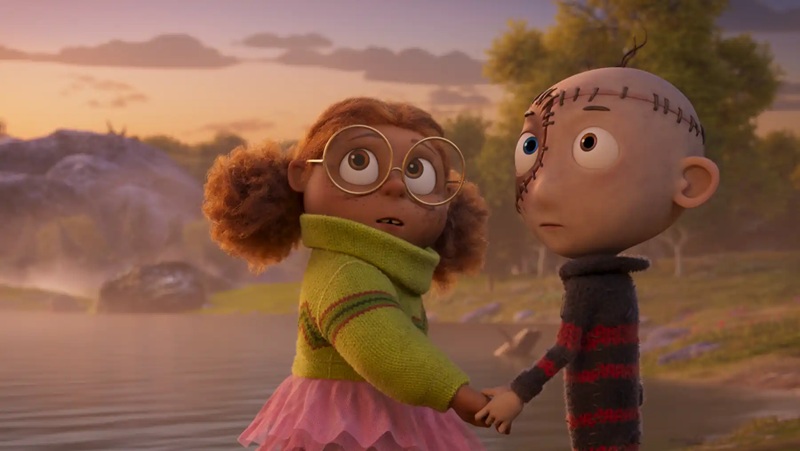
Stitch Head (Hudson, 2025)
The first twenty minutes of Stitch Head is just sublime. In terms of art design, story set-up, and characterization, it is on par with the better Pixar films. The titular tyke is the first creation of the Mad Professor living above Grubbers Nubbin. Like the eldest child of a self-absorbed parent Stich Head vacillates between assisting the professor that hardly notices him and caring for each new creature born scared and confused into a world it hardly understands. He reads the other monsters stories, assures them he is and will remain their bestest best friend, and, most importantly, warns them that if they act too much like the monsters they are, they risk the humans in the valley below them forming an angry mob.
To be honest, the second half of the movie is never quite able to capitalize on the most poignant and interesting themes in the set-up. Once Stich Head leaves the castle to join the carnival, the world building is far more generic and the story grinds to a crawl. There are echoes of Pinocchio as the protagonist finds he is being exploited — that not all attention is good attention. But the mash up of Pinocchio and Frankenstein is hit-or-miss in part because in the Disney movie the protagonist’s vulnerability to exploitation is driven by naivete. Stitch Head’s loneliness is fueled by neglect from his surrogate parent. He can’t extract the same lessons from running away from home, because he does not have the same lessons to learn.
If the middle dilutes the film’s overall impact, it does not entirely blunt the effectiveness of the end or hurt the film too much beyond my downgrading it from “great” to “very good.” Feeling as though one is a freak or a monster is, I would imagine, fairly common to kids of all generations. Given the rise of social media, the idea of being on display for the world to scorn or laugh at is one that I suspect the current target audience can relate to as well.
Obviously, Stitch Head’s situation relative to the other creations invites comparison to kids who see the birth of new siblings changing their understanding of and relation to their parents — perhaps one of the scariest awakenings a child can negotiate. But as with all Frankenstein stories, there’s a God/Human metaphor at play too, isn’t there? I suspect that archetypal connection will give (or could give) the film a bit more emotional impact to adults than what we feel at most kid’s movies. After all, fears of being alone in the world, or abandoned by our “creator,” are not-specific to one age group. Watching the Mad Professor serially repeat, “YOU will be my greatest creation!” one cannot help but recognize the source of Stitch Head’s desperate hope that if he can make himself seen, he will be loved. Rare is the kid’s film that asks us not just to pity or sympathize with the misunderstood soul that is acting out but also the faithful but hurting good kid who is trying to earn what should always, ever only be given freely.
Perhaps because it does so many things well, I was not a fan of the way the film dispenses with the main villain, Fulbert Freakfinder, at the end. In the a film that reminds us of that monsters are often not as monstrous as fear makes them out to be, his fate seemed a little unnecessarily over-the-top, something that would be more at home in a Looney Tunes cartoon than in a morally serious animated bildungsroman.
Caveats aside, Stitch Head is a solid piece of work, and it is exciting to see GFM (Good Family Movies) enter the family movie space with something a project that is a little more ambitious than singing trolls or bank robbing animals.

