
I did freelance movie reviews for a major evangelical magazine for about a decade, so needless to say, I have been pitched a lot of Christian movies for review consideration. Most have not been very good. So much so that when I stopped writing for that outlet, one silver lining was that I could be more selective about what I chose to review. I got very good at finding ways of telling people who thought they were being discriminated against because they were Christian that they were mostly getting bad reviews because they were making bad movies. It took a lot of work at times to remember that the Christian admonition to “speak the truth” included the rider “with love.”
All of which is to say that when the rare Christian film comes along that I can sincerely and honestly praise, that clears not just the lower bar that cultural arbiters sometimes allow for artifacts of their own tribe but the expectations one would have for any movie, I get a little suspicious of my own response. In the case of The Charitable Sisterhood of Second Trinity Victory Church, I had to show it to a family member who grew up in southwest Virginia (the setting of the film) during the 1970s (the time it is set). Her endorsement gave me more confidence in my initial impression — that the film is one of the best Christian genre films I have seen.
A word about terminology. I have defined a “Christian” film elsewhere as one which, at minimum, answers two of the following questions affirmatively: is it made by Christians?; is it about Christians?; is it marketed specifically to Christians? The last question is usually the acid test, since the genre as it currently exists is usually the product or artistic descendent of Christian production companies that became more common in the wake of Mel Gibson’s The Passion of the Christ and after Michael Medved’s Hollywood vs. America. Those companies’ raison d’être stemmed from the belief channeled in Medved’s book that mainstream, commercial studio films had an anti-religious bias and the evidence provided by Gibson’s film that Christian viewers were an untapped audience that could make films that met their approval extremely profitable.
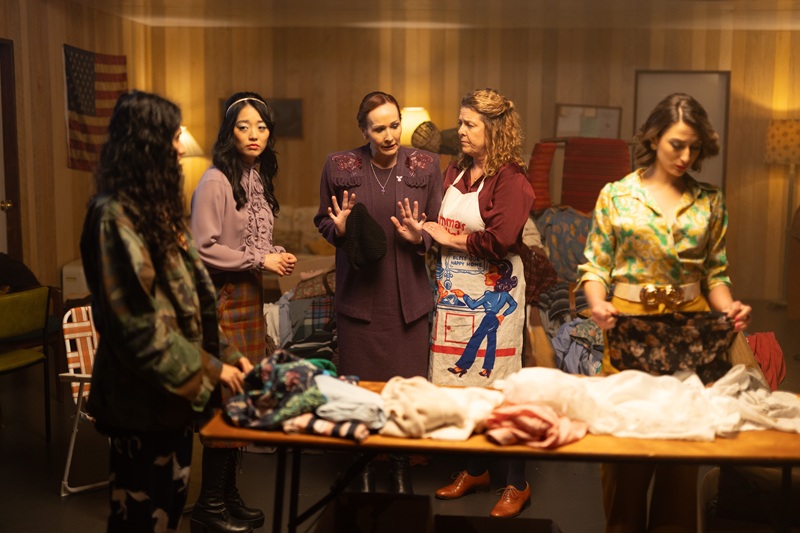
Of course The Charitable Sisterhood doesn’t fit that description exactly. It is made by Australians for one. But the film is part of a platform called Eternal Entertainment, a service that lets viewers sign up for free accounts to stream Christian-themed films and programs. Each film has a “Give” button where viewers can contribute to artists and filmmakers whose work they appreciate. With microbudgets to work with, the creatives who made Sisterhood were looking for single-set plays with a small cast. They settled on Bo Wilson’s 2014 play about women in a church basement sorting through donations to a charity drive. Director Dean Owen-Sims found a middle ground between shooting it as a play, which would limit camera locations and shots, and shooting it like a traditional movie, which would break up the rhythm of scenes and diffuse the intimacy the script requires. He allowed the performers to rehearse and perform it as a play, with single, continuous takes, while placing cameras in different spots over three different renditions so that the editors could choose the takes that worked best. The result is a film that is never visually static despite the limited composition elements and which showcases the performers, who are very much up to the challenge.
I am hardly the only critic or who thinks that writing is usually the weakest element of Christian productions. The isolationist tendencies and rigidity of moral thinking in Christian subcultures can make films (or novels) offered as realism come across as, at best, arrogant, at worst, hopelessly deluded. The first thing I noticed about Charitable Sisterhood is that while the characters were quickly recognizable as types, they had depth and nuance often missing in such productions. Within the first five minutes, for example, I noted that Lorraine (Libby Fleming) referred to the donations as “crap” that had to be sorted through, while checking her more crude language once Bea, the more upright and uptight pastor’s wife arrives. When the inner-circle gossips about the way Janet, a newcomer, dresses, Lorraine also admits, “If I had a body like that…”
None of these exchanges are shockingly out of character. Even when they cuss, they use euphemisms. But the film understands better than most films about Christian characters how much of church personality is performative. These women aren’t hypocrites; they are not entirely different behind closed doors from what they show in more public moments. But they feel the pressure of expectations and they welcome the small spaces where they can let their constant vigilance lag and be their more authentic selves. Libby recognizes and resents the privileges of patriarchy without becoming anti-marriage or anti-men. She doesn’t want a matriarchal society, just the occasional break from the constant chores assigned to mothers specifically and women more generally.
Bea is bossy, but — and I can’t stress how important this was for me in appreciating the film — she is sincere. At one point, when her temper gets the better of her, Bea crosses over from catty to nasty, and she is checked by Libby. She apologizes — not for everything, but for what she knows is wrong. When the chips are down, each of the characters is motivated by their individual and collective values and seek to act on them. To be a film about Christians that is embraced by Christian viewers, films do not need to present their characters as perfect saints. Making them authentic in their faith is enough.
I haven’t said much about the plot. It turns in the middle of the first act with the discovery that two of the women are not who or what they claim to be. As the sisterhood decides what, if anything, to do with the discovery of their neighbors’ secret sins, the interpersonal dynamics shift in ways that are genuinely interesting. One of the women is carrying unresolved grief, another a terrible burden of guilt. When the latter is discovered it leads to some powerful introspection about different kinds of self-righteousness and morality. In one of my favorite film scenes of the year, Janet triumphantly tells Bea, “I told you!” when another woman’s secret is fully revealed only to have Bea reply, “And I heard you.” The ice in actress Kathryn Harmon’s voice when she delivers that line is about as perfect a line delivery as you could ask for from someone trying to convey contempt at someone glorying in another’s misfortune.
Perhaps the underlying, foundational concern for the suffering person that lies in the hearts of these characters is what makes the film so very special for Christian viewers. Institutionalized religion can warp or suppress our best impulses, but it can also fan into flame some of our weak but true virtues. From the viewpoint of this observer in the pews, we have lived a decade or more in a world where people claiming to be Christians have seemed to justify cruelty, reveled in having power over the least of these, and convinced themselves that they were honoring God in so doing. Any film that reminds us that true charity comes from the heart and results in loving our neighbor rather asserting our superiority to her is a welcome addition to the Christian film genre.
I also appreciated that the film’s resolution recognized the complexity of living in the world, rejecting cheap grace answers in favor of recognition that true Christian charity sometimes calls for more than the donation of an unused water ski or a shabby coat one has outgrown. Sometimes the needs of our neighbors exceed what can be solved by tossing a few dollars into the collection plate. Many who will give money will balk at giving time, attention, or empathy.
Viewers who haven’t watched a lot of low budget Christian fare might be surprised, if they watch this, to have a film this cheaply and quickly made praised so highly. As with sports, though, a bigger budget doesn’t always mean a better product on the field (or the screen). Just as we are cautioned not to judge the person in the pew next to us by whether her coat was bought on 5th Avenue or The Salvation Army, so too we should learn to look deeper than the surface polish of our art. He who has ears to hear, let him hear.

