
Are You There God? It’s Me, Margaret (Craig, 2023)
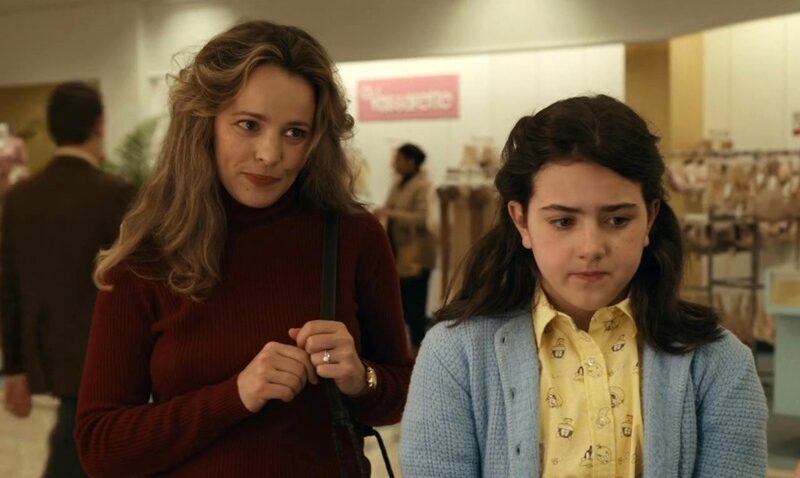
There is an exchange between Margaret (Abby Ryder Fortson) and her mom, Barbara (Rachel McAdams) in the opening scene of Kelly Fremont Craig’s adaptation of Judy Blume’s novel that deviates slightly but significantly from its source material.Margaret, upon hearing of her family’s plans to move from the city to suburban New Jersey complains about the move, and mom attempts to console her by letting her know the move means that she can quit her job as an art teacher to be a stay-at-home mom. The guilt of not having more time to spend with her daughter has been hard on her, and this move will alleviate it. “But you love teaching art!” Margaret laments.
My uneasiness on a first viewing is that this exchange seemed to pointedly take the focus away from Margaret and make the story as much Barbara’s as hers. There was an important point conveyed here (more on that in a second) but that point struck me as anachronistic in a film that was otherwise striving for 1970s period detail. In the book, Chapter One begins after the move, so we get only Margaret’s characterization of the move rather than watching it play out. And eleven year-olds are not always reliable narrators.
That last point is important because in the book Margaret characterizes her understanding of the reasons for the move as for mom’s pleasure/convenience, even if they are at her child’s (and husband’s) expense. New Jersey is better becasuse dad “could commte to his job in Manhattan.” Since when is a commute a plus? It is better because Margaret “could go to public school” even though she doesn’t want to. Finally, though, it is a place where mom “could have all the grass, trees and flowers she ever wanted.” Margaret, the narrator adds, “I never knew she wanted that stuff in the first place.”
In other words, in the opening chapter Margaret implies that they are moving for mom — that she and dad are sacrificing their own desires for something that Barbara wants. Kelly Fremon Craig, who also wrote the screenplay, implies that mom is herself ambivalent about the move, highlighting as positives things she may not want “in the first place”in order to model for her daughter the positive attitude required of most women in patriarchal socieities. I don’t have an issue with this interpretation; it strikes me as almost certainly correct. But I think it is significant that Blume has Margaret — at least in the first chapter — fail to see it that way.
One might argue that since the novel is a bildungsroman, Margaret only comes to understand her mother’s (and her own) place in the patriarchy upon maturity. But Margaret, even at the end of the novel, appears to still be stuck in a blaming mode. In her report about religion to her teacher, Margaret says that “if I should ever have children I will tell them what religion they are so they can start learning about it at an early age.” She adds, “Twelve is very late to learn.” Allowing Margaret to choose her own religion, like allowing her to go to public school, is perceived by her (and perhaps by most readers) as something she is told is for her benefit but which is actually for her parents’ benefit — they don’t have to face the discomfort of making a contentious decision.
If such a reading feels unduly harsh towards Barbara, I don’t disagree. The adult Blume may very well see as clearly as the adult Craig does that Barbara has so normalized and internalized the patriarchal expectations of her society that she she is forever taking the blame for things not her fault. Some as yet uneradicated part of her self, can’t bring herself to justify things to her daughter by saying, “Because that’s just the way things are.” Beyond that, though, Blume is brave enough as a writer to remain committed to Margaret’s 11-12 year-old consciousness, even if doing so risks never making manifest through epiphany what is still there in a dozen latent details: Margaret’s negative feelings for her mom, while neither fair nor accurately directed, are the product of something more than just adolescent brattiness.
I would argue that Craig’s screenplay is not wrong (at least not entirely) to suggest this is a painful story about how systems, be they systems of thought or behavior, get passed from one genration to the next. A consistent motif in Margaret’s prayers, in the whole book for that matter, is unfairness and unworthiness. The holidays become a stress specific to Margaret because she has to choose between Christmas and Hannukah, leaving her unable to enjoy either. (And exemplifying how religious systems in general, not just one specific system, make her life harder.) Margaret prays for God to “let” her get a good grade on a test so that He can be proud of her. Her antipathy towards rules is perhaps best exemplified when she is asked to join Nancy’s secret club and cannot think of a single rule to add to the charter. Margaret is frozen in part because she does not want to disappoint anyone. But to make no decision that would disappoint another is to have no desire of your own. And that sounds an awful lot like the same complementarian bullshit that leads her mom to make the best of the move rather than to answer Margaret’s questions honestly. To be female in this world is to prioritize others’ potential disappointments over your own wishes or even needs.
Where Craig’s screenplay is a bit harder to defend as an adaptation is in the parts where Barbara steps out of the periphery of Margaret’s consciousness and becomes the focal point of our attention. She paints a bird. She says “no” to a PTA assignment. We see her write the Christmas card that brings her parents back into her family’s life. Her husband, Herb (Benny Safdie) is a bit more supportive in the movie. In the book he “hollers” at her when he finds out she has send them a card. He “shakes” their letter at his wife and asks her how they got the address, implying that either by his edict or by mutual agreement, she was forbidden to write to have contact with them. (Bonus points if you see the rhetorical absurdity of linking “mutual agreement” and “forbidden” in the same sentence.) In the book, he casually invokes centuries-old antisemetic cruelties, claiming that her parents want to check Margaret to see if she has “horns.” The film does include the detail of Herb having Playboy magazines in the house, which Maragret knows about, and which contribute to her self-consciousness about her own preubescent body. The film portrays this as a one-off mention, allowing all the girl’s club to look at the magazine. It even mediates some of the potential blame by having Nancy insist that Maragret get it and bring it to them to show, making her the proximate cause and Herb only the remote cause of whatever impact such material has on his daughter’s (much less his wife’s) self-esteem. Craig portrays Herb and Barbara as an affectionate couple. The book, in other words, is a bit rawer and a bit blunter in the way it depicts cracks in this relationship. Those cracks, in turn, contextualize Barbara’s capitulations to patriarchy — could she be making the best of an impossible situation? By contrast, Barbara in the film comes across as lacking in self-esteem without any fair attempts to answer what the root causes of that lack might be. The only thing standing in between her and self-actualizaiton is the will to say “no.”
Small but material changes from the book bothered me on a first viewing. What a revisit clarified is that that the film works as an update of the material more than as an exact representation of it. It would be admittedly hard to limit a film to Margaret’s consciousness, and doing so might make it less accessible. The book is written for adolescents. The film, perhaps by necessity, needs to make room for the adults that the adolescents who read the book grew into. Works like Jane Austen’s Emma or Marjane Satrapi’s Persepolis are able to provide an adult’s perspective on their childhood, and they are all the more poignant for the authors’ admissions that children, while poignantly aware of their own victimizations, can be naive about the ways in which they inflict pain on others. These books are about female childhood but with adult narrators. To Kill a Mockingbird and Ridley Walker have child narrators, but they are books about plot rather than character. Margaret, at least in the novel, is more akin to Holden Caulfield or Huck Finn; they are adolescents narrating about themselves, with authors skillful enough to trust the audience to see those things it might be unrealistic to expect a true child to recognize. In Holden’s case, his own mental illness. In Huck’s case, his unspeakable cruelty to Jim. In Margaret’s case, the disproportionate blame she places on her mother for the situations in which Barbara has the least power to address and alleviate.
A film that was singularly focused on Margaret could have engendered greater recognition from adolescents, but if the modern adolescent is more self-aware about patriarchy — and I expect she is — it could just as easily have had an opposite effect, leading contemporary feminists to blame Margaret for the sin of having been eleven in the 1970s when kids, girls especially, were not taught to advocate for themselves or speak out about feminist issues. Are You There God? It’s Me, Margaret is about a girl who can’t wait to be a woman. She prays to get her first period. She practices using pantiliners. And she pleads with mom to let her wear a bra. In perhaps the film’s best moment of capturing the timelessness of its themes, Margaret, after finally getting fitted for a bra, admits that she immediately wanted nothing more than to take it off. “Welcome to womanhood,” Barbara says wryly. This exchange is also Craig’s, not Blume’s. In the book, mom asks if Margaret likes the bra and her daughter replies, “I guess.” Like so much of the book, what passes between mother and daughter is unspoken. Margaret’s embarassment is so palpable, her descriptions of her mother’s care tend to fly under the radar. If book mom is less self-aware than movie mom, she is nevertheless present, far more careful about her daughter’s frail emotions than I remembered from my own childhood readings.
Adolescent readings, like all adolescent experiences, can be emotionally powerful. But they are not nuanced, and they are often powerful precisely because they lack complexity. By making Blume’s novel more intergenerational, Craig might be guilty of shining a spotlight on what Blume leaves lurking unobtrusively in the shadow, the ways in which Margaret’s traumas (micro and macro) are so broadly relatable because the forces that contribute to her shame, pain, and anger are so ubitquitous. What is so powerfully instructive, finally, about the film,is not that it felt forced to update the material in some small ways but that so much of it could be transcribed from pages fifty years-old with little to no change.
You’ve come a long a way, baby.
This film was voted onto The Arts & Faith Top 25 Spiritually Significant Films Directed by Women — #25.

