
The Arts & Faith Top 25 Spiritually Significant Films Directed by Women
Arts & Faith posted its first list of the Top 100 “Spiritually Significant” films in 2004. Originally intended as a project that could/would be updated annually, the Top 100 remained untouched between 2006-2009. Two more updates would come in 2010-2011, at which point voters realized they needed time to reflect and process the results. By 2011, five different iterations of the list had been published on the web, and, as is often the case, the process of making canons gave way to examining and critiquing them. The first Top 25 list — Spiritually Significant Horror Films — set the twofold expectation for interrim projects: they should address a timely theme or underepresented genre and give advocates of those films an opportunity to generate interest and discussion.
Even before I bought the Arts & Faith domain from Image Journal in 2018, there was consistent chatter at the site (which was then a message board of the kind that replaced e-mail listervers in popularity in the late ’90s and early ’00s) about how much of the conversation was dominated by men. The first Top 100 produced after I bought the site, published in 2020, had only about eight films directed (or co-directed) by women, and that was only after jurors voted to limit the list to one film per director in order to encourage greater diversity. We discussed doing a Top 25 list (or even an alternate Top 100) devoted to films directed by women but decided instead to see if a concerted effort to be more inclusive would show progress in the next election cycle, culminating in the 2025 Top 100.
It didn’t.
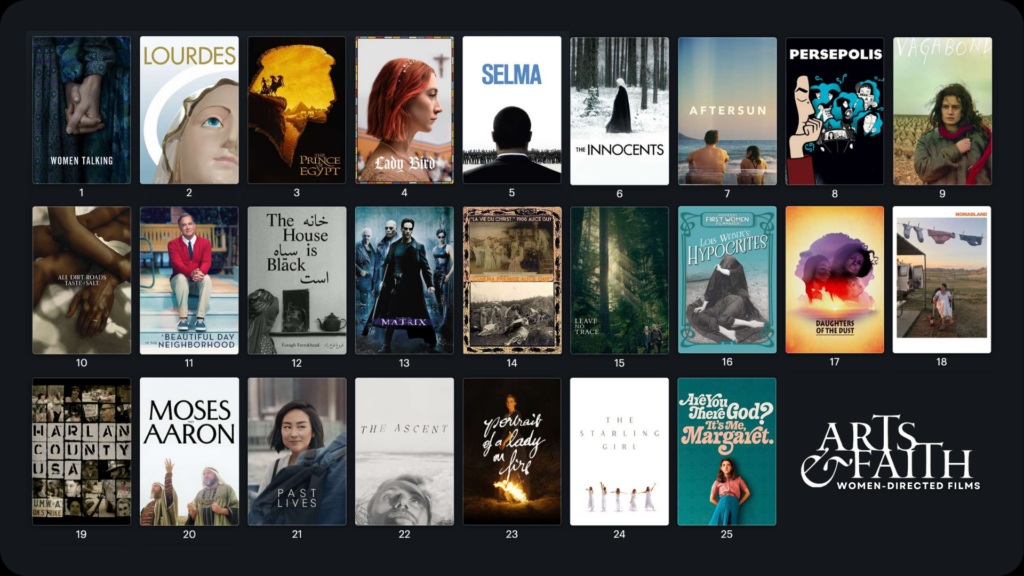
Much of that history was summarized six years ago when I wrote the post “Crawling Towards Diversity” for The Porch. As new members joined the community and my colleague Lindsey Dunn offered to act as project leader for 2026 Top 25 list, consensus built that it was time for the community to spotlight the contributions of women to the canon of film titles we indvidually and corporately found “spiritually signifcant.” The project culminated in the release of this list in June 2026:
Auteur Theory
“Spiritually Significant” has always been a slippery term, and the addition of a genre or theme focus to Top 25 lists has served to heighten my own awareness about how much and how often we use labels to gloss over differences of style, approach, and rhetorical effect. When we did move musicals, I figured we would not have to argue about what qualified as a musical, but we ended up discussing concert films, filmed depictions of stage plays, and films that used soundtracks to tell a story. Discussions of documentaries forced me to consider where a line might be between documenting and recreating. Themes like Crime and Punishment forced me to question who gets to define what is a crime.
On the surface, Films Directed by Women seemed to be clear cut as a theme, even if it did necessitate some heat checks regarding the inclusion of non-binary or transgender directors. What surprised me about my own deliberations was how much the category brought to the surface long-held reservations about auteur theory in general. The notion that the director is the primary dirving force, the “author” of the film, has never been without skeptics, even if it has been widely embraced in my lifetime. The very act of limiting lists to one film per director carries with it an endorsement of an auteurist classification system. I liked the idea of giving attention to female-centered films, but…it felt off to me to think of Tim Robbins as the “auteur” of Dead Man Walking or that Gabriel Axel had more to do with the spiriual significance of Babette’s Feast than did Karen Blixen.
But as the list came together, I also wondered if the problematic and eclectic nature of auteur theory might be film’s way of marginalizing the contributions of women in the same way genre divisions so long kept down female novelists. Sarah Orne Jewett wrote “regional” fiction; Mark Twain was somehow exempt from the associations that accompanied being relegated to that lesser genre even though his dialect and description is as central as Jewett’s. Jane Austen, Louisa May Alcott, or, yes, Judy Blume, all saw their accomplishments undercut by saying they wrote juvenalia. Try dismissing C.S. Lewis or A.A. Milne that way and see how far you get.
The counterpart to the auteur is the studio director, which may account for some of the recency bias of this list. Even in the nominations we saw big holes of representation for titles between 1950-1990, perhaps because fewer women were able to achieve the kind of professional, studio success that allowed them to call their own shots or shepherd their own projects. Catherine Hardwicke points out in Miss Representation that she was only tapped to direct Twilight because it was a low budget genre film nobody expected to make oodles of money. When it was successful, when the franchise became valuable in a commercial sense, the reins for sequels were handed over to men. Those scrambling to make a name or a living in the profession are seldom given can’t miss projects with award-winning aspirations. There were nominations for this list of films by Ida Lupino, Amy Heckerling, Penny Marshall, and Martha Coolidge, but more often than not, those working within a (studio) system can’t always get the same recognition as those who finally knock down some of the doors their predecessors were banging on.
It would be a mistake, however, to think the Top 25 list simply echoed the court of public opinion. Conspicuosuly absent are films from notable auteurs Chantal Akernman, Claire Denis, Kathryn Bigelow, Gillian Armstrong, Kelly Riechardt, and Joan Campion, to name just a few. While I am allergic to being contrarian for contrarian sake, I actually came to believe that these absences were less a scandal than an opportunity to celebrate. I wondered before this project — I wonder still — how many casual filmgoers could name twenty-five different female directors and how long it would take for them to do so. Tokenism is real thing in canon-making, and the diversity of this list pleases me far more than would a carbon copy of titles that had already appeared in the Top 100, even if the absence of Bright Star, The Queen of Versailles, An Education, and Outrage sting.
A Different Way of Looking
We live in culturally — and spiritually — divided times. Lists such as this one — and the beauty and insight of the films on it — can be vandalized by thoughtless or careless stereotypes about what women artists depict. For me, the beauty of this list lies in its diversity. There are films with narratives that revolve around men. There are films with narratives that revolve around women. There are stories about the young and the old. Intimate portraits are made of relationshiops between daughters and fathers and daughters and mothers. We see adult women wrestling with how to relate to their partners, their allies, their lovers, their friends, and their oppressors. Perhaps what ties these films together for me is less a shared subject matter than a deep curiosity about the world that can be found in all sexes but, if I am honest, feels like it is practiced more consistently by women. The actress Geena Davis, again in Miss Representation, responded to the Hollywood assumption that men will not go see films about women, by reflecting on how deeply strange it was to her that one half of the world could profess little to no interest in the other half. It takes a moral sensibility and exercised imagination to put oneself in the shoes of another, the act from which almost all spiritual growth, emotional maturity, and moral courage blossoms from tiny seeds to mighty, maejstic oaks. Film is, metaphorically, the forest of enchantment through which I have wandered most of my adult life. Here are some of the trees in that forest that I have too often rushed by in my hurry to return to a favorite haunt. Climb them, look at them, marvel at their towering strength or willowy grace. Carve your lover’s initials in them as you remember time spent together in their shadow. Some of them have been in that forest waiting patiently for you since the day you were born. Do not take them for granted, and never forget to give thanks to the ones who planted them.

