

Real Genius (Coolidge, 1985)
Author’s note: this review is part of jury deliberations for the 2026 Arts & Faith list of Top 25 Spiritually Significant Films Directed by Women.
Long before I identified as a feminist or had any experience as a movie critic, much less any pretentions of being a feminist movie critic, I knew that Real Genius was “different.”
I doubt that I gave much thought to whether the reasons for its difference stemmed from the fact that it had a female director; I am not sure I knew its director was female, much less how rare that was at the time. I knew that Jordan (Michelle Myrink), the hyper-talkative co-ed who knit fifteen year-old Mitch (Gabe Jarrett) a sweater — and barged into the men’s room to give it to him without an ounce of self-consciousness — made me all sorts of interested in ways that the Chris Knight’s beauty school babes in bikinis did not. I most likely knew that the film’s PG rating meant that even though there could be lots of crude sex talk, there would most likely not be any body parts I wasn’t used to seeing.
If the films of John Hughes have not aged particularly well in the “Me too” era, it is worth remembering that they seemed tame in the mid 80s. Films like Porky’s (1981) and Fast Times at Ridgemont High (1982) had pushed the teen comedy envelope. Real Genius came out the same year as Rob Reiner’s The Sure Thing and a year after John G. Avildsen’s The Karate Kid. Those films presented geeky, awkward, sexually naive guys who were immersed in a world where they were told that everyone was getting some, that most women were willing if you carried yourself with enough confidence, didn’t wear braces or glasses, and weren’t too cowardly too stand up to the school bully. Reiner’s film, like Coolidge’s actually shows the male protagonist rejecting the advances of a more sexually aggressive female, awoken to the charms of the the less agressive (but still stunningly beautiful) girl who is hiding in plain view. Refraining from exploiting the system that hyper-sexualized women didn’t just make you decent, it made you downright heroic.

It wouldn’t be until over forty years after Real Genius that I finally caught up with Coolidge’s debut film, Not a Pretty Picture. She has described it as a documentary/drama hybrid, since it shows rehearsals for an attempt to film a dramatic recreation of her own rape experience. It is worth highlighting from one interview that Coolidge did not intend that film to be self-therapy. She also recognized that the acting participants could and would bring to the performance their own experiences, suggesting that the exercise was something other than a mere recreation of the details of one specific experience.
Speaking only for myself (though I suspect my experience is representative of many men of my age and background), the bigger awakening about sexual assault was not how bad it is but how ubiquitous it has been for periods of our life. Reading that back into the sex-infused comedies of the ’80s, so much lands differently when one is aware of what women (either the characters or artists) were enduring. Part of what seemed titillating about Real Genius at the time was not how the women (characters or actresses) were treated, which seemed relatively benign compared to what one saw in other genre movies, but how openly and willingly the female characters participated in the sexual banter, flirting, and microagressions.

The obvious example comes in one of the film’s most often quoted exchanges in which Chris Knight (Val Kilmer) asks Susan, a woman he has just met if there is anything he can do for or *to* her, only to be asked, “Can you hammer a six-inch spike through a board with your penis?” When he laughingly admits he cannot, she dismisses him with a smirk and a retort: “A girl’s gotta have her standards.” Chris’ reaction here suggests this is not an attempt to emasculate him. Chris has, to some degrees, rejected hierarchy (more on that later), and so finds her word play, even her (momentary) verbal domination of him to be arousing precisely because any sort of engagement with the oppositive sex, be it verbal or physical, is more pleasurable when the other person has willingly engaged.
I had forgotten until recently revisiting the film, that Chris later finds Susan having what is presumably a sexual tyrst with the film’s villain, Professor Jerry Hathaway. He smirks rather than being humiliated. When Chris tells Jerry he has found a solution to the laser problem they have been working on all semester, Jerry curtly dismisses Susan, telling her to get dressed and take a cab home. So even though Chris does not humiliate Susan in the previous scene, Susan gets humiliated. This minor exchange allows Chris to be differentiated from his antagonist: good guys don’t humiliate women. They might occasionally engage in crude flirting — and women might even give as well as receive in such verbal sparring — but there is a demarcation, however crudely drawn, between the mutually pleasurable and the exploitative.

Susan’s part, as small as it is, gets complemented by the portrayal of Sherry Nugil, the pedophile cougar who claims to have been waiting three years to bed the fifteen year-old Mitch as part of her quest to sexually possess the ten most brilliant minds in America. Sherry’s advances frighten Mitch, who rebuffs them only because he realizes that he would rather be with Jordan. Sherry, it should be mentioned, eventually ends up with Laszlo, the original genius who had been living in the walls and basement of the the dorm, only surfacing to warn the new generation of male masterminds that their brainpower is being used to create a military weapon. Laszlo recognizes that Sherry only stays with him past the bucket list intial experience because he has hacked a Frito-Lay sweepstakes and won a boatload of merchandise. But…he doesn’t care.
It should not be surprising that both these scenes are built around meaningful consent. The film is not anti-sex. It is not even against transactional sex, so long as the transaction is mutually acceptable. Mitch, as a minor, can’t legally consent, though I suspect the film plays to a male adolescent fantasy to be desirable to older women without having to actually confront the very real differences between fantasy and reality. Early inNot a Pretty Picture, the female actress and Coolidge herself try valiantly to explain this point between fantasy and experienced reality to a male who claims that many women he has eoncountered confess to having had rape fantasies. That was thirty years before Esther Perel, a therapist, made the same point about sex fantasies in Mating in Captivity.

If this part of the argument seems like I am damning Real Genius with faint praise or giving it a pass only because I am grading 80s sex-comedies on a curve, I concede that may be partially true. But for the context of a list about female-directed movies, I think it is fair, perhaps even necessary to insist that we make more than a passing attempt to give a full picture of the cultural landscape women artists had to endure. If the contrast between Real Genius and Not a Pretty Picture gives us hints as to how the director softened the material, the contrast between the film and writer Neal Israel’s previous film, Bachelor Party, gives an even clearer picture of of just what Judith Fetterley meant in The Resisting Reader about literature (or, here, film) mandating a male point of view. There was a lot to resist in the genre, and I think any reasonable assessment of the contributions of resisting auteurs be clear about just how strong was the current they had to row against.
As surprisingly advanced for its time that the film’s sexual messaging might be, it manages to get away with some of its messaging, I think, precisely because the film isn’t really about sex. It’s about hierachy and subordination. It is no accident that the film’s soundtrack begins with “You Took Advantage of Me” and ends with “Everybody Wants to Rule the World.” Mitch and Chris are largely sympathetic because, even though they are men, they are exploited by the patriarchy, getting a taste of what it is like to be subordinates to someone who is their intellectual and moral inferior but who has inherited a position of power.
Even before the film’s finale, in which Chris and Mitch ludicrously break into a military base to sabotage the weapon’s demonstration, there is plenty of messaging about the damaging spiritual impact of hierarchy (be it patriarchy or some other form of exploitation) on those who must bear the brunt of its abuses. In a blink-and-you-miss-it confession Chris admits during the ice-skating scene that he is “so depressed.” In one of the film’s montages, a room full of silent, studying students look on as one of their own has a nervous breakdown, begins screaming, and runs out of the room. They shrug and someone takes the vacated seat at the study table. When Laszlo points out that the laser’s specifications would have limited applications other than weaponry, Mitch expresses anger at being lied to. Chris’ response is telling: it’s easy to lie to Mitch since he trusts people (presumably because he is just beginning to understand and experience life in the real world). Chris, on the other hand, is a self-proclaimed cynic, seeing (or experiencing) the worst of people yet allowing himself to be willfully blinded by the rewards that corrupt power is willing to share with him for his compliance. Few lines in the film landed harder than Chris’ stinging, “I’m such an asshole,” delivered by Kilmer with the perfect mix of grief, anger, and self-abasement.
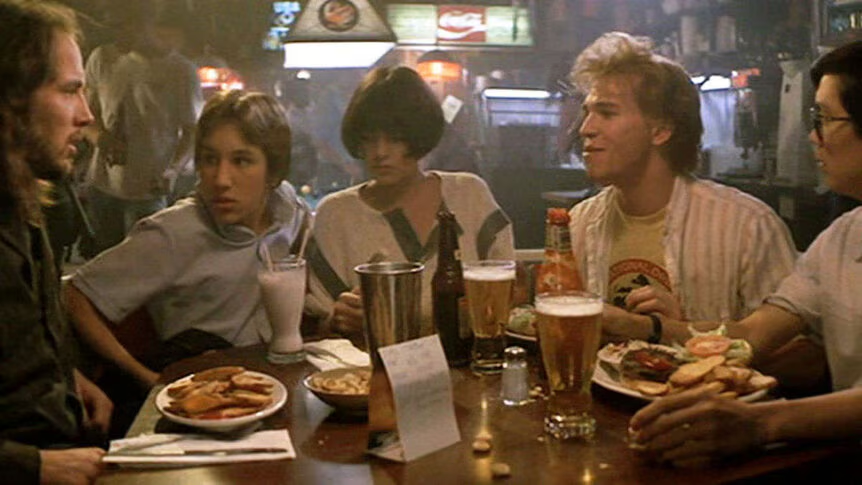
And yet, for all that, Real Genius is a film with hope, and I persist in believing that maybe part of that comes through because Coolidge, like all women, had to digest the lesson that power structures often abuse those not at the top in order protect those at the top both earlier and more frequently than her male counterparts. When Mitch is at his lowest, having been humilated by jealous coworkers resentful that he will replace them on the hierarchy, Chris is at his best, offering consolation and solidarity. As ridiculous as the improvised mission onto the military base is, there is something, okay, I’ll say it, beautiful, about the fact that when confronted with their own complicity, Chris and Mitch at least try to fight the power. Even Lazlo comes to realize that resistance serves others more than exile. Licking one’s wounds and nursing one’s hurt pride is understandable, but perhaps there can be room for a third way besides surrendering to one’s oppresors or becoming just like them.
Real Genius is, in many ways about victims of various forms of abuse finding healing, growth, and renewed purpose. They learn to stop seeking the rewards and affirmation of those above them on some socially constructed pecking order and to love themselves and each other for what they share. Patriarchy, like all forms of domination and subordination, warps and injures those it privileges, not merely those it exploits. Real Genius is smart enough to know that sometimes those two classes of people intersect.

