
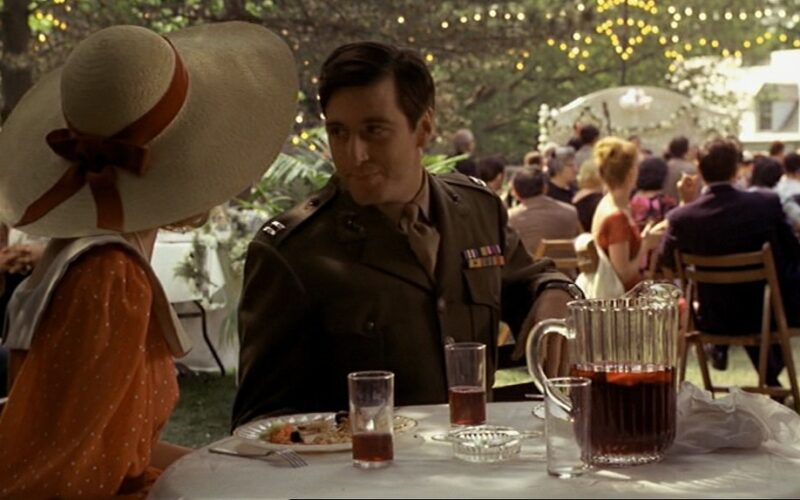
Favorite Film Series: The Godfather (Coppola, 1972)
There is an irony or a writer’s lesson or something to be gleaned from the fact that I started the “Favorite Film Series” because I wanted an excuse to write about The Godfather. Yet despite creating serviceable entries for my favorite films from 1966 (the year I was born) through 1971, I delayed and shelved the project before I could write about the film that catalyzed the series. Writing about one’s favorite films is harder than I reckoned, and the sheer volume of material produced about The Godfather made me feel a little like a Shakespeare scholar called to write a dissertation on Hamlet. What else is left to say?
I did write an appreciation at Arts & Faith in 2024, on the occasion of it finally being voted onto one of that organizations lists of “spiritually significant” films. That list was for films about “Crime and Punishment.” The Godfather finally made the A&F Top 100 list in 2025, a recognition of the film’s moral and spiritual resonances that I thought was long overdue.
What I wrote in 2024 gets at the heart of why the film is precious to me, though as with all things dear, it is impossible to exhaust the qualities of something or someone you have spent your life thinking about. Michael Corleone’s line to his girlfriend, “That’s my family, Kay; that’s not me” remains for me one of the most tragic lines in all film. It is tragic because it is true. It is tragic because it is not. It is tragic because he wants it to be true, and we want it to be true for him. It is tragic because he knows that loving his family too much could well destroy him and that becoming like them would force anyone who would fain love him into the impossible decision of having to choose between what the heart wants and what the soul knows is right.
And yet…Michael is so very, very lovable. In a quiet moment during lockdown as he is being instructed how to kill a rival and a corrupt police captain, a crew member tells him sincerely how proud Michael made his father and their whole community for being a war hero. Don Corleone is feared and respected, but Michael is loved. He represents the small piece of everyone’s soul that did not compromise, did not buckle. He is an aspirational figure, one who provides hope that determinism, whether it is economic or biological, isn’t an irresistible force. We are, or can be, something other than the product of our environment.
I was told growing up that the thing that made the Corleones so lovable despite being criminals was their commitment to family. I had a lot more growing up to do before I was capable of seeing that, actually, the family was dysfunctional. It is not just that the model for family is an obsolete, patriarchal one. Family is, in the final analysis, a myth they are all meant to buy into and promote, but one that never quite rewards or reciprocates the absolute loyalty it demands. Family is the ultimate value in a system that requires some sort of absolute value, for only those who think in moral absolutes can dismiss the cognitive dissonance that would drive the less hardened heart insane with guilt.
There are moments of kindness, though, and they feel especially tender in a world where cruelty and violence is the legal tender. The way Michael lights the baker’s cigarette at the hospital is one such quiet moment of appreciation. The patience that Don Corleone has with the rhetorically clumsy Luca Brasi — in comparison to his impatience and disgust at the pampered Johnny Fontaine — show him to be a person who can give respect and loyalty and not simply demand it of underlings.
Much has been made, and I think rightly so, of the “I believe in America” speech that opens the film, situating the Corleone family as some sort of emblem for the immigrant experience and/or Michael as an emblem of the country itself. The juxtapositions between Organized Crime and other institutions (such as the government or the papacy) is perhaps more developed in Part II and Part III, which may be why I don’t harbor quite the same love for the sequels. They feel a little more written to a thesis, while Michael’s decline and fall gives The Godfather a central focus that keeps the breadth of the story from expanding into nebulous abstraction or even soap opera.
All great films should grow with you, tell you and teach you different things at different stages of your life. If you are lucky, they may even contribute to your growth from one stage to the next. I am less certain about hell and who I think may be going there than I was when I first encountered The Godfather. For one thing, I find it increasingly hard to make comparative valuations of sins or crimes. Beyond that, though, I find it hard to believe that God could harbor love for anyone or anything and not be able to effect its (or their) transformation. Since there is a part of me that still very much loves Michael, I can’t imagine my capacity to persist in love exceeds God’s own.
Which is why the end of The Godfather is its own very special brand of heartbreaking. Kay Adams-Corleone sees the good in him enough that she can’t believe, even at the end, that some piece of that goodness cannot remain accessible. If she realizes, with cause, that she will never reach that part of him again, is that not a recognition that free will is meaningless unless it includes the freedom to chose one’s own damnation? The 2014 film Calvary begins with a claim that the thieves on the crosses on either side of Jesus are meant to teach us that we should neither presume nor despair. I guess that is where I am with The Godfather these days. I still have hope, each time I watch it, that the end might be different, that Michael could yet make different choices (or respond differently to the choices he has made). Without that hope, the film would make me despair. I also know that grace without repentance is cheap grace, and it would feel presumptuous to assume that everyone can or will be saved just so that I feel better about my own chances. I mean, I’ve never shot anyone in the face, whether he deserved it or not.
That’s my movie hero, Kay; that’s not me.

