
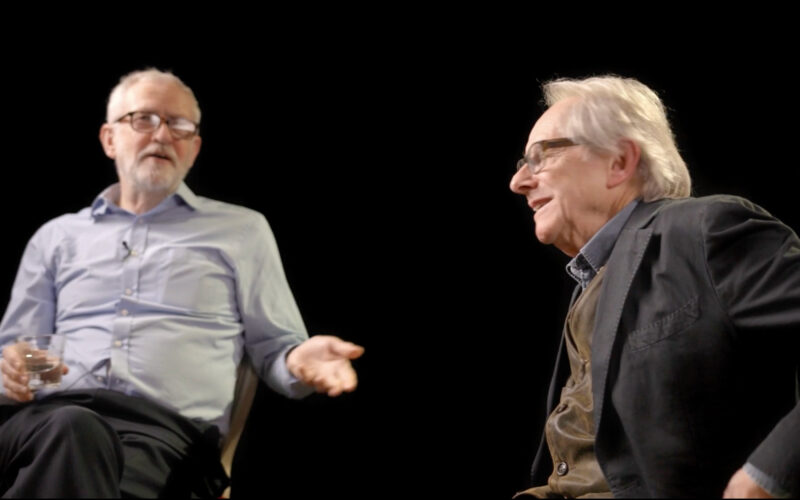
The Bad Patriots (Fraga, 2024)
A seventy-plus minute conversation with Ken Loach and Jeremy Corbyn about corporate media bias and political propaganda can’t help but generate some interest for anyone who knows the first thing about either of these two figures.
The problem is that director Victor Fraga approaches the conversation with an inexplicable, at times irritating assumption that anyone and everyone will be as shocked as he purports to be that such biases and practices exist in Great Britain and not just countries such as Brazil, where…
If I can’t finish that last sentence, it is at least in part because I am not sure Fraga ever successfully articulates why it is, or should be, more surprising that the “demonisation of progressive figures” is practiced in Great Britain than that it is practiced anywhere else. In his “Director’s Statement,” he says, “Despite our firm belief that Britain has a far more robust democracy and balanced media, the tricks used in order to degrade vaguely anti-establishment figures, and to assassinate their character, are remarkably similar on both sides of the Atlantic.” I am not sure who the “our” is that statement, and that lack of clarity makes it unclear whether Fraga is making a claim about his own surprise or making an assumption that such surprise would be wide-spread, even ubiquitous. It’s not, which means when Fraga frames the documentary as a shocking expose or stunning revelation, it grates, even to the point of getting in the way of letting the more nuanced and experienced Loach and Corbyn describe political propaganda and media censorship in practice.
The most glaring example is the use of uncontextualized voice-over periodically reading over-the-top reviews of Loach’s films or editorials against Corbyn. The incendiary nature and illogical hate-spewing of these harangue will be familiar in tone to anyone who has ever watched an ideologically driven “news” network or read an ideological extremist screaming talking points on social media. Are they all from the same source? (If so, their use undercuts claims of how pervasive the bias is.) Are they meant to be representative samples of a larger whole? (In which case, having the same voice performatively read them without sourcing them feels suspicious.)
When Fraga steps back from trying to situate the film as a smaller part of his “manipulation trilogy” and allows the focus to stay on Loach and Corbyn, Bad Patriots is informative as well as interesting. Whether Loach is discussing how he bypassed BBC censors or Corbyn is telling which lie about him resulted in the person making it having to pay a fine, the details about living within such an environment are generally more engaging than the assertion that such an environment exists.
In one snippet that was not particularly surprising but still informative, Loach claimed that one way that distributors justify censoring left-leaning films is by claiming they are not “commercial,” a self-fulfilling prophecy where suppression leads makes it harder to find a work of art which in turn leads to claims of claims about the reasons for its lack of commercial success. To the extent that made sense, it reminded me that one way of pushing back against censorship is to seek out works that crowd-sourced social media campaigns go out of their way to trash, sight unseen, for political or social reasons. If you haven’t seen Sorry We Missed You or The Wind that Shakes the Barley, I recommend both. I never did manage to catch I, Daniel Blake, so I will be rectifying that gap in my film knowledge soon.

