
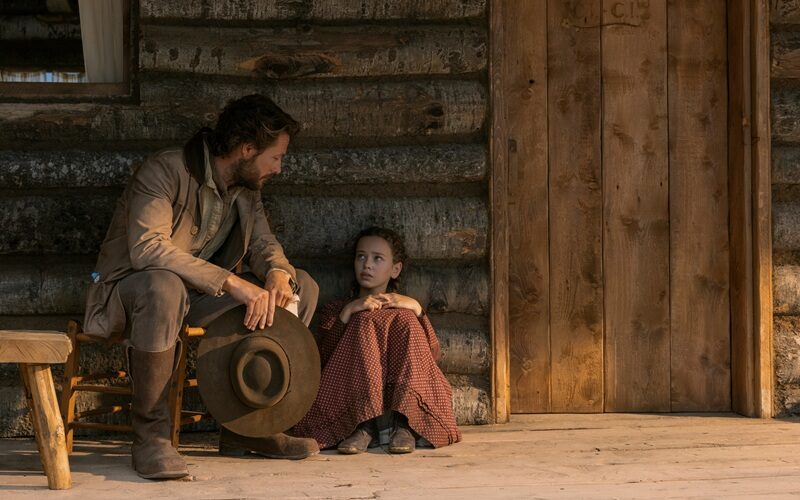
Little House on the Prairie (2026)
Rebecca Sonnenshine’s reimagining of Little House on The Prairie that drops on Netflix this month is passable fare for the binge-watch era, though I am uncertain whether it was necessary in any real artistic sense. It was a recognizable intellectual property, Netflix bought it, and I would assume the books themselves and the the 1970s television serial with Michael Landon have enough fans to make that a relatively safe investment.
Lest my ambivalent tone be misconstrued, I count myself among the fans of both, ableit for different reasons. I did not engage with the books at all until I was teaching American literature and filling in gaps in my education. My specialty in graduate school was Early-American Literature, and Wilder did not publish until 1937. I came to see her not as a chonicler of the American westward expansion, but as an important conduit through which the modern imaginative picture of the nineteenth-centruy pioneers was formed. Although she was closer in time (and actually lived through) the events she chonricled, I found her relationship to them akin to Hawthorne’s relationship with Puritan New England. The books presented in broad strokes an emblem for a time period that, while not a fabrication, was too often thought of as being the representative example of the time period rather than one person’s general impressions of it. Wilder’s books have also been important for me as an exhibit in the argument that American literature marginalizes women authors both by funneling them to genres with less prestige (especially juvenalia) and then dismissing their accomplishments and contributions because they happen to be accomplished in those genres.
I did not engage with the 70s show until I was preparing a conference paper early in my career about Christian fiction directed toward adoloscents. I approached it with hefty cynicism, suspecting it might be a prototype of what I later dubbed “evangelical pornography” (see Chapter Two of Inconspicuosly Christian Film Criticism). Instead, I found it wholesome without being grating, something that was (apparently) liked by Christians but not directed to them or marketed to them exclusively in the way that so many films of the nascent Christian film industry were. About the same time David L. Cunningham directed and Katie Ford wrote a six episode miniseries that made many of the same moves the Netflix series does, ostensibly to make the the material a little less whitewashed in its portrayal of history. Interactions with the Native Americans are highlighted more than they were in the show. Dr. Tan, the African-American doctor who appeared in one chapter of one book in the Little House series is given a featured role.
It bears repeating that these are changes in emphases and not fabrications. The books are composed of vignettes that are loosely tied together by theme, character, and location. They lack the focus and depth of modern novels, which perhaps makes them better suited to be adapted to serial television than into more concentrated films or mini-series. The racial stuff is not grafted onto the material, but it is cherry-picked from it. The result of such cherry-picking is to highlight the ways the past was a distant mirror, with people more or less like us, dealing with the same issues we have to deal with. Caroline walks out on a racist neighbor who refuses to let the store’s black owner join the women’s society. Charles declines to administer fronteir justice to a pair of horse thieves, saying violence never did much good. Our lives, individually and corporately, are chock full of contradictions and changes, making it possible to paint drastically different pictures depending on which details are highlighted and which are elided. The Ingalls family is a little too perfect for my taste. The parents, especially, came across as idealized versions of the figures Wilder draws in her books.
The picture painted of the Ingalls family here is one of nearly unfailing moral rectitude. I am hard pressed to think of a single example in the show where one of the parents does something knowingly wrong or where their instincts fail them. The kids are susceptible to the pressures of teasing, and maybe Mary envies the nice dresses of her wealthier coutnerparts, but there is never really any situation in which Mary and Laura don’t know what the right thing to do is nor much doubt about whether they will do it. Evil exists in the world of Little House, but it abates in force the closer it gets to the family. Even the cruelty of nature, such a powerful part of On the Banks of Plum Creek (which features a locust attack and a snow storm as scary as anything Jack London ever penned), feels more asserted than felt. Sure, the whole enterprise starts with a dangerous river crossing, but that is treated as an exceptional event rather than a daily does of “and this could easily kill you.”
Yes, Ken, fine, but what are you saying? Is the new series any good?
I think that mostly depends on what you bring to it and what you hope to get out of it. I would not subscribe to Netflix just to watch it, but if you already have the streaming service, it is entertaining fare, on par with Anne With an E or Heartland. It’s safe, and sweet, and virtuous, and if it all looks and feels a little too pretty, if the clothes are all a bit too neatly pressed and the hair and make-up a little too perfectly applied, there’s always fifty back seasons of Survivor to provide a reminder that living in the wilderness is not the romanticized adventure our collective memories and imaginations make it out to be. Winsome isn’t bad in small doses. I enjoyed the new Little House, but after six episodes I was ready for it to be over.

