
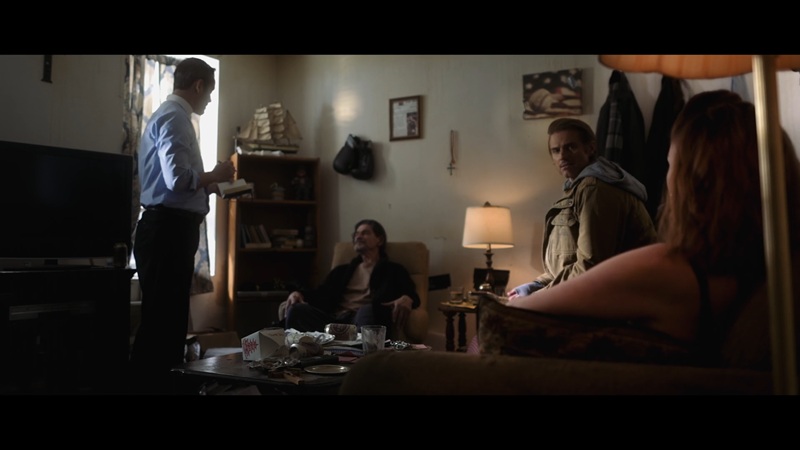
All Saints Day (Krinsky, 2025)
The claim that a film based on or adapted from a stage play suffers from its origins is such a generic critical comment that one hesitates to make it, but that is what I think is going on here. All Saints Day is never incompetent in its execution. It is, however, so static in its development and stagnant in its tone that I found myself tapping out of the film experience and examining myself about why I was so unengaged.
The story itself is not without dramatic potential. Two brothers and a sister stage an intervention for their eldest sibling, an alcoholic who speaks to their absent, presumed dead, mother, which may or may not be a sign that he is entering dementia. Forty years earlier, the siblings’ mother abandoned them, charging the eldest (Kier) to care for his younger brothers and sister and admonishing the next eldest son (Ronan) to help his brother keep the family that she was leaving together. In the four decades that pass between the opening scene and the movie proper, one brother, Mickey, migrates from Boston to California to become a priest and the sister, Fiona, is surrendered to foster care. The adult Fiona participates in the intervention even though she hardly knows any of them and Kier is wracked by guilt at giving her up.
That summary hints at a writing problem. It is both sketchy and vast, saddling the present moment in the film with a lot of backstory that does very little other than explain how we got to the intervention. There is a real difference between backstory in stage drama and family history in real life. The former tends to be treated here as a mystery that explains a character’s motivations and actions. There is nothing wrong with the assumption that people are influenced in their behavior by things that happened to them long ago. But when those traumatic events or family narratives become the totalizing answer for every feature of a person’s identity, those characters get reduced to stereotypes. Ronan is the enabler. Mickey’s religion was and is an escape. There is no sense in the movie that these characters could have made different choices or might have developed and changed in their reasoning for and attitudes about those choices over forty years. It doesn’t help, either, that the Irish drunk is itself a stereotype, since the film leans into its Boston setting, ostensibly to provide some differentiation between this family and any other family dealing with abuse, abandonment, or addiciton.
One could argue that stereotypes, like all generalizations, are grounded in common experiences. There is some truth in that. All Saints Day hovers around the fringes of insight in the way it illustrates how our explanations, justifications, and rationalizations so easily become prisons of our own making.
That is another way of saying the material is not itself the problem, but the staging contributes to and accentuates its biggest weakness, which is that its too generalized, not specific enough. The film proper at no time feels like the culmination of a forty year story. It is more like a short story — focused on a single incident — with more and more backstory piled around the edges as a means of character explication. A stronger screenplay would, I think, tell us less and let us infer more. The arguments between the siblings sound too much like dramatic exposition and not enough like people operating under the influence of the traumas we are told they experienced.
How is that related to the screenplay’s original life as a stage play? It has been, admittedly, hundreds of years since play writers felt bound by Aristotle’s unities of time and place, but there is a stage tradition going back to the Greeks of narrating exposition and concentrating the play proper around dramatic action. I do not even claim that style and structure is inherently wrong, just that it may be wrong for this material, because the events depicted are not particularly dramatic in and of themselves. This may be why the screenplay keeps trying to wring emotion and drama from the past, offstage, setup. Were All Saints Day a novel — had I spent significant time with any of these characters — I probably would have found it easier to invest emotional energy in the outcome. But imagine attending an intervention for someone you hardly know — an acquaintance, a co-worker, a distant cousin. There would be solemnity prompted by the seriousness of what you were doing, but the emotions would be far more blunted. Even if the characters are fictional, it is far easier to generate some empathy and concern for characters you have spent a signficant amount of time with. I don’t mean this comparison to be catty, but the intervention for David Silver in Season 4 of 90210 is more dramatically effective than this one. And the reason is not because the things said to him on that soap opera by the characters who care for him are markedly different from what we hear in just about any dramatization of an ntervention, but because the stories told by those who love him are part of the viewers’ shared history with the character, not just summaries of things the character did offscreen.
If the screenplay is the weakest element of All Saints Day, it should be acknowledged that the acting, directing, and production values, keep the film from sinking entirely. Don Swayze (yes, he’s Patrick’s brother) is given some bombastic scenes (such as one of an early drunken fit where he screams at absent parents) yet manages to hold back enough to allow us to share his brothers’ hope that there is some part of his consciousness that is still reachable. Jeff Berg, Chad Doreck (listed as Döreck on his IMDB page), and Aly Trasher all appear to understand that with this much yelling going on, they need to find and lean into quiet moments lest the audience feel too assaulted by volume. Although the film was reported to have been shot digitally, the lighting and production values make it look more like commercial films than does a lot of indie fare shot on video, so kudos to director Matt Krinsky and cinematographer Sam Krueger. There is enough quality work on display here to make the critic long for some verdict in between “fresh” and “rotten.” It is hard for me to recommend a film that did not engage or entertain me, but I see enough artistry on display here that I would probably check out the cast’s and crew’s subsequent work.

