
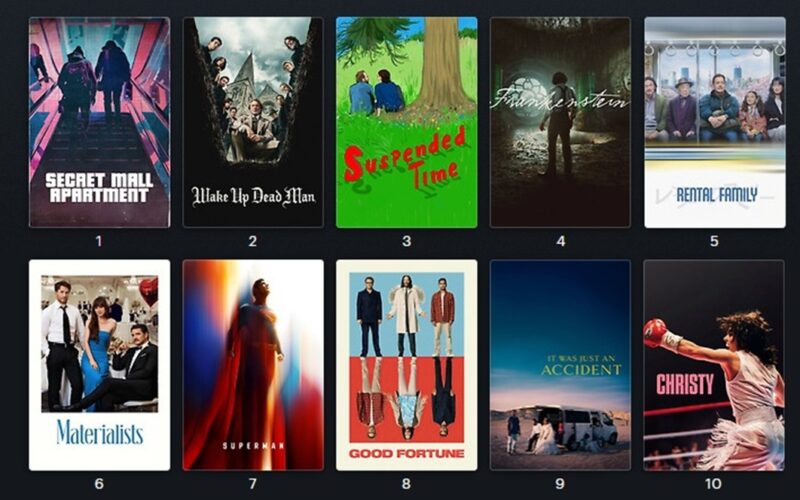
2025 Top Ten
When I look at my favorite film experiences of 2025, the movies and performances that resonated with me the most powerfully, the common thread I see running through all of them is trauma.
I realize that is a bit like saying all drama has conflict or that art is about human experiences, but I don’t think the theme is vague to the point of meaninglessness. How humans deal with and respond to trauma is more interesting to me than the trauma itself, and I do favor films that recognize the impact that violence, real or implied, has on its characters over those that simply have compelling action, however thrilling.
There is trauma that is acute, such as the physical beatings and murder attempts endured by Kal-El in Superman, Christy Martin in Christy, and Vahid in It Was Just an Accident. It is hard–or it should be–to see or hear people assaulted, abused, or tortured, and not feel some measure of pity. When a narrative engenders other emotions such as compassion, sadness, respect, fear, or even admiration, it is often because it appears more interested in the responses to trauma than the trauma itself. Those responses are varied and complicated, whether they are manifested by different characters (such as in It Was Just in Accident) or by internal struggles within the victims, striving to harness or even understand contradictory impulses.
There is also trauma that is diffuse, endured over a prolonged period of time. Sometimes that someone is undergoing emotional or psychological trauma is less obvious, even to the person subjected to it, than are the obvious effects of assaults on one’s body. The characters in The Materialists, Rental Family, and Wake Up Dead Man are often unlikable, even if we understand that their present hurtful actions are driven, at least in part, by past hurts. Yet to the credit of each of those movies, the audience is allowed to sit with those characters through compelling and nuanced character arcs that cannot be resolved by a single, dramatic victory.
Anyone who has read about or studied trauma, even cursorily, has heard of “fight or flight” as the most common responses to immediate threats. Freezing is less frequently mentioned but practiced just as often, particularly when the human or animal under threat calculates that neither fight nor flight is likely to be effective. This can result in “playing dead,” literally or figuratively, or perhaps hibernating, withdrawing, or disassociating. The director in Suspended Time, the cosmically linked rich man and poor man in Good Fortune, even the superhero with the red cape, must at times survive by doing nothing when overwhelmed by forces, circumstances, or people beyond their individual capacity to master. Freezing is different, I think, from surrender. The latter is a conscious decision, made before one’s strength is gone (Superman does that, too). The former is something more primal. A hereditary instinct that shuts us down for our own good when the reasoning brain would still try to survive through problem solving.
Sometimes a work is poignant not only for a person’s response to their own trauma but for a witness’ acknowledgement of it. I have never been a Guillermo del Toro fan, but the changes in his version of Frankenstein to the character of Elizabeth complicate the already complex ways in which Victor’s own trauma intertwines his guilt and pain. Christy Martin’s long walk out the door after being shot was dramatic, but her return to the gym and the response that she gets from the men there, is what finally moved me to cathartic tears. As the men apologize, one by one, for what she had to endure, she finds herself at the center of a group hug. By apologizing, they do not take on guilt for actions not their own; rather, they bear witness to a world designed to make those like Christy vulnerable to violence no matter how strong, individually, they might be.
The outlier here is probably Secret Mall Apartment. The trauma of one’s neighborhood or way of life being destroyed by industrial capitalism is much harder to dramatize than the trauma of being punched in the mouth. And, truth, be told, there is so much joy in the documentary that it is easy to overlook the pain — that of strained relationships, pediatric hospitals, and memorials to victims of terrorist attacks. Like all great films, Secret Mall Apartment is both large and small; the proverbial world in a grain of sand. One particular art project, the creation of a hidden living space in the unknown bowels of an indifferent, perhaps even hostile, larger environment, becomes both a catalyst for thinking deeply about whether art matters and a reminder that we still have choices about how to organize our lives, even when we are surrounded by a world that seemingly offers no place for us.


I enjoyed your list, Ken.
I had forgotten about Good Fortune! I would have considered it for an Arts and Faith nomination but it slipped my mind.
Looking forward to seeing your #1…that mall is just a half-hour from my mother and father-in-law’s house…who would have known it would lead to a great documentary?!
Thanks again.