
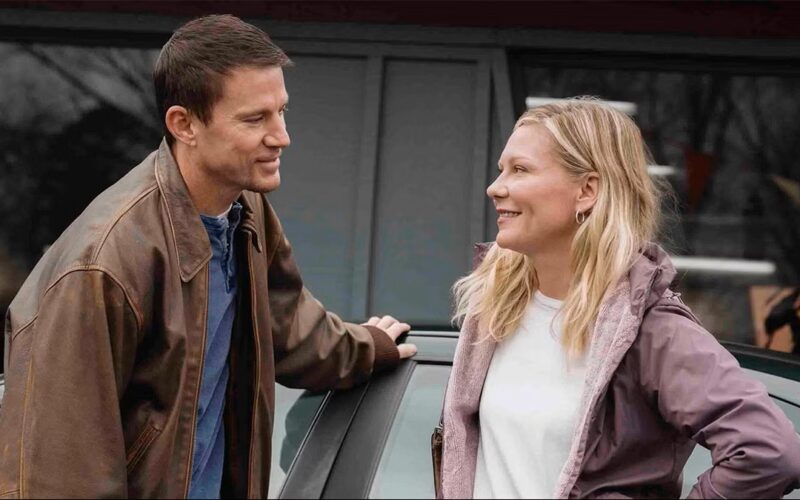
Roofman (Cianfrance, 2025)
Roofman is either a morally confused movie or a morally confusing one.
The film opens with Jeffrey Manchester (Channing Tatum) robbing a McDonald’s with some kind of shotgun, marching the oddly unafraid employees into a freezer. Because he gives one his own coat rather than, you know, killing them all, the film suggests here and throughout that he is oddly polite and not a real criminal. Plus he’s not doing stick ups for drug money or anything, just to buy his daughter a bicycle and maybe a big screen television.
I had a sibling who was murdered while working at a fast food restaurant — by a man with a gun who walked the employees into the freezer. So, I will admit to being triggered by this scene as well as offended by it. Had that been a one-off, I might have worked my way back into the film, but it wasn’t. Roofman consistently portrays Jeffrey as victim rather than victimizer. He can’t afford to buy his daughter a bike and she is not old enough to pretend she is satisfied by his second-hand erector set. His wife (not sure if she’s an ex or they are merely separated), refuses to talk to him on the phone when he is in prison. At one point, while robbing a Toys “R” Us, he pistol whips a security guard, screaming that it is not his fault and that the man “made” him resort to violence by not complying more quickly. After robbing “forty-five” stores, Jeffrey finally has enough to buy his daughter her birthday present, but police ruin his gift-giving moment, chasing him through the neighborhood as he rolls down a hill in slow motion wearing a feather scarf and they tumble after him. The only thing missing is Keystone Cop piano music.
There were a few moments where I thought the film was on the verge of asking viewers to explore why so many are charmed by Jeffrey despite the pesky facts. The first is during a voice-over while Jeffrey is in prison. Jeffrey suggests that if you make yourself agreeable enough and don’t cause problems, “They forget that you are in there [prison] for a reason.” Sure enough, his demeanor provides him with an opportunity to escape, after which he hides out in a Toy Store, stealing M&Ms (product placement!) at night and spying on the store manager (Peter Dinklage) who is being mean to the pretty, divorced Christian mom, Leigh (Kirsten Dunst). Leigh thinks that donating toys for a Christmas drive is something that nice guys do, prompting Jeffrey to steal a bunch of toys from the store so that he can be a nice guy.
He of course bumps into her while dropping off the toys. After interacting with him once or twice, she invites him over for sex despite the fact that he refuses to give her an address and claims he can’t tell her about his job because it is classified. Pretty soon, he is gifting stolen merchandise to her teen daughter, it being apparently not creepy at all for a stranger you’ve just met to to want to hang out in your daughter’s room after eleven to do Legos. Leigh’s oldest daughter is a bit more suspicious, but here, like everyone else in the film that is negative to Jeffrey, she is portrayed as unreasonable, or an uncomfortable situation is turned into a joke. (She puts a sign on her bedroom saying “Emotionally Unavailable,” so it’s somehow funny that she won’t open up to the guy who could have just escaped from prison for all she knows.) But then Jeffrey buys her a car, so all is well.
Speaking of the car, there is a scene where Jeffrey (in his “John” alias) drives recklessly with Leigh, her two daughters, and the salesman in the car, but as nobody gets *physically* hurt the film once-again suggests that’s it’s no big deal. At another point, he commits arson, burning down an entire building to try to keep his identity a secret. Big fireball, but no casualties, so I guess he’s not a bad guy. In still another scene that is played for laughs but is quite disturbing once one gets past the surface, he gets so frustrated that he starts battering a stand of Elmo dolls with a baseball bat. I guess it is funny because Elmo is cute and giggly, so no matter how much you batter him, he still wants to be your friend. It is scary, I guess, because beneath the affable, sad-sack exterior there is constant violence waiting to erupt.
It bears repeating that I would probably have endured the film better if the “feel sorry for me no matter how many people I victimize” narrative was Jeffrey’s con that the film was depicting but had not itself bought into. A post-credits montage of real-life participants, though, presents a baffling assortment of rationalizations and justifications alongside the very rare perspective (usually from law enforcement) that almost all the nice things he did (like donating toys) were at someone else’s expense. The film does show Jeffrey apologizing to Leigh, though it then turns around and has the real-life subject say that her daughters thought he was great and the family mostly thinks of the time he was a part of their life as an “adventure.” What?
Derek Cianfrance is a very talented director, and I can see how the outline of this story looked promising on paper. It could have been a farce like Raising Arizona or it might have been a John Q. genre-piece or a social commentary about a criminal being the face of our discontent with the unfair system that we all feel like rebelling against from time to time. But I don’t know that Roofman ever picks its lane. The romantic comedy genre is littered with “big lie” set ups where love blossoms under false pretenses and rooting against the lie feels like rooting against love. That trope is annoying enough when the lie is relatively innocuous. But for that convention to work in even the most tired genre piece, we have to want the relationship to work out more than we want the lie to fail. Roofman never makes a persuasive argument that Jeffrey’s relationship with Leigh is different in kind from his relationship with his ex, that it changes him or provides him with a different perspective. Perhaps there is a gesture in the direction of reform in the film’s last act, symbolized by the Heat dilemma — are you willing to walk away at a moment’s notice? But it is less than convincing. What Jeffrey wants is not a different life with Leigh or to be a different person so that he can have Leigh. What he wants is a life where if he lays low long enough, everyone just forgets about past crimes, gets on with their lives, and lets him get on with his.
But the belief that he could do that is a lie. It’s the con-man’s lie. The narcissist’s lie. The lie that once you have forgotten about the people you have hurt, their injury is healed. Of all the lies Jeffrey tells himself or the film tells us about Jeffrey, the biggest and most irritating one is that stealing from anonymous corporations doesn’t hurt anyone, even if it requires sticking a gun in someone’s face to do it.


Great review. Nailed it