
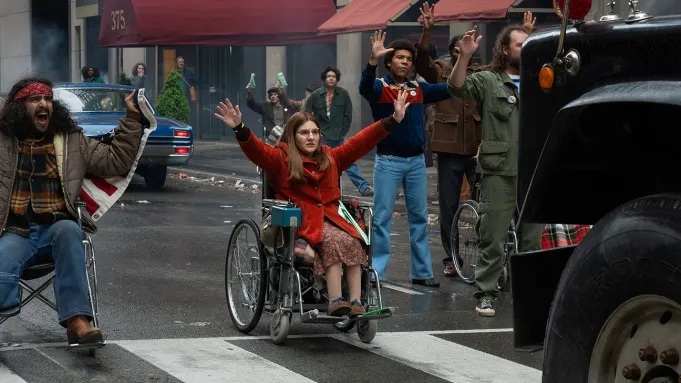
Being Heumann (Seder, 2026)
I don’t know how many years had to pass after 9/11 before I got used to seeing airline hijackings and plane crashes in commercial movies without feeling a little cheap. Maybe I haven’t gotten there yet.
I do know that when I see a commercial film featuring protestors storming federal buildings by force, occupying them to disrupt government functions, and doxxing federal employees as a means of intimidation, I find it hard not to make connections to another historical “protest” in America’s recent history.
Does that make me a whattaboutist? I hope not, and I certainly acknowledge that there are differences between the protestors in the film and those who exercised similar tactics decades later. The most obvious is the cause their respective protests were meant to support, but it’s not the only one. Even so, there is an air of moral certainty and dare I even say smugness that permeates this film’s attitude towards its occupying army of cripples that made me reluctant to join the chorus of hosannas.
Judy Heumann, as portrayed by Ruth Madeley, is a self-described “asshole” who justifies her bullying assertiveness as what is necessary to get the job done. Or, rather, I should say, who allows it be justified by others in that way, since the claim that she is just what the disabilities movement needed came from a colleague. There are, unquestionably, seeds of truth in the film’s insistence that ableist societies and institutions find it easier to ignore rather than rebut the arguments of the disabled, so asking the most vulnerable to play nice is, and has always been, asking them to accept inferior status until the rest of the world is less inconvenienced by the costs of noticing them.
But movies are products of their time and place, just as movements are. Sian Heder’s followup to Coda drops in a moment where audiences asked to be outraged that an administration would simply ignore laws passed by its legislative branch may actually find themselves notalgic for a time when getting the right cabinet member to do his job was sufficient assurance that the force of government would enact the will of the people. It doesn’t help that any complexities in the legislation or problems enacting it are reduced to a single scene in which protestors argue among themselves the value of curb ramps. It falls on me to point out that even this issue is not hammered out by debate; it is settled among the protestors through Judy’s pronouncements and directives. Heumann argues that the ultimate good is to remain in the room until everyone is “heard” even if it takes hours. The film, of course, doesn’t follow the argument for hours. Here, as throughout, we are told about what a grind the protests are, how many days a hunger strike has lasted, etc. What we don’t see is the grind. The protesters get shampoos in the bathrooms and have sex in the elevators, and run wheelchair races in the hallways. In comparison to the picketers in Harlan County, USA or the marchers in Selma, their treatment comes across as nasty, though hardly scandalous. Judy is shocked when some of the building’s occupiers leave after being rousted and intimidated by the police. When a colleague tries to explain that people were scared, Judy looks at her as though she is speaking gibberish.
None of these criticisms are meant to suggest that the Americans with Disabilities Act was not an miportant piece of legislation or that the people whose work and advocacy helped bring it about don’t deserve praise adn recognition. I do wish, though, that Being Heumann had some of the complexity, nuance, and power, of Selma or Stonewall Uprising, chronicles of two movements the film itself name drops. Structuring the film around a single objective — sign or resign — gives it a “big contest” feel that makes its beats all too familiar. I had very little sense of the lives of any of these people, their hopes and dreams, their personalities, beyond the snippets of testimony at an impromptu “hearing.” In a climactic moment, when they all start chanting “we won,” I could not help but think the emphasis was far more on the “won” than the “we.”
Being Heumann played at the 2026 Viriginia Film Festival and is an Apple Original Film.

