
One Day in Sedona (Sorgen, 2026)
It is Before Sunrise with fiftysomethings.
How you feel about that elevator pitch is probably a better predictor of how you will feel about the movie than would be any endorsement or critique I could give. For the record, I liked it, though not as much as any of the films in the Linklater-Delpy-Hawke collaboration.
One Day in Sedona shared with Before Sunrise the knowledge that deep, meaningful conversation can be intoxicating, invigorating, and memorable. I did not think that the characters here had the same romantic spark that their younger counterparts did in the other movie, but maybe that is as is should be. In our twenties, that spark is everything. In our fifties…we have begun to be skeptical whether anything is everything.
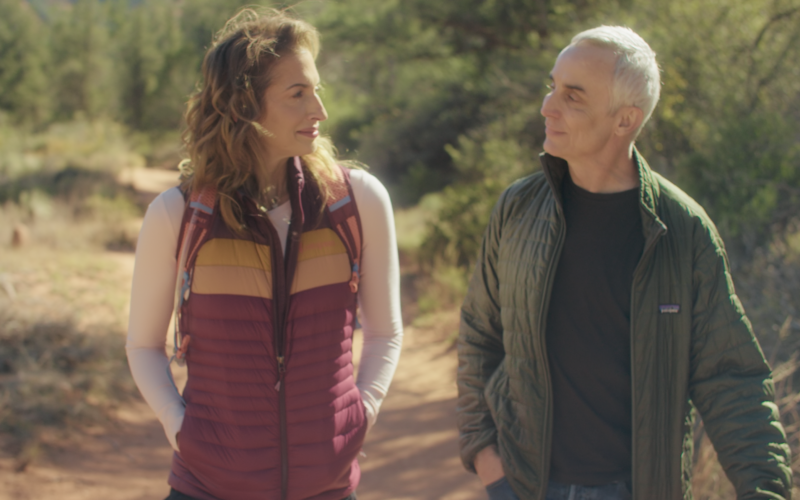
Jules (Alysia Reiner) and Will (Wallace Langham) do the meet cute at the parking lot of a hiking trail. He asks for water; she shares a thermos. She is thinking about her father; he is trying not to think about his recent separation. The meeting is the most conventional part of the movie. Honestly, given the social nature of the hiking path (see, for instance, The Way), I see no reason why two relatively open people could not have simply met while walking, especially if going at their own pace. It seems important to the movie, for reasons I only partially understand, that neither Jules nor Will be looking for a relationship. The title One Day in Sedona suggests a fairy-tale-like randomness. The lyrics of “Drive,” the song that opens and closes the film, which Jules listens to while driving to the hike, also suggests a yearning for something bigger and deeper: “I’m done being cautious,/I’m done being small…” I did not seee Jules and Will expressing (or suppressing) that deeper yearning for connection that fuels the eroticisim of so many romances, which may be why the stakes here never felt larger than movie stakes.
But lest I go too far down the rabbit-hole of comparison, I need to acknowledge the ways the film works on its own terms. First, and most important, Jules and Will sound like they are in their fifties. It’s not just their backstories, though those are age appropriate. They have opinions and ideas about things. They are able and willing to talk about other things besides pop culture. If Before Sunrise is the more obviosu comparison, Nick Hornby’s High Fidelity would be a great contrast. In Stephen Frears’ film adaptation of Hornby’s novel, the vacuous nature of the conversation was used to underline the emptiness of postmodern existence. The characters there did not have opinions so much as monologues or observations they had honed and waited for the opportunity to deliever. In Sedona, Monique Sorgen pulls off the impressive task of making the conversation, once it starts, sound like an actual conversation. It is neither too smooth, like movie dialogue, nor too meandering, like in mumblecore.
It is also nice that the characters are somewhat fresh, not just a collection of writerly stereotypes. When Jules arrives in a Lexus and parks next to the guy getting off his bike, I braced myself for all the stereotypces those modes of transportation typically convey. Yet by being dialogue-heavy, the film allows the characters to show more facets than characters in a typical romantic comedy are usually allowed to have. I also note, in passing, that I give the film an extra half star just for avoiding the “stupid misunderstanding” romcom trope, where characters have to pretend they don’t like each other for a time or are misled by some random note, text, or observation that almost derails things but turns out to have an innocuous explanation. The trajectory of the relationship is a slow build rather than a more turbulent series of ups and downs.
Sorgen also gets props for filming two people hiking while managing to keep the film visually interesting. There are efficient uses of close-ups and varied camera angles to provide a sense of time and place. In a smaller budget movie one might expect fewer takes, fewer cuts, and a more visually static composition. Sorgen’s confidence with the material shows. She knows when to let one of the characters have the center of the frame, when to show a reaciton shot, when to let the background make them bigger or smaller.
Such a dramatic structure puts a lot of weight ont he performers, but Reiner and Langham are up for the task. If either of them wasn’t excellent, there would be no movie, because there is not enough anything else in the movie besides their relationshiop to focus on. Reiner’s voice (and hairstyle) makes her sound and look a little like Mary Steenburgen, though she has a delivery pattern that doesn’t lean into upspeak quite so much. Langham, with his cropped, greyish hair, reminded me of a cross between Titus Welliver and David Stratharn. The thing that impressed me most about both of them — and about Sorgen’s writing — is their willingness to eschew the more demonstrative, emotive delivery of certain lines that by their very nature, could start a fight. For example, an early scene where Jules recognizes that Will has a tan line where his wedding ring should be leads to an explanation. Langham’s delivery here is softer than I expected and doesn’t carry with it the anger at being misconstrued that one might expect. These character, I keep going back to are older. He understands why a random woman meeting a guy she doesn’t know might have to scan for signs of safety and sincerity. She, in turn, is observant enough to gauge what he says and not simply assume that all men are liars.
The only part of One Day in Sedona that fell completely flat was the ending. Just as Sorgen has trouble getting these two characters on the right path, she struggles a bit with how to get them off the path when the magical hike is done. Since this is a film about grown ups, I wanted them to just do grown up stuff — I like you, here’s my number, let’s meet for coffee next week and see if the connection is still there. Instead, we have to have a cinematic separation to create fake, movie tension. How they get separated without exchanging numbers is plausible, I guess, and set up earlier in the film when Jules mentions that hiking is a period of cell phone fasting for her. (Though even that felt a little forced, since a single woman planning to walk through the wilderness on her own might see a phone as an emergency necessity rather than just a nuisance.) That said, they separate and our last act gets more or less wasted in less interesting plot questions (will they find each other again?) when I would have appreciated a few more minutes of character development or even a peek at them preparig for the next meet just as much.
That being said, I would not mind a sequel showing us where these two are a year from now. Or, given Sorgen’s writing chops, a series set in the park that follows a different pair of walkers each episode. For some, that might sound too repetitive, but we have been having conversations with each other for thousands of years. Good ones never get old.

