
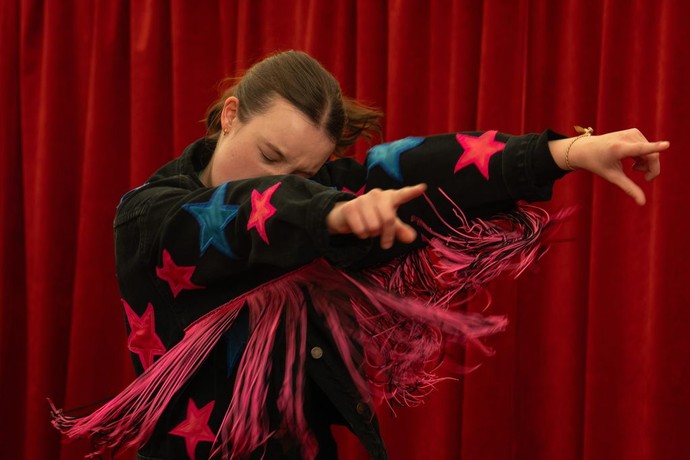
Sunny Dancer
Individuals who have journeyed through the valley of the shadow of death can recognize a fellow pilgrim from a grief tourist or uninitiated bystander. Gallows humor is met with laughter as opposed to raised eyebrows. Platitudes do not become placeholders for dealing with uncomfortable emotions. The weight of grief is allowed to be borne. There is true consolation in being around fellow souls who understand your suffering and encourage you to keep choosing life. Such awareness is the beating heart of George Jaques’s Sunny Dancer, a film that endeavors to bring the magic of classic teen ensemble dramas like John Hughes’ The Breakfast Club to the ‘sick flick’ genre.
Sunny Dancer centers around the experiences of seventeen-year-old Ivy (a fantastic Bella Ramsey) as she spends the summer at Children Run Free Camp (CRF) in the Scottish countryside. CRF is for teens affected by cancer. Ivy’s parents force her to attend because they are concerned that she is depressed and emotionally withdrawn despite being in remission. Initially, Ivy resents the cheesy positivity of the camp and is critical of her peers seeming willingness to go along with the program. As the film progresses, Ivy’s misgivings ease and she learns to find herself within a community of fellow sufferers that do not define themselves as ‘cancerous others’.
There is much to commend in Sunny Dancer. While the underlying stakes of the narrative remain high (the specter of cancer), the film largely avoids the unrealistic romanticism that permeates other teen genre entries like A Walk to Remember. Its adolescent leads are not reduced to plaster saints – sweet creatures whose long-suffering has rendered them perfectly patient or otherworldly wise. Instead, Jaques allows the audience to see these teens as they would be outside of their illness. Ivy and her camp friends embody a familiar range of teen behavior in which virtues live in constant tension with youthful vices. They are equal parts charming and obnoxious. They are as capable of compassion as they are of holding petty grudges. They are both generous and self-serving. They are not above using their cancer diagnosis to obtain free amusement park tickets or to negotiate for lesser penalties for wrongdoing. Though there is a romantic subplot, the script places greater emphasis on the characters navigating life as individuals and that is refreshing.
Sunny Dancer also highlights the important role humor plays in coping with trauma. Ivy and her friends trade cancer jokes (“It’s all in your head – too bad it’s brain cancer”). They aren’t afraid to tease one another for embodying stereotypes connected to the disease. “You were a beanie kid?!!? Yuck!” cackles Ivy in response to one camper’s confession about their chemo hair loss coping strategy. There is a subtle running gag where the inspirational messages on placards around the camp grow increasingly ludicrous as the film progresses (“Each day comes bearing its own gifts, untie the ribbons” to “Stay alive each day”). This is a creative way to address the casual manner such tone-deaf, empty platitudes are often tossed out to the suffering as if they were legitimate lifelines.
Still, the film is not immune to some of the problems characteristic of the ‘sick flick’ genre. The counseling session scenes attempt to offer the audience bite-sized doses of therapy but end up feeling like papered over versions of harder conversations about mortality and survivors’ guilt that deserve more depth. Jaques also could not resist adding a last-minute knife twist regarding the fate of one of the leads. The reveal came so suddenly that it felt like someone pulled the ‘tearjerker alarm’ to ensure that the audience didn’t leave the theater without feeling “something”.
Most disappointingly, the film wants its youthful audience to consider what it means to truly live and embrace the time you are given (a worthy goal) but then proceeds to offer teenage rebellion as the best answer. Ivy and her friends get drunk multiple times (who packed these kids’ overnight bags?), instigate random fights, and hook up with their crushes. These risky actions are all celebrated as signs that the youths aren’t defeated by illness and adversity. This isn’t a moral failing on the director’s part so much as it is a failure of imagination. By participating in these basic forms of rule-breaking, Jaques sets his characters up to follow the easiest and shallowest course of action. Their well-being is rooted firmly in the material with no concern given to if anything exists beyond that realm. In its efforts to prove that these teens are normal in their appetites, Sunny Dancer hasn’t given them much room to explore the idea that embracing life might entail more than just engaging in physical pleasures.
Ultimately, my feelings about Sunny Dancer were mixed. I don’t want to be a fuddy-duddy but I am genuinely concerned that the film’s main philosophy for helping teens deal with life-threatening illness seemed to be ‘let them do what they want because they could die soon’. It tries to show that love (both romantic & platonic) enhances one’s life but this message is overshadowed by the reckless behavior of the teens. That makes the film hard to recommend, especially to adults

