
Ask E. Jean (Meeropol, 2025)
Just to be crystal clear, I believe E. Jean Carroll entirely in her claim that Donald J. Trump raped her in a department store dressing room. One might wish that two juries finding in her favor would settle that question, but, alas, we live in a world where it is easier to run for the presidency and ignore the rule of law than it is to be hold sexual predators accountable, even when they admit on tape that they don’t wait for consent when the urge strikes them.
The facts of her case against Trump alone make Carroll’s story worth telling, but Ivy Meeropol’s profile documentary makes it clear that it is not the only thing that makes her an interesting person. Even had Carroll not been a celebrity of sorts, writing for magazines such as Elle and Playboy, her response to her rape is presented as reprsentative of the way women of her generation were socialized to accept inequality and unjust treatment in a patriarchal world.
I am sympathetic to the broader themes of the profile, too, but…they never quite come together in a cohesive way. Meeropol is committed enough to not making it a puff piece that she includes numerous snippets from Carroll’s television appearances that land differently today than they apparently did when she was at the height of her fame. The most obvious, but far from the only one, is a clip of Carroll on Geraldo scolding Paula Jones and Anita Hill for allowing themselves to be victimized. Carroll claimed at the time that they could have avoided the worst parts of their experiences by being firm and clear when the inappropriate behavior of powerful, famous men started. The flip way in which the younger Carroll (from the tapes) talks to other women, doling out advise about not taking any crap and embracing their own fabulousness would be easier to swallow if one felt as though her experience prompted her to at least question some of the generalizations and assumptions she showered television audiences with.
The documentary is fairer and more balanced for including this clip and at least two others where she advises one victim of a controlling spouse and one victim of rape to handle their experiences in ways very different from how we now know she was dealing with her own victimization. It turns out that to make a good profile, a director may simply need a flamboyant personality, but to make a great one she may well require a personality with a bit more introspection. Actually…that’s probably not entirely fair. Carroll may well have more than her fair share of introspection. I don’t think people can survive that find of trauma and public stress without it. But having it and being able to display it in the context of a journalistic interview is something else entirely.
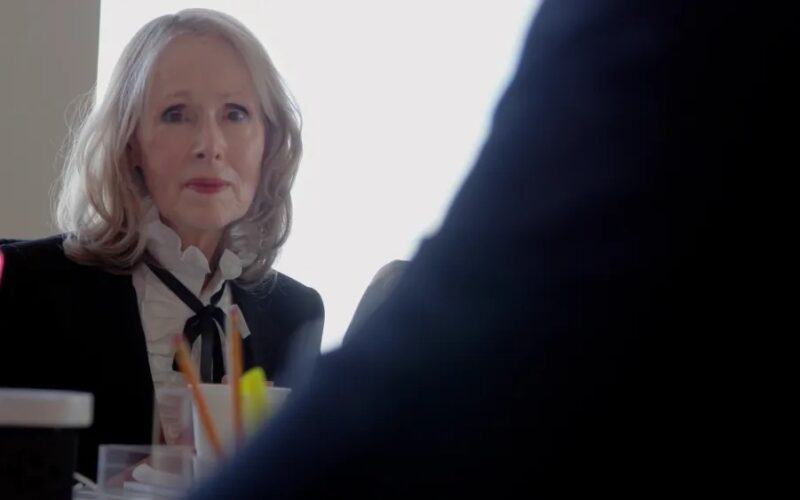
Carroll’s approach to the trial is both informative and troubling. She claims that she could only win if the jury believed she was “fuckable” and so embarks on a strategy of wearing the same clothes she wore at the time of her rape, adopting the same hair style she had at the time of her rape, and generally trying to make herself look younger with make-up. One does not need to be an armchair psychologist to wonder whether such a strategy defuses or perpetuates the misogyny of Trump’s “she’s not my type” non-defense.
Despite the flaws of the documentary as a profile, the footage of Carroll’s deposition is documentary gold, laying bare for all to see how horrifically rape victims are treated, blamed, and shamed. Carroll herself points out that one of the clearest signs of how big a toll the experience took on her is the difference in her appearance in footage from the first and second trial.
Trump is blissfully absent from most of this, except as he exists in Carroll’s memory. The two exceptions, both necessary to the documentary and relevant to the case, are footage from Trump defaming Carroll on CNN after he lost the first defamation suit and footage from Trump’s own deposition in which he mistakenly identifies Carroll as his former-wife, Marla Maples. Carroll’s attorney pointedly asks whether it is safe too assume that the women he did marry were his “type,” and he concedes they were. The fact that he couldn’t distinguish between his former wife and the women he claims he would not look at twice is itself powerful evidence of how little he thinks of all women and how laughable and risible his attacks against Carroll’s feminninity were.
But…we all knew that. Or at least everyone knew that who wasn’t already willfully desbelieving Carroll for reasons having nothing to do with the truth. Trump famously claimed he could kill someone in public and people would still love him, so even if he were to finally admit the rape and pay Carroll the 88 million dollars he owes her, it is hard to know whether that would make a dent in the amount of hate mail she gets from those willing to do his rhetorical assaults for him.
Meeropol told the audience at Full Frame that the film is at the end of its festival circuit and will be getting a public release soon. I guess I hope people will see it for the deopsition footage, even as I admit that I was a tad disappointed about how skittish the profile was in dealing with the elements of the Carroll’s story that make her, and not what happened to her, compelling. A better film might have been about how culture attitudes have and have not changed, how there is no such thing as a perfect victim in a court system that gives license to attack vicitms. Nothing in the past of a rape victim justifies the rape or negate the courage and strngth of character she shows by speaking the truth to power. Carroll repeatedly says that she is bringing her case for “all women” and that her victory is for all of them. I assume that means even the ones that don’t look “fuckable” on the witness stand, right?

