
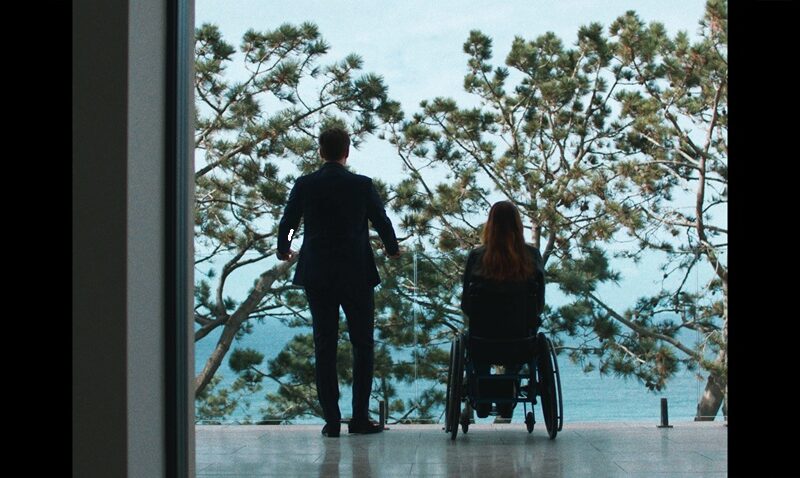
Where Did the Adults Go? (Marsh, 2026)
I found Where Did the Adults Go? stagey. Yet in film critic lingo, “stagey” carries a more negative connotation than I felt about this particular film. Consequently, I had to do some hard thinking about what that term means and whether it was fair to attach it to writer/director Courtney Marsh’s project.
The film is about three siblings, Cynthia, Bryce, and Miles, who meet at an inherited property on the anniversary of their parents’ death. Cynthia (Carey Cox), an author who incidentally is confined to a wheelchair, wants to get her brothers to agree to sell the property so that she and her wife can use the money to invest in their careers. Bryce (Amadeus Sarafini) is adamant that property should be retained, both for practical reasons (timing the real-estate market) and more nebuluous, personal ones. Much of his resentment appears directed at Cynthia’s book, which has the same title as the movie and ostensibly has many autobiographical elements that paint the family in general and the parents in particular in unflattering ways. Since any two of the siblings can overrule the third, both Cynthia and Bryce need to appeal to Miles (Carson MacCormac), the youngest sibling, who tries to be fair to both sides but is consumed by his own relationship problems. Miles’s girlfriend recently left him, apparently to decide whether or not she was a lesbian, and neither of his own siblings, as much as they want to win Miles to their side of the in-family debate, appear to have the patience or relational skills to manufacture much empathy for his situation beyond what they will hope will get him to agree with their reasoning about the house.
That summary makes the film’s plot sound more complex than it actually is. For as much background as we are given about these characters and the causes (distant and proximate) of their conflicts not much actually happens. The proportions of exposition to action are closer to what I would expect in a play or novel, where the gradual revelation of layers can feel more organic. Here it seems calculated, almost overwritten. It is easy enough to fall back on the generalization that film is a visual medium and plays rely more on dialogue. But there are plenty of dialogue-heavy films where the dialogue pops. The Social Network. Molly’s Game. Glengarry Glen Ross. Quiz Show. I am not merely trying to say here that Marsh is not as good a screenwriter as Aaron Sorkin, David Mamet, or Paul Attansio. Who is? I am trying to articulate what is different about the dialogue that makes some wordy films electric and others a little dull.
One obvious answer, at least in terms of the Sorkin screenplays, is that he often writes about people who are highly intelligent. His characters, be they lawyers or politicians, are themselves professional, practiced wordsmiths. So maybe–maybe–one could claim that Cynthia, a writer, should be more erudite, but writing and speaking are two different skills, especially speaking in the moment when one is emotionally triggered. It is not that the arguments the siblings have are not polished enough, rather the opposite. When and how they choose to enter into the exchanges they do felt somewhat unnatural to me. Not an exact quote but when someone says, “I don’t want to get into a fight, but…” and proceeds to make a statement or ask a question for which there can be no logical expected response other than a fight, I felt as though the author had a really good fight scene written but didn’t know how to get to it. It’s almost like the speech-heavy equivalent of a Mission: Impossible movie where they choreographed all the set pieces and then built a plot around them. The fights here are carefully designed to fill in the viewer about the backstories rather than being convincing examples of what the characters would say. For example, when Bryce challenges Cynthia on her attitude or conduct, and she replies, “Give me one example of…” that’s a writing trick allowing Marsh to introduce backstory. It’s effective. By the end I know a lot about these characters. Yet it feels a bit too pat. That’s not a criticism unique to this story. I felt similarly about another stagey, talky screenplay from this summer: The Invite. It was penned by writers that had won an Independent Spirit Award for their first screenplay, so perhaps this single-set, dialogue heavy movie makes it hard on the scribes to tell the story any other way except through expository dialogue.
Another way that the screenplay felt too worked over was in how very, very, evenly the conflicts that emerged were presented. I am not saying all family dramas have parties clearly in the right and clearly in the wrong, but I would find it very rare if I spent this amount of time with actual people and did not walk away thinking one party had the stronger argument even if the other landed points here or there. That sort of balance comes across as a writer not wanting to take sides, which is fine, except that the only way a writer can be neutral is by not allowing the work to have a dominant perspective or point of view. That in turn, makes it hard to like any of these three — or, at least, I did not like any of them. Miles is perhaps the least irritating, but only because he is preoccupied with his own conflict. Since we haven’t lived through the backstory, it is impossible for us to know whether Cynthia or Bryce is more honest about the family dysfunctions or whether they are both hopelessly lost in their self-serving interpretations. Miles trying to not take a side is perhaps credible, but it is still frustrating since it doesn’t get us any closer to a ressolution, even a resolution about what we think. We recognize a lot quicker than Miles does that it is pointless to try to remain neutral between these two parties.
Having said all that about the writing, why didn’t I feel as negative about the film overall? Well the actors are all terrific. It is hard to play prickly, angry, irritated people and not induce the audience to say “a pox on all of you!” and just give up. Cox and Sarafini especially appear to glean that material this emotionally heavy needs to be underplayed just a bit lest it become histrionic. Also, for all my complaints about the dialogue, Marsh does do a keen job as both writer and director of letting the actors occasionally work in silence, either through reaction shots or full scenes. For my money, the single best scene in the film comes early when Cynthia discovers a copy of her novel along with a hand-written note to her parents that they apparently either never read or chose to ignore. It was a rare moment that allowed us to experience a wound being reopened rather than simply having the emotional scars put on display. Also, for a film that was shot in ten days on a shoestring budget, its cinematography is surprisingly good. One way the film did not feel stagey was that Marsh avoided many of the pitfalls of single-locaiton shots, and she was able to keep the film visually interesting even though the visual elements she had to work with were limited.
Marsh also makes it a point in her director’s statement to say that “disability representation” was important to her. She stated that in Cynthia she wanted to make a character whose disability was a “part of her life” without being the defining factor. Here I think she was mostly successful. I found it refreshing that one part of the backstory we did not dwell on was an explanation for the wheelchair since everyone in the room would know this and and not need to bring it up in dialouge. Instead we get, particularly in the dynamic between Bryce and Cynthia some insights into how the fact of the disability affected their perceptions of growing up in the family. That’s more interesting than spending a lot of time on the causes of the disability itself.
I had a producer once tell me that all first films are judged by a single metric. Did they garner enough attention and make enough money that they made possible a second film. By that criteria, I would label Where Did the Adults Go? a success. I cannot say I was enthusiastic about the story as a whole, but there was certainly enough there that I would buy a ticket to whatever Marsh or Cox or Sarafini did next.

