
Favorite Film Series: Jesus Christ Superstar (Jewison, 1973)
The parameters of the exercise seemed simple enough: pick a favorite film from each year of my life. Progress on the series has been slow for an unexpected reason. I did not watch a lot of movies until my teen years, and my subsequent attempts to address holes in my cinephile inventory have mostly glossed over the 60s and early 70s.
The first movie I recall ever having watched in a theater was The Neptune Factor, which came out in 1973, so I figured that if there were not any movies from that year that were particularly dear to me, I could always come up with 400 words on a film that had biographical significance, if not artistic merit. Turns out the DVD for the movie is pretty hard to find, though, so I could not revisit it.
The most esteemed or frequently cited films of ’73 are a hodgepodge of indies or genre films that were not part of my childhood film-watching experience nor my adult film-watching aesthetic. Badlands came out that year, but I have tried and failed to appreciate Terence Malick over the years. The Exorcist is a film of immense cultural and artistic significance, but it is also one I find easier to respect than to love. Magnum Force is another film that I have seen a lot and that has influenced my love of the medium. I revisited it for this series and almost wrote an essay on the cultural work of Eastwood’s character claiming he would not care if the whole police department was “queer” if they could shoot as well as the young posse of cadets that turn out to be bonded together by a different kind of secret. The Sting was commercially palatable; I find it diverting but I hold no particular affection for it. In combing through list after list of films from that year, I continually found that the films I liked, I did not think very good. The films I conceded were good, I did not particularly love.
Which brings me in a round about way to Jesus Christ Superstar. It is hard for me to admire it as a piece of filmcraft. The desert location is visually bland, swallowing up the characters who might fill the stage of a theater. The camera goes from close up to long shot in ways that don’t work for me. The color palette is dull, almost dingy. But oh, that soundtrack….
Before there were DVDs or even VCRs, there were records, and my parents had the double-album soundtrack for Superstar with the lyrics printed in the booklet. I would listen endlessly to that album, often skipping the thirty-nine lashes, crucifixion, or instrumental resurrection. I did not yet grasp the difference between musical and opera, between dialogue put to music and songs. These were more like songs I heard on the radio than showtunes that I might hear from the other Broadway albums my parents had: Camelot, South Pacific, The King and I, etc.
In 1973, I did not identify as Christian. My parents were nominal Roman Catholics, but I had never been taken to church much less instructed in the tenets of a faith. I understood on some childish level that there was something vaguely naughty about the scolding, mocking, “So you are the Christ? / Yes the great Jesus Christ / Prove to me that you’re divine / Change my water into wine.” I could not articulate what that something was, any more than I could explain what “I Don’t Know How to Love Him” was about other than a girl who had a crush on a guy who didn’t love her back. My teenaged, post-conversion self would be scandalized enough by “If I die, what will be my reward?” and Jesus being overwhelmed by the poor and penitent snapping, “There’s too many of you!” followed by “Heal yourself!” As I grew into an adult, I didn’t stop liking the soundtrack, but I thought I was not allowed to like it…that there was something wrong, perhaps even sinful about loving something that I suspected was not doctrinally correct.
But the music had imprinted itself on me in ways that proved inescapable. That’s what great art does, and it is one of the primary reasons why religion has feared art, especially music, so very, very, much. You could take the album away from the boy, but you could never take the music away from the man. As the years passed, I would find myself, in odd moments, out of nowhere, singing, “Look at all my trials and tribulations / sinking in a gentle pool of wine….” As I became more intentional about studying the Bible, nuances of the lyrics were revealed, and they, in turn, revealed nuances of the Biblical passages. “People who are hungry / people who are starving / matter more / than your feet and hair!” resonated more after I had lived in a foreign country and seen abject poverty. That social and moral development combined with the lyrics to give me a framework through which to think about the Bible’s social justice themes.
“Neither you Simon, nor the fifty thousand / Nor the Romans, nor the Jews / Nor Judas, nor the twelve/ Nor the priests, nor the scribes / Nor doomed Jerusalem itself / Understand what power is / Understand what glory is / Understand at all, understand at all.”
Perhaps no song from the soundtrack has prompted more introspection in me than “Poor Jerusalem.” The idea that it is possible for those who call themselves Christian to fundamentally misunderstand Jesus’s call and teachings laid dormant like a seed in my soul, ready to grow and nourish me when the shame and cynicism and despair caused by evils done under the guise of righteousness made me want to abandon my own Christian walk and label millennia of Christian teaching as delusional.
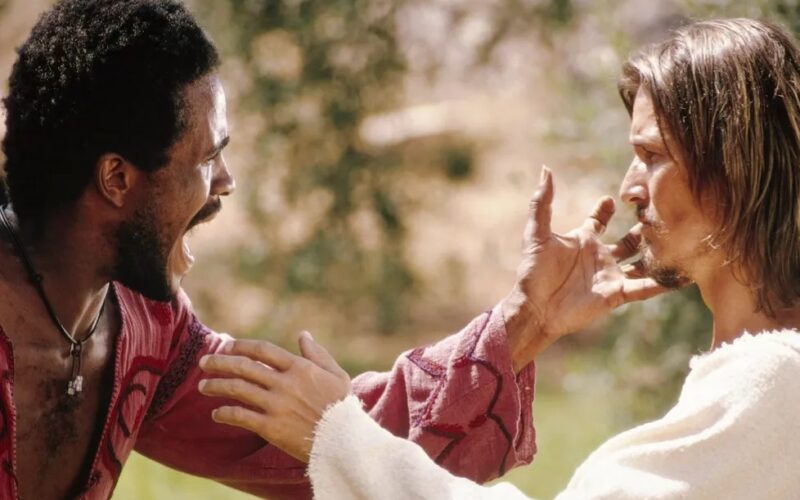
On a less cosmic but still personally significant scale, I have also come to see the casting of Carl Anderson as Judas as having a significant impact on my beliefs about racial differences. Like Miloš Forman’s Ragtime, here was a movie that allowed me to identify with a character who had a different skin color than I did but who, the story revealed, was like me on the inside. Over the decades since Jesus Christ Superstar, it feels to me as though the pendulum of critical opinion has changed about the efficacy and ethics of cross-racial casting. I understand (or think I do) arguments against it that are rooted in the need for representation as well as the need to provide professional opportunities for performers from underrepresented people groups. Ultimately, however, my heart tells me that one of film’s superpowers is its ability to allow you to imaginatively identify with characters who don’t look like you.
I would not be the first person to suggest that Judas, not Jesus is the protagonist of the film. It took me far too long to realize that, longer still to realize the semi-scandalous title represents Herod’s perspective: “I only ask things, I’d ask any superstar…” The title of “superstar” is applied by the king, not adopted by the king of kings. If Jesus Christ Superstar lacks a perfect understanding of the man’s mission, deity, and purpose, perhaps that is as it should be. The material it dramatizes, especially as represented in the Gospel of Mark, often shows that those closest to him struggled to grasp, accept, and apply his teachings. I may never warm to to film’s self-doubting messiah, but I’ll always be grateful for Judas’s anguished confusion, Peter’s humbled self-confidence, and the seductive logic of Simon’s political machinations. “Keep them yelling their devotion / but add a touch of hate at Rome…” Weber and Rice may not have understood Jesus as well as I think I do, but they were able to school me, decades ahead of time, about those who claim to follow him yet keep getting tripped up by their own fallen agendas.

