
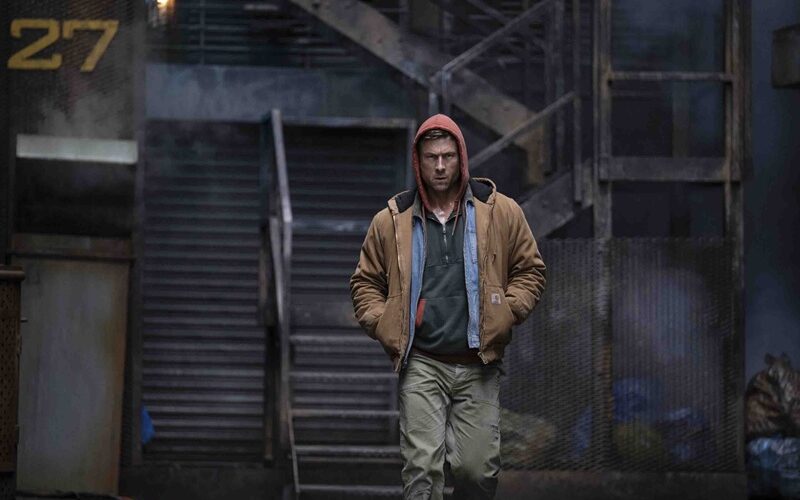
The Running Man (Wright, 2025)
“Why don’t you just fake the whole show?”
Buried in the rubble of the mess that is Edgar Wright’s adaptation of Stephen King’s dystopian novel, protagonist Ben Richards (Glen Powell) asks evil producer Dan Killian (Josh Brolin) a question with no real answer. Killian’s response, that audiences respond differently to things that (they think) are real than they do to things (they know) are manufactured is on the cusp of insight, but the film has very little interest in exploring it. It’s called The Running Man; we can’t ever be more than five minutes of screen time removed from a chase or a fight or an explosion.
Paul Michael Glaser’s 1987 film of the same title made the decision, in retrospect a sharp one, to lean into the camp of the premise rather than the sociopolitical themes. The hunters there were video game characters played by former athletes, wearing silly costumes and wielding chainsaws, blowtorches, and lethal hockey sticks. Here they are masked shooters hunting down alleged criminals who gullible audiences have been told were too lazy to work like everyone else. It’s all a giant I.C.E. metaphor, I guess, and I would probably be okay if it wanted to do that if it took that premise seriously. We are a little too close, I think, to have have masked fascist goon squads being played for commercial entertainment vehicles. Heck, I am of an age where I think we’re a little too close to play terrorists flying planes into buildings to kill civilians for entertainment, but what do I know?
The biggest weakness in the ’87 film, for me, remains here. The view of propaganda is pretty simplistic, with the audience turning on a dime when the narrative needs it to, vacillating between willing dupes who just want to have their boredom and bloodlust satiated to outraged citizenry who are capable of having huge ideological shifts based on a single revelation of previously hidden truth. The world building in both versions is paper thin, but one accepts a more infantile form of world building in comic-book movies than one does in dystopian ones.
The same relative weakness applies to the characters. Richards is angry at being unable to get medicine for his sick daughter and for having been fired for sounding off to his boss. Killian is evil. That’s it. The hunters are faceless oppressors. The one big change works to the detriment of Wright’s film. In the ’87 version Arnold is framed for firing on a civilian crowd and forced to appear on the show. Here Richards, however unwillingly, volunteers. Both, in their own way, feel as though they have not choice, but as with The Long Walk (another King adaptation), the question of whether oppression and victimization justifies the characters to participate for money in what they claim to morally despise is glossed over without much real consideration. I weary of dystopian MacGuffins, films that posit wide spread societal collapse as a way of explaining why action plot elements are happening but then spend all their energy on elaborate set pieces rather that could be very easily divorced from the purported setting.
Despite the world-building and character development problems, there is too much talent on display here for the film to crash completely. But it is long, with chase after chase, long after the film dispenses with any pretense that this will be resolved through strategic thinking. As the body count accumulated, I lost what little interest I had in how the film would be resolved.

