
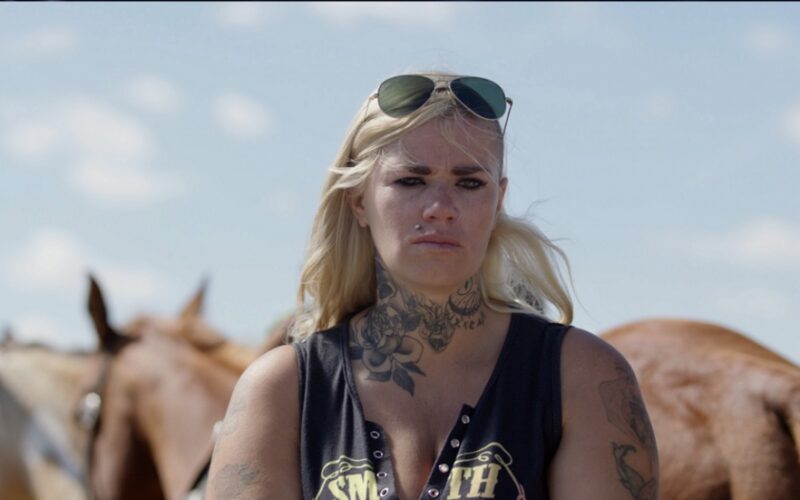
East of Wall (Beecroft, 2025)
East of Wall occupies a murky space between drama and documentary where it is not always apparent what is embellishment and what is meant to be accepted at face value.
Less narrative than character sketch, it presents us with a portrait of Tabatha Zimiga, who plays herself. At the start of the film, Zimiga’s husband has died and the horse ranch that she now runs on her own doubles as a foster house for troubled and unwanted youth. Zamiga’s biological daughter, Porshia, also plays herself in the film.
I am not typically bothered when a dramatic film conflates historical or biographical events with fiction — as long as they don’t rest their claims for relevance on authenticity. Conversely, I don’t accept everything in a documentary as factual and am thus not troubled if it is editorial to some degree…so long as it doesn’t out and out fabricate evidence.
I do think that there is — or should be — a higher bar for films that try to leverage the fact that they are have their origin in the real world. A classic example would be Dead Man Walking. I know that Susan Sarandon is not Helen Prejean at that Sean Penn plays a composite character rather than a specific murderer that she counseled. While changes to surface details might be defensible in the cause of some broader argument about the death penalty, they also undercut the film’s moral authority in the service of bolstering its artistic impact. When you are making claims about right and wrong, good and evil, details matter.
I am not saying that I know East of Wall fudged any particular details. I am saying that the line between embedded journalism and docudrama is fuzzy enough, and I would have preferred the film stay on one side of it. The film is peppered with snippets of videos from TikTok, and these made me wonder if the film was depicting Zimiga’s life or promoting her business. Either would be a good thing to do, but giving us the latter under the guise of the former felt a bit like bait and switch.
On the positive side, Kate Beecroft’s direction is solid. The framing of the people is often cinematic without feeling posed, and she lets onlookers dole out exposition about Zimiga rather than forcing her subject to answer a lot of questions about the value of the space she creates.
Ultimately, Zimiga’s story is challenging not because her care for the downtrodden and abandoned is inexplicable but because the need is so high. A smarter film might have explored the similarities and differences between parents who are incapable of caring for their children and those (to paraphrase Zimiga) who just don’t give a shit. Are the latter a bigger drain on systemic social resources than the former? Do we — individually or corporately — owe more to one set of abandoned children? Everyone agrees that Zimiga is laudable for stepping up and trying to help, but drama requires some conflict, some sort of adversary rather than the abstraction of grief or the amalgamation of “the system.” I left East of Wall persuaded that Zimiga was most likely a good person doing good work, though a documentary short probably would have had the same impact.

