
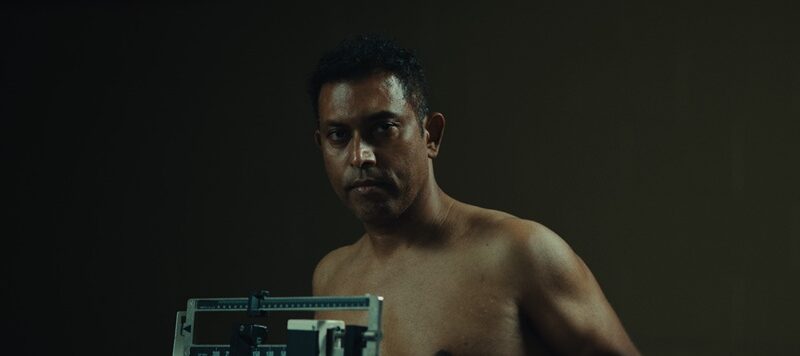
American Warrior (Martin, 2024)
“Are you a janitor, or are you a fighter?”
The question is posed by Dennis (Danny Trejo) to Jai (Omi Vaidya), who has been thrust into the limelight and offered a high-profile MMA fight after a video of him thwarting a store robbery goes viral. It is the kind of on-the-nose expository dialogue that would grate in a more pretentious movie, but American Warrior leans into its conentional story, inviting reviewers in its press kit to compare it to Rocky and Warrior.
“The change is all up here,” Dennis continues, pointing at Jai’s head.
I don’t really believe that … and neither, I think, does the film. After all, Jai does not become a warrior until after he starts working as a janitor. A local gym is one of the few places that will give him a chance after he gets out of prison. Everyone else is apparently ashamed of his work, but not Jai. In an early scene he is instructed to “show the ropes” to a new worker who complains as they are literarlly cleaning toilets that the system is corrupt and has railroaded him. Jai does not even answer his co-worker’s question about why he was imprisoned — that comes later. He just stays focused on the job at hand.
In one of the scrpt’s few interesting and unconventional touches, we will find out eventually that Jai was in prison for white-collare crime. He both takes the fall for his family and appears to be the only one who thinks that shady corporate business practices are actually wrong. I kept waiting for the script to pay off that bit of character development, especially when both Dennis and a female reporter doing an interview remind Jai (and through him, us) that his fight opponent for the big match has a reputation for rule breaking and fighting “dirty.” Given Jai’s ethnicity, there is surprisingly little here about how an “American” warrior is (or is supposed to be) distinctive. Jai is estranged from his family because of his jail time, but he appears equally ill at ease with the Tik Tok, superficial, celebrity culture that promises a quick redemptation pathway to success and glory. So while there is, superficially, a contrast of cultures, the examination of them never digs past differences in clothing or names of holidays. Since Jai and his family celebrate Diwali, I presume he is (and they are) Hindu, but how, if at all, his religious difference informs his attitude toward MMA, or anything, is sadly unexamined.
If the worst thing I can say about American Warrior is that it is generic, the best is that it knows exactly what it is and doesn’t try to overreach. Vaidya’s performance is key here, since Jai’s inner strength is more important to the story’s success than his physique or backstory. There is a short little scene early of Jai microwaving some meal and then eating it standing up that Vaidya manages to make seem not-at-all pitiful. Another marker of the character’s self-control and genuine goodness is his comfort around women, whether they be love interests, employees, or family members. Gallantry has always been a marker of virtue in the code of chivalry, and Jai’s form of gallantry is one of quiet respect rather than flamboyant preening.
I am sympathetic to the argument that American Warrior is forever hiding its potential light under a bushel of sports movie cliches. That Jai ends up fighting the guy he kept from robbing the store seems equal parts implausible and unnecessary. The reason sports movies are so tricky is that because the thing we love about sports is its unscripted quality. It’s not that the things that happen on the field or in the sporting ring are always new, but rather that we never know which of the potential storylines will emerge as the sporting event unfolds. For example, in Bernard Malamud’s The Natural (perhaps the greatest American sports story) we are reminded that the last hurrah of the aging veteran intersects with the coming-of-age of the fresh, new sensation. In more didactic and blunt stories, like Rudy or American Underdog, there is no counter-narrative to hold expectations at bay and create suspense. To the extent that we know which of tropes a sports movie is leveraging, we know the end, and that is definitely the case here.
Thus, to be great, a sports movie has to, in some ways, thwart our expectations by being about a different sports lesson than the one we are anticipated. Rocky ends up being about going the distance, not about the plucky underdog getting the outcome he deserves. Christy turns the narrative of sports as an escape from a grinding life of oppression on its head. But in American Warrior Jai is idealized to the point here that there is no real tension in the climax. We could imagine someone like him losing such a fight in real life, but we can’t imagine — at least I couldn’t — an entire movie built around just how deseriving he is only to deliver the agony of the defeat rather than the thrill of victory.
That makes American Warrior…passable. The performers and characters are likable and it is easy enough to root for them in the moment, even if we have no real attachment to them. Winning is better than losing, and having self-respect and self-control is better than not. But the final fight does not so much complete a redemption, since Jai has not really fallen, as validate that Jai is who he has always been. You can make the warrior be a janitor, but that doesn’t doesn’t change who he is on the inside. Perhaps if Jai had more self-doubts the last act would have had a bigger emotional payoff. In the end, the film, like the fighter, is likable, though hardly an all-time great.

