
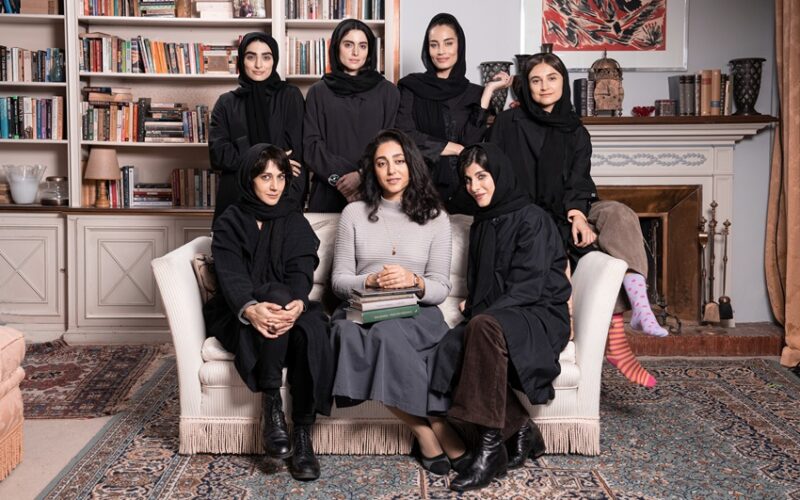
Reading Lolita in Tehran (Riklis, 2024)
Azar Nafisi’s Reading Lolita in Tehran is one of the most beautiful and powerful memoirs I have read. Because it is a personal favorite, news of its having been adapted into a film filled me with excitement. The film failed to live up to my hopes for it, and in retrospect I probably should not have been too suprised. Several of the features that made it a great memoir did not translate easily or effectively from page to screen.
Perhaps the easiest of those features to articulate and exemplify is the memoir’s literary emphasis. The word “Lolita” is every bit as important to the title as the word “Tehran.” This memoir is not merely a chronicle of life in Iran after the Islamic revolution, although it is that. It is also a chronicle of a life devoted to literature and a test of the premise that literature can and does matter in some significant way, even in, especially in, places like Tehran. The memoir is structured around four books that Nafisi taught to her students when teaching, to a group of women (it feels dismissive to call them a book club) when she was not at the university in any offical capacity. The film keeps these divisions, but discussion of the books themselves is reduced to one or at the most two scenes, with the lessons in it drawn so broadly that they lose much of their power. Does The Great Gatsby celebrate the decadence of Western capitalism or critique it? Are the women in Pride and Prejudice as constrained by their patriarchal environments as the Iranian students are by their own? Do I even remember what the teacher or any of her students had to say about Daisy Miller or Lolita herself? The novels become shorthand signifiers for the big ideas the women are wrestling with, not deep wells of inisight or experience from which they (or we) learn.
These are not superficial questions; they are deep ones. But the film never really conveys the intoxicating intimacy and power of such sustained dialogues. A single debate over a novel’s theme is different than a weeks long series of debates, discussions, and contemplations. The contents of the novels, while raising timeless questions, is a context for shared relationships, shared lives.
From such interactions, intimate friendships are formed. But this is another place where the film pales in comparison to the memoir. The other women, besides Nafisi, are nearly indestinguishable. One of them has been tortured, and while the scene is horrific, it becomes a distinguishing event — something that happened to her — rather than something that we see as central to how she approaches life. Over a period of twenty years, Nafisi has many interactions, and the single greatest way the book is superior is that Nafisi the writer is able to give them voice, personality, and identity. They all blur into one another in the film. Erich Auerbach comments in the opening of Mimesis that the absence of change, the relative flatness of characters, is the biggest distinguishing feature between mimetic realism and epic stereotypes. Odysseus, despite all that has transpired between the end of the war and his nurse’s moment of discovery, is emotively, behaviorally, and psychologically the same as he ever was. Auerbach compares the representation of Odysseus to that of King David in the Old Testament. Both have extraordinary things happen to them; only one seems to carry the memory of those past experiences in his present affect.
Director Eran Riklis faces a challenge, of course, in that film is a visual medium and a group of people sitting around talking about books is not the most cinematic scenario to try to film. I get that; I really do. But that’s not to say it can’t be done at all. Films like A Man for All Seasons, Before Sunrise, or The Social Network are all dialogue-driven movies that are nevertheless riveting. But the fact that Riklis and Marjorie David are given screenplay credit suggests that Nafisi had little to no input on how the story was shaped or re-shaped cinematically. (Her writing credit says only “Based on the novel by….”) David’s previous writing credits are almost all for serial television, which might explain the tendency to contract big ideas into emblematic scenes in which the key idea is verbalized rather than demonstrated. I hasten to add, such a writing style is not inherently bad or inferior; it just does not serve this material well.
I still love the memoir. The film is not terrible, but I think it foregrounds what the book treats and background (the Iranian revolution and its broader societal impact), which pushes to the background what the book foregrounds (the ways in which the book dicussion group builds the relationships and helps the indvidual women process what is going on around them).

