
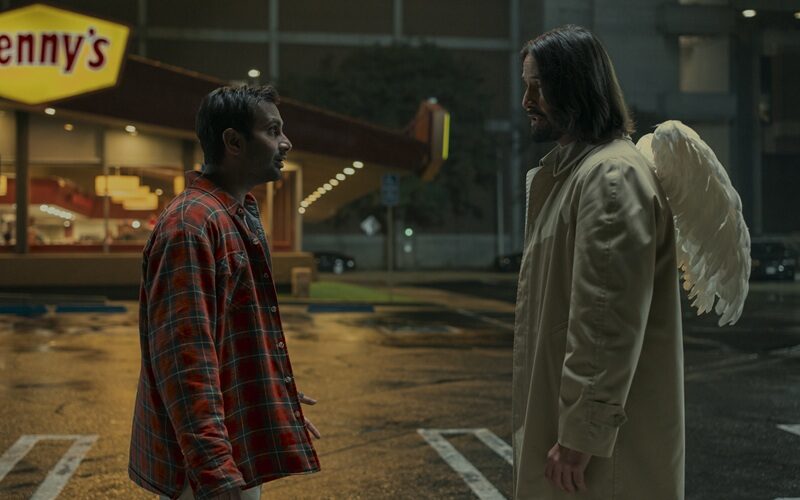
Good Fortune (Ansari, 2025)
The body-swapping conceit of Good Fortune is tired and overused, but the film’s execution of it is so good that it manages to transcend the constraints of recycling a familiar premise.
Arj (Aziz Ansari) is a wannabe film editor who is stuck piecing together a living as a short-term worker in the gig economy. He stands in line for cinnamon rolls for people with more money than time, and he offers personal services through an app that allows people to go online to find someone to clean out their garage. After completing a job for the entitled but affable Jeff (Seth Rogen), he convinces the the wealthy man-child to hire him as a personal assistant for a seven-day trial period.
On the one hand, it is more convenient for Arj to have one person (Jeff) to please rather than a horde of faceless people hiding behind a third-party app, any of whom can make him the target of their discontent with things unrelated to his work. But being immersed in Jeff’s world, getting constant reminders of his conspicuous consumption and the seemingly arbitrary causes of their disparate wealth and power, comes with its own psychic and emotional costs.
A more generic film would make Jeff into a monster here, but Ansari is less interested in critiquing Jeff than he is in interrogating the systems that create those like him. And by “systems,” I don’t just mean economic or political. The Arj/Jeff body swap is prompted by a well-meaning but seemingly incompetent Angel named Gabriel (Keanu Reeves). Angels in the Bible are messengers of and for God, so Gabriel’s inability to communicate to Arj (or through him, us) why a life of toil and injustice is more blessed and desirable than one of wealth, power, is humorous but also biting.
Introducing Gabriel’s character raises the body-swapping stakes. The very thing that makes the film above-average, though, also proves to be its Achilles heel. It does not make a credible argument for why Arj would or should agree to go back to the way things were…most likely because it does not have one. “I did everything I’m supposed to do!” Arj complains as he approaches despair, and we understand, even if Gabriel does not, that his complaint is less against Jeff than God, less against a system that blesses some than one that allows any who are sincerely trying to be trod upon. When Jeff finally reaches his breaking point and demands a meeting with God, Gabriel demurs that such a request is above his pay grade. The perception of injustice is less spirit breaking than the perceived silence of God (or his representatives) in the face of it. And while a voice out of the whirlwind or an inquiry if he has ever made an elephant might be sufficient for Job, it presupposes an understanding of how and why the challenges are theological that neither Arj, Jeff, nor the movie actually have.
I don’t say that as a criticism. I think Good Fortune is right, actually, that traditional Christian ways of talking around social justice make little sense and provide little comfort to those who do not share the theological framework that informs them. The scene in which Gabriel crashes a union organizer’s meeting at “Hardware Heaven” shows him attempting to speak the language of human experience but being woefully ill equipped to understand, much less pass judgment on, the plight of humans. When he is himself fired and has to supply his own daily bread, Gabriel is unable to adopt the wondrous, satisfied outlook he recommends to Arj. He does ultimately find meaning in the joys of dancing and eating tacos, suggesting that the best blessings of existence, while not free, are still accessible to more people than not. While I think there is some merit in that argument, I do not think it is a fully satisfying one.
There are gestures toward more satisfying resolutions. Losing the relationships he has spent a lifetime building makes whatever financial contributions he can make to the hardships of people he loves far less satisfying. Arj also wants his successes, not just his failures, to be earned rather than handed to him. That is admirable as a personal trait, but it still sidesteps counter-arguments about whether anything in this life is truly earned when advantages and disadvantages are inherited.
Despite the weakness of the resolution, the film manages to succeed largely because of the great work by Reeves and, yes, I’ll say it, Rogen. Ansari is fine, but his character is inherently sympathetic. Rogen has the tougher task of making Jeff the face of privilege and yet still not a complete miscreant. Reeves has to make Gabriel simple and naive but not stupid. Though actors rarely get award nominations for comedy, it would not surprise me to see either Reeves or Rogen get “Best Supporting” nominations.

