
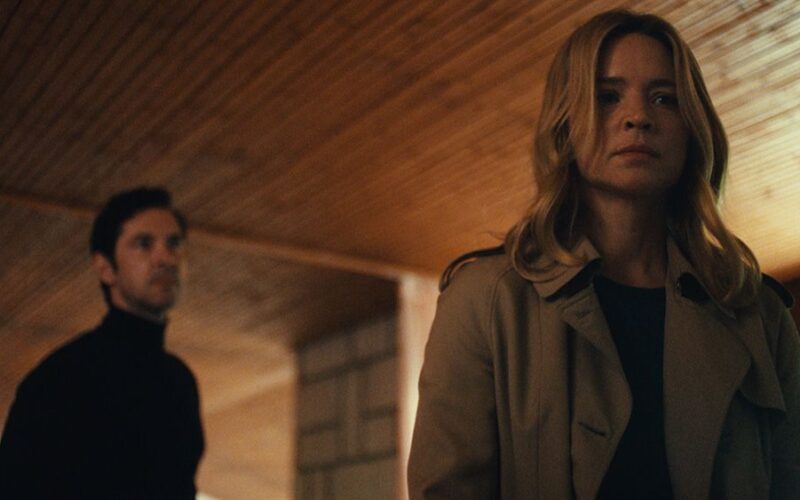
Just the Two of Us (Donzelli, 2023)
Just the Two of Us puts the Tolstoy adage about families to the test. The Russian master opined in Anna Karenina that all happy families are alike, while unhappy families are unique in their misery. The marriage of Blanche (Virginie Efira) and Grégoire (Melvil Poupad) is miserable in ways that seems drearily familiar.
Girl meets boy. Girl falls for boy. Against some small misgiving she moves and becomes isolated in the new relationship. He questions her time at work. When her sister gives her a car, he claims the gas to drive rather than take the bus is a waste of money. He turns apologies into accusations. In a typical scene in the escalating cycle of abuse, Blanche finds Grégoire in bed, ostensibly depressed with shame over a radio show that has made him recognize his behaviors as abusive. But it turns out to be an evasion technique to bury the fact that he blew up at the kids. He pressures her to forgive him without every admitting anything and blames his jealousy on her increasing desire for privacy.
All of this is presented competently. Efira is a great actress and Poupad does what he can with such a one-dimensional character, but truth is you know where this is going from the moment Grégoire tells his girlfriend that he doesn’t like her new haircut. Aside–these characters are not American and they don’t profess to be Christian, but one of my earliest “that’s weird” realizations of how misogynist evangelical American males could be was when a well-known and regarded pastor/author shared how he couldn’t hide his disappointment at his wife’s “momish haircut.” I’m sure he tried…valiantly…because, love your wife like Christ loved the church and all. But her putting her comfort and preferences about her body over what he found sexy was just a bridge too far. Tellingly, he insisted that she instantly knew what she had done wrong and he didn’t even have to saying anything.
What does this personal memory have to do with the movie? Maybe nothing. But one way the film tries to answer the unanswerable question of why she puts up with his behavior before she is so deeply entangled that habit and the kids can be an excuse is that she is swept away by love or lust or attention or . . . whatever. If I wasn’t satisfied with the happy couple first-act either, maybe that’s because it left me wondering if there was any interpretive space in between blaming the victim and offering some credible explanation of why she did not see the warning signs that the film so glaringly flashes for all the audience to see.
The film is based on a novel by Éric Reinhardt, so I suspect what would make for an incremental transition from normal to monster in a novel is a bit more rushed and obvious in a screenplay where significant character reveals are hard to integrate into normal day to day interactions unless you are a screen write of the caliber of the Dardennes. Donzelli is also given a writing credit, as is Emmanuelle (2024) writer/director Audrey Diwan. The inclusion of the latter makes me wonder if this film thinks it is exploring the theme of women being stigmatized for pursuing sensual pleasure.
Perhaps the one thing that did make the movie a little more interesting than its subject matter was the setting. Blanche’s sister and the medical personnel around her seemed to me to be much more supportive than one is used to seeing in such movies. So much so that I did wonder how long Blanche would be allowed to stay in the hospital after one of her caretakers tells her that doing so is a “short term” solution. Basically, they just let her hang out there because she is scare of her husband but doesn’t yet know what to do or how to leave him. I was grateful for the resources society invested in Blanche, but I wondered if they were unique to her geographic location or class status.
Spousal abuse — whether it is physical, psychological, or both — is an ugly, terrifying thing. The fact that movies like this are still being made is a depressing sign that the subject they tackle is still too much with us. So it is hard to knock a film that asks us to feel bad for a woman who is treated badly. But it is also hard to love a film that does so without bringing some insights or ideas about its subject either. Absent that, a movie with a topic that can’t be entertaining fails to be insightful or informative either.

