
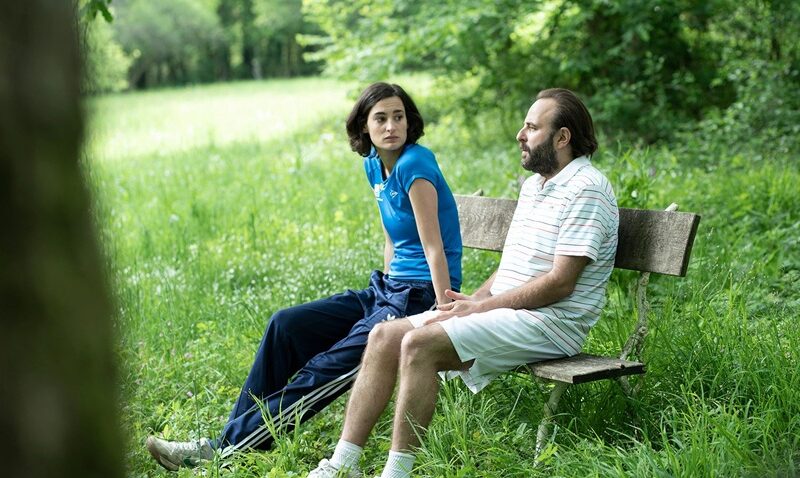
Suspended Time (Assayas, 2024)
Suspended Time is the first narrative set during the COVID-19 pandemic lockdown in which I recognized elements of my own experience of the time. The World Health Organization reports that just over seven million people have died from COVID-19 since its emergence. While this number is devastating, and journalism at the time of lockdowns rightly focused on those hardest hit and most vulnerable, it is fair to say that reactions to the pandemic, including lockdowns, impacted more people than the virus itself.
After a voice-over describing the director’s memories of his childhood home, the film shows us two couples sharing a country residence near the end of lockdown. Paul (Vincent Macaigne) is clearly a stand-in for Assayas himself. He’s a film director who shops compulsively on Amazon, practices telehealth with his counselor while sitting in the woods, and frets about whether his brother Etienne (Micha Lescot) has left their delivered groceries outside long enough to prevent contact transmission. Etienne needles his brother over the inevitable inconsistencies surrounding which protocols Paul follows and which he can dispense with when they would require genuine sacrifice. One brother responds to the scary changes around them with fear, the other with suppressed anger. They haven’t lost their health — yet — but they have lost freedoms to do as they please, go where they wish, work when they want.
Neither brother uses the word “privilege” to the other, but that is what they have lost. And it is true of privileged people (including myself) that they rarely stop to thing about their privileges as such. For them, such freedoms are not exceptional boons the universe (or God) has granted them but normal results of a functioning society that regular people have come to expect. It is to their credit (and the film’s) that they are aware of their relative privilege, though the knowledge that others are suffering worse is never quite the balm to pain we try to make it. Paul, for instances recognizes that freelance workers in the film industry need productions to start again — don’t all have inherited estates and savings to wait for more absolute assurances that returning to life is “safe.”
Because Paul is a neurotic filmmaker serving as a stand-in for the director himself, I have seen Suspended Time compared to Woody Allen films. But while the latter appear to me to wallow too much in their own neuroses, Assayas’s film feels to me like the meditations of someone generally grappling with the questions that are vexing him and taking stumbling steps towards learning and changing. When Paul is asked in a Zoom interview how film productions must change in light of the pandemic, he says “I don’t know.” Not knowing how our lives will evolve, change, and adapt is scary. But dealing with those fears is different from the sort of existential despair that assumes their are no answers and just tries to whistle in dark.
The grandaddy of all plague narratives is Boccaccio’s Decameron. It too, tells the story of privileged elite retreating to isolation in the face of a pandemic. I have always interpreted that text as chastising the Italian nobles for hiding from their responsibility, with the increasing lewdness of the stories they tell while isolating suggesting their own moral atrophy in the face of inaction. It is to the credit of Suspended Time, that it prompted me to reassess my assumptions about others in similar situations. Isolation is its own kind of trauma, and inaction can stem from paralysis, not just indifference.
I very much appreciated the fact that the pandemic does cause Paul (and one assumes, Assayas) to reevaluate the value and meaning of his work, it does not lead him to the hasty conclusion that art is pointless or meaningless. Art’s meaning and value can be enhanced by its fragile transience, and questions of its utility in the context of man’s ultimate mortality are really no different from those we could ask (and that the author of Ecclesiastes does ask) about anything we devote our lives to in an attempt to fill the void. While in suspended time, Paul rediscovers art books he loved as a child, rewatches movies, downloads songs from the Internet. While the theme is not overdone, it is clear how many of the couples’ best memories are tied to the experience of art.
Most thoughtful people who experienced lockdown, I think, came to realize that its end would not usher in a return to how things were before. Suspending time, is an illusion, a conceit. What was actually suspended were certain activities. How we spend our time, which activities we cling to and which we allow to stop when not required, says a lot about why we do them and how we value them. As the film nears its end we see small change. In a small but significant scene, Paul takes a door that has been irritating him “for years” and sands it down so that it will open and close more easily.
Not all changes are monumental. Small gestures and actions can be meaningful if we are willing to pause and attend to them. Conversely, sometimes habits, activities, the pace at which life moves, fools us into thinking we have no agency at all. Sometimes doing the work that is in front of you in the present moment, be it loving your partner, being patient with your brother, or fixing a broken door, is the way out of the paralyzing stuck-ness of not knowing what to do.


Thanks for these thoughtful reflections, Ken. Now I would really like to see this.