
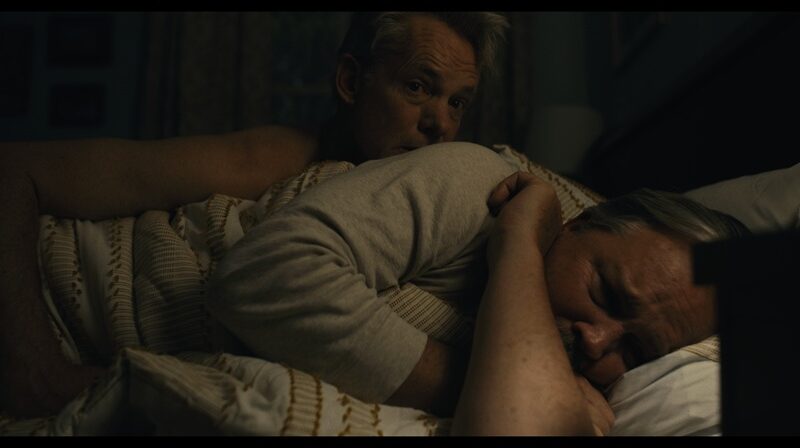
If You Should Leave Before Me (Anderson and Anderson, 2025)
If You Should Leave Before Me has a lot of things going for it, including and especially an understated performance by Shane P. Allen as a grieving man. But like so many modern films, be they independent or studio, its writing is not at the same level as almost all its other technical and creative elements. The result is a film that sounds far more interesting on a pitch level than what we see executed on screen.
Allen plays Mark, half of a gay couple. He and his partner, Joshua (Josh Wilcox), spend the first thirty minutes or so of the film bantering about coffee and couches in dialogue that strains a little too hard to be normal and representational. These scenes work on the informational level — they provide us with a sense of how long the couple has been together. They are so generic, though, that they don’t invest us in the relationship emotionally. When we understand where the film is going, there is a consequent sympathy for the grieving couple, but we don’t mourn their losses so much as assent to the sincerity of their grief.
There is a lift as the film enters its second act and we see the premise unfold. Mark and John are at some sort of limbo station where souls of the recently deceased come and the couple guide them to the afterlife. There are all sorts of ways this premise could play out, and for a moment it does look as though the story will, at last, situate their specific relationship into a broader context. Will some people object to being led into the afterlife by a gay couple? Will the couple resent having to serve in death those who rejected them in life? Interesting questions.
Even here, though, the writing is a little too on-the-nose. I smiled when the afterlife was represented with cardboard cutouts of trees with a stray lamp post. But I cringed when one of the pair said the afterworld was like “Narnia.” One sign of less confident writing is the tendency to draw attention to itself, explain its jokes, summarize its exposition through dialogue. Why is there a door (to the afterlife) for Mark but not for Joshua? Why indeed? A smarter, braver film would have let the audience notice and ask such questions as the action played out. Here, the couple dutifully ponders the meaning of their situation as though they were preparing a Cliffs Notes version of the story for anyone who might not have caught the necessary details. A screenplay that assumes the audience is two steps behind better be two steps ahead or that audience is more apt to yell “I know!” at the screen than to marvel at what better films let them figure out on their own time.
Although the movie never quite takes off, there’s too much talent here to let it crash and burn. The third act gives Allen more to do, and he is up to the task. By singling Allen out, I don’t mean to slight Wilcox, who is fine. It’s just that for reasons I don’t want to enumerate (plot spoilers), Mark ultimately proves to be the more rounded character, Josh a bit more flat and one-dimensional. This is understandable once some of the secrets are revealed, but the film invests too much in hiding which of the two is the true protagonist.
From a representation standpoint, If You Should Leave Before Me is about gay people, but their sexual orientation is incidental. The relational dynamics surrounding grief are presented as being universal. Whether that is a good think or not probably depends on your expectations and experience. I came of age in the 80s and 90s, and a staple of so many gay stories that made an impression were about how the lack of legal standing rendered relationships vulnerable to outside forces when one side or the other was incapacitated. The double damage of the AIDS epidemic was not just that so many gay relationships were ended prematurely, but also that survivors were denied the public and private spaces to grieve their loved ones. In the press materials, the directors speak of the film as being catalyzed by the loss of parents and grandparents, further reinforcing the thesis that the film is exploring universal human experiences rather than the distinctives of grief for gay couples.

