
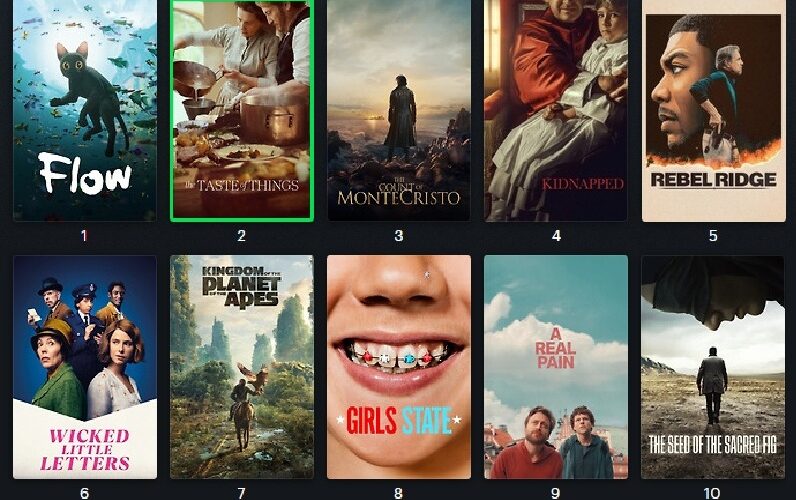
2024 Top Ten
In Stephen Frears’s adaptation of High Fidelity, the hapless but somehow affable protagonist, Rob, lists his dream jobs, with “architect” coming in at #5. Eventually, after some pushback from his girlfriend, he admits that he had difficulty filling out the list and may have been reaching by the end.
That’s not to imply anything about the back half of my list. I did enjoy them all, which is my ultimate criterion for whether a film belongs on my annual Top 10 list. But the fact that I am writing this in February underscores the unavoidable fact that the United States’ presidential election was not the only vote I had a tough time marshaling enthusiasm for last year. Maybe I’m getting older, or maybe post-pandemic the distribution patterns are more pronounced, creating movie deserts for much of the year.
Then again, Augustine said what is sought with more effort is received with more pleasure, so when a movie is good these days, I tend to appreciate it all the more. Here are the ten I appreciated the most:
10) The Seed of the Sacred Fig — Mohammad Rasoulouf
Iranian cinema has gone from being a cautionary tale about what America could too easily become if we give in to our own theocratic influences to a sober mirror of just how far down that path we may have already traveled. A judge’s family lives under house arrest conditions, terrified that one public misstep may cost the patriarch not only his job but their freedom. Remember when V for Vendetta seemed bold for shouting that a government should be scared of its people and not vice-versa? Maybe when we reach the point that we are sufficiently scared of one another, it becomes nearly impossible to distinguish the victims of theocratic totalitarianism from its agents.
9) A Real Pain — Jesse Eisenberg
The story of two cousins touring historically significant Holocaust-related sites in Poland provides stars Jesse Eisenberg and Kieran Culkin the opportunity to entertain and annoy in equal measure. It is always risky to make the Holocaust a context for your movie, and allowing it to provide the context for what is essentially a familial odd couple story could backfire in many ways. Here, though, it helps explain the weight of family and the ease with which one cousin’s comfort in the world is shaken. Benji (Culkin) certainly is a real pain for David (Eisenberg), but he also feels real pain. That David feels it too is made a bit too obvious by the script but is nicely underplayed by Eisenberg.
8) Girls State — Amanda McBaine and Jesse Moss
Are we ever told why this sequel to Boys State moves from Texas to Missouri? Does it matter? The maddening feature of both these documentaries of young people learning about the political process through mock elections is that they show the endless optimism (naivete?) that things can be different alongside the relentless structural and social pressures to conform. For my money, Girls State is a slightly superior film to its predecessor because some of the participants begin to question the competition itself, allowing us to ponder whether participation is a gateway to grown-up opportunities or an initiation into grown-up conformity.
7) Kingdom of the Planet of the Apes — Wes Ball
I said earlier this year that this franchise has quietly succeeded in doing what Star Wars and Terminator never could — creating stories within the metanarrative that complement the previous films without being dependent on them. Four films into this run, and I still don’t know if it is a remake or a reboot. Could we eventually get the time-traveling astronauts and buried Statue of Liberty? Possibly. But in between the evolution of the apes and the potential post-nuclear wasteland of the novel and original series lie … decades? Centuries? The refreshing courage of this franchise is that it seems content, for now, to populate the gap years with stories rather than rushing at warp speed to a place that would allow it to simply retell the previous stories with better makeup.
6) Wicked Little Letters — Thea Sharrock
I am convinced that, eventually, the Academy Award requirement for a film to get a qualifying theatrical run to be eligible will go away. We already have streamers like Amazon, Netflix, and Apple giving cursory runs for critics before streaming their content. This mystery, comedy, social commentary is the type of film that once-upon-a-time might find legs at a local arthouse cinema or multiplex backscreen filled with people who just wanted to go to the movies for a fun night. Olivia Colman is perfect — when is she not — as a deeply disturbed embodiment of a deeply disturbed community. There is a lot of religious messaging here for those with ears to hear; it has some powerful themes about community, morality, duty, and perseverance. Most of all, though, the film invites us to examine why we put so much emphasis on some seemingly trivial sins and misdemeanors while accepting larger-scale personal and structural injustices.
5) Rebel Ridge — Jeremy Saulnier
On its release, I compared my response to Rebel Ridge to my initial reaction to James Cameron’s Aliens so many years ago. Both are genre pieces crafted so artistically that one is almost surprised at how good they are. We have come to accept mediocrity in certain genres, and we’ve experienced enough of it to anticipate what the rest of the film will be. The story of an ex-miliary African-America confronted by a corrupt Southern police department begins with a pitch-perfect opening encounter and just never missteps. Aaron Pierre is a totally credible as a man who knows he is not invulnerable but who has so conditioned himself to make decisions on principle that he has almost forgotten what fear feels like. In that word “almost” lies a lifetime of experience and a portrait of a world in which some things have changed for the better but others remain stubbornly as they are until human beings stop waiting for superheroes to save them and brave the consequences they are no longer certain they can avoid.
4) Kidnapped: The Abduction of Edgardo Mortara — Marco Bellocchio
This one hit hard. I’ve been trying to tell anyone who will listen that the intersection of Christian rhetoric and American politics in the last decade or so is a distorted profanation of the true teachings of Jesus embodied in the Bible. I still believe that, but to do so requires honesty from individual Christians and Christian institutions about our very real failures to be salt and light, to be living embodiments of the tenet that the gospel is literally and not just theologically “good news.” The most chilling part of Kidnapped is that the church takes a Jewish boy away from his family, but that they do so with the utter conviction that they are doing right. The terrible actions we are able to justify in service of what we have decided is an absolute good are sometimes too horrible to bear even if they are too numerous to deny. God have mercy on us for the things we do in your name.
3) The Count of Monte Cristo — Alexandre de La Patellière and Matthieu Delaporte
I paradoxically thought this novel both unfilmable and done to death. Dumas’ revenge story is so delicious that many a scribe has tried to excise the dramatic parts of its daunting 1300-page body. To do so requires some star power, and Pierre Niney invests the role of Dantes with recognizable humanity as he moves through a series of situations so large and dramatic they tend to force the audience to see the characters occupying them as two-dimensional avatars working their way through a quest video game. This production adds visual splendor to shipwrecks and imprisonments and escapes, but it is never better than when it lingers on a human face that convinces us of what these eyes have seen and this soul endured.
2) The Taste of Things — Anh Hung Tran
When one orders a list like this based on personal affinity rather than implied objective artistic excellence, one will inevitably have at least a few films that one knows belong on the list but may be less certain about where. The story of Eugénie (Juliette Binoche) and Dodin (Benoît Magimel) is a love story filled with more joy than many other love stories because the lovers share a passion for something else besides each other. The first thirty minutes is a love letter to food, rivaling Babette’s Feast and Big Night in its ability to mesmerize us with the accumulation of details about food preparation. Cooking, like the love it supports and nurtures, is work. But work can be a joy when it is an expression of passion and not just a means to make a living. Few joys in life rival finding a soul mate, but surely one of them is being afforded the opportunity to express one’s love, skill, and talent in a way that not only brings satisfaction to oneself but pleasure to others.
1) Flow — Gints Zilbalodis
I think of myself as a narrative junkie when it comes to movies, so I was surprised at how deeply Flow resonated with me. When Cat’s home is devastated by a flood, he finds refuges on a wooden boat, eventually helmed by a menagerie of different survivors. An allegory of coexistence and a testimony to the potential of overcoming long-standing enmities, Flow has plenty of human life-lessons for any not yet so hard hearted that they cannot be moved by courage, compassion, love, and mercy in whatever guise it might come. As the waters recede, the film strikes the perfect balance between renewed hope for our own progress and mourning for what we have lost along the way.

